Bengal tigers move to mid-hills. Sighted in Palpa, Arghakhanchi
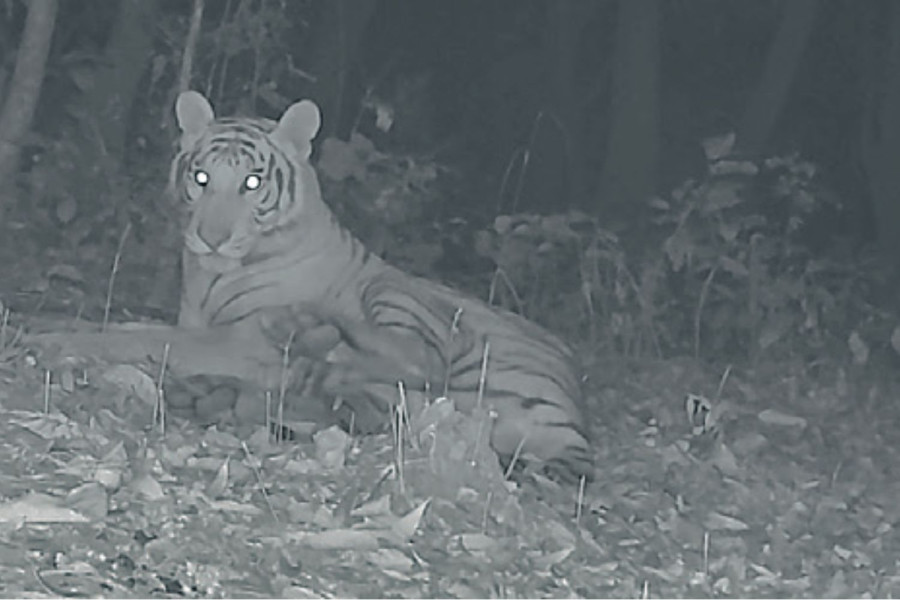
Camera traps confirm three Bengal tigers in the two hilly districts, beyond their usual range in the Tarai. A Royal Bengal tiger caught on a camera trap in Arghakhanchi on February 15. Photo: Courtesy of Bachan Prasain
In a landmark discovery for wildlife conservation in the country, three adult Royal Bengal tigers (Panthera tigris) have been officially recorded in the mid-hill districts of Palpa and Arghakhanchi. The images captured through camera-trap technology suggest a significant altitudinal shift and range expansion for a species traditionally associated with the lowlands of the Tarai.
The study, conducted by the Central Department of Zoology of the Tribhuvan University (TU) to assess wildlife occupancy in Lumbini province, identified the presence of these apex predators at altitudes exceeding 1,100 metres. The findings come at a critical juncture as Nepal grapples with the dual challenges of rising tiger populations and increasing human-wildlife conflict.
According to Hari Prasad Sharma, associate professor at TU and coordinator of the study team, the tigers were detected in multiple locations. In Palpa, one tiger was recorded near Mathagadhi Fort at an altitude of 1,110 metres in Mathagadhi Rural Municipality. Another big cat was captured at 536 metres in the Danda Lagar area above the Jhumsa stream in Tinau Rural Municipality.
Simultaneously, a third tiger was documented in Arghakhanchi district. It was sighted near Rajiya in Shitganga Municipality at an altitude of 934 metres above sea level. Notably, this individual was spotted on a trail frequently used by local villagers, highlighting the thinning interface between wilderness and human settlements.
“This is a clear indicator that Bengal tigers are not confined to the Tarai forests. The presence of adult tigers in the mid-hills suggests a search for new habitats as the core protected areas in the lowlands reach their carrying capacity,” Sharma told the Post. “It is a vital sign of a healthy ecosystem, but also a call for revised management strategies."
The research team installed 94 camera traps in the area spanning the Chure range and community forests. The grid-based survey used 44 cameras in Palpa and 50 in Arghakhanchi, positioned near water sources, ridgelines and animal corridors.
Field coordinators Bachan Prasain and Sagar Khadka confirmed that the cameras remained active for 21 days. In Palpa, sightings occurred between February 15 and 16, while the Arghakhanchi tiger was recorded on March 14. “We are currently analysing the stripe patterns to determine if the sightings represent three distinct individuals or if some were repeat captures,” said Prasain.
The study also revealed a high density of other predators, with nearly 40 leopards recorded across both districts. In Shitganga, a tiger and a leopard were remarkably captured by the same camera, indicating intense competition for resources in the Chure belt.
For residents of the hilly terrain, the news is a mix of pride and apprehension. Santosh Thapa, a resident of Rahabas and former chairman of Mathagadhi Rural Municipality, noted that while sightings were rumoured in the past, this provides the first scientific proof.
“We used to hear stories of pate bagh [Bengal tigers in Nepali], but without data, it was just hearsay. Now that it’s confirmed, the local government must act. We need warning signs and awareness programmes. Thankfully, we haven’t seen livestock loss or attacks yet, unlike the frequent leopard incidents in neighbouring Gothadi settlements,” said Thapa.
This is not the first time the Chure and mid-hill regions have surprised researchers. The first significant evidence of tigers in the Rupandehi- Kapilvastu-Palpa border was recorded in 2018. Baburam Lamichhane, a noted tiger biologist involved in the study, confirmed a female tiger in the Palpa-Rupandehi border and a male roughly 40 kilometres west in Kapilvastu.
More recently, in 2024, two tigers were spotted in Buddhabhumi and one in Bijayanagar of Kapilvastu.
Nandaprasad Adhikari, the chief of the Nisdi Sub-Division Forest Office, said that a tiger had been spotted in the Jyamire area of Nisdi Rural Municipality in Palpa last year. These historical records, combined with the new sightings in various places of Palpa and Arghakhanchi, suggest a steady northward migration of tigers.
Although the growing tiger population is exciting, conservationists urge caution. Tolak Raj Chapagain, senior forest officer at the Ministry of Forests and Environment, emphasised the need for conflict mitigation. "As tigers move into non-protected areas, the risk of human-tiger encounters rises. We must resolve these tensions through community engagement and improved habitat management," he said.
Ghanashyam Gurung, WWF Nepal Representative, believes that the recent camera-traps results will shape future conservation policies. “This data helps us plan for habitat connectivity and ecotourism. It also aids in curbing illegal poaching by identifying new hotspots that require patrolling,” he said.
When Nepal began scientific tiger counts in 2009, the country had just 121 tigers. The number rose to 198 in 2013, 235 in 2018 and 355 in 2022. Chitwan National Park and its adjoining forests host the highest population. In 2022, Chitwan had 128 tigers, followed by Bardiya with 125, Parsa with 41, Shuklaphanta with 36 and Banke with 25.




 25.92°C Kathmandu