



 14.81°C Kathmandu
Sat, Oct 24, 2026
Money
Wagle set to unveil large deficit budget above fiscal ceiling
Ambitious Rs2.1–2.2 trillion spending plan focuses on infrastructure, tax reform, and a revenue push despite weak collections and rising fiscal pressure.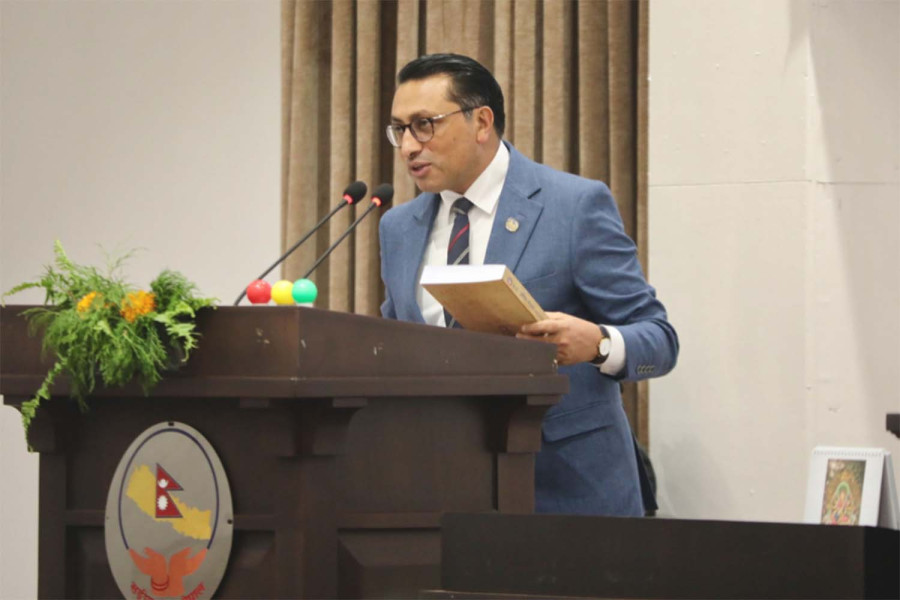
bookmark
Yagya Banjade
Published at : May 29, 2026
Updated at : May 29, 2026 06:39
Kathmandu
Finance Minister Swarnim Wagle, who has consistently opposed oversized budgets, is set to present the new budget on Friday, exceeding the fiscal ceiling set by the National Resource Estimation Committee under the National Planning Commission.
Amid contracting revenue and slower-than-expected growth in foreign grants, Finance Minister Wagle is set to present a large-sized budget with an ambitious revenue collection target.
The committee had originally fixed the budget ceiling for fiscal year 2026–27 at Rs1.89 trillion. The ceiling was revised on Wednesday at the finance minister’s request, raising it to around Rs2.15 trillion. Officials involved in the process said the final budget size is likely to be between Rs2.1 trillion and Rs2.2 trillion. If that estimate holds, the budget would be about Rs450 billion higher than the revised estimate for the current fiscal year.
The government had initially allocated Rs1.964 trillion for the current fiscal year. This was later revised downwards to Rs1.688 trillion during the mid-term review, reflecting weaker revenue performance and lower-than-expected expenditure.
Sources involved in budget preparation said the larger budget reflects expectations of a ‘strong government,’ increased policy ambition, and an assumption that governance reforms would help boost revenue mobilisation. “Expectations from the new government are very high, so we have had to present a large budget with many new programmes,” the source said.
Infrastructure remains a central focus of the upcoming budget. According to officials, the government does not plan to introduce a large number of new projects.
“Instead, funding will be directed towards national pride and other major projects nearing completion, with a phased approach to finishing remaining projects in subsequent years,” the source involved in budget formulation said.
The government is also under legal and administrative pressure to revise civil servants’ salaries, as existing law requires salary adjustments every two years. A committee led by Chief Secretary Suman Raj Aryal recently submitted a report recommending a minimum salary of Rs35,000 and a maximum of Rs121,000.
At present, an office assistant earns around Rs24,000, while the chief secretary receives approximately Rs77,000 per month. Despite the recommendation, officials said the government is unlikely to fully implement the proposed structure. Instead, discussions are ongoing around a more modest increase of 10 to 15 percent, alongside a plan to reduce the size of the civil service and improve pay for remaining staff.
Agriculture, energy, and tourism are also expected to receive priority allocations. The government is preparing programmes aimed at increasing agricultural output, reducing production costs, and improving market access for farmers. The energy sector is expected to see increased investment, including higher funding for the Nepal Electricity Authority.
Officials also said there is internal discussion about allocating up to Rs150 million per lawmaker for local infrastructure projects through the Ministry of Infrastructure Development. However, eligibility would depend on inclusion in the federal project bank and compliance with cost, feasibility, construction timeline, and environmental assessment standards.
The government is preparing to introduce a new infrastructure financing model by mobilising alternative development finance, diaspora capital, and private sector investment to raise funds for infrastructure development.
“Foreign aid, loans and private sector investment will be focused on high-return projects. Transformational projects will be advanced with clear targets, fixed budgets and strict deadlines,” the source said. “Performance contracts will be signed with project heads, digital progress tracking will be introduced, land acquisition and forest-related obstacles will be resolved, and key personnel will not be transferred until projects are completed. These provisions will be included in the budget.”
Broader priorities include governance reform, reducing the tax burden on the middle class, and strengthening economic diplomacy. Digitalisation is expected to play a central role in improving administrative efficiency and stimulating economic activity.
The government is targeting around 20 percent growth in revenue for the next fiscal year through a combination of tax revenue, grants, and borrowing. Officials described this as highly ambitious given the current slowdown in economic activity.
Revenue performance in the current fiscal year remains weak. As of the last week of May, the government has recorded a growth in revenue by only seven percent Against a tax revenue target of Rs1.48 trillion, only Rs1.026 trillion had been collected, representing about 69 percent of the target. Foreign grants also remain below expectations, with only Rs20.77 billion collected against a target of Rs53.44 billion.
Officials noted that revenue growth has slowed significantly in recent years. Before the pandemic, average annual revenue growth stood at 14.9 percent over five years. In the five years following the Covid pandemic, this figure dropped to an average 8.7 percent.
Despite weak revenue performance, the government is proceeding with an expansionary budget. Officials said donor confidence is expected to improve following the formation of the new government, potentially increasing grant commitments, although past trends suggest limited gains.
The budget is also being guided by the government’s 100-point roadmap and commitments made in the Rastriya Swatantra Party manifesto. Planned measures include land distribution for landless communities and expanding housing programmes.
Tax reform options under consideration include reducing the top personal income tax rate from 39 percent and raising the tax exemption threshold from Rs500,000 to Rs800,000. A possible shift to a multi-rate VAT system, or adjustments to the current 13 percent rate, is also under discussion, though no decision has been finalised due to administrative constraints.
Officials said concerns about implementation capacity remain a key reason for delays in VAT restructuring proposals, including the possibility of a multi-rate system, which some officials argue would be difficult for the current tax administration to manage.
Capital expenditure is expected to rise as a share of the total budget, with increased allocation for infrastructure and information technology. The government has set a long-term goal of achieving an average seven percent economic growth rate over the next decade and is expected to set a similar target for the coming fiscal year.
A total of Rs407 billion has been allocated for capital expenditure in the current fiscal year.
“However, next year, approximately 90 percent of the amount by which the budget size increases will be allocated to capital expenditure,” the source said. “Although the budget for the infrastructure sector is set to increase, there are not many new projects. Preparations are underway to select projects that can be completed quickly, are of national importance, and contribute significantly to the economy, and allocate them adequate budgets.”
The budget framework is built on five strategic pillars: governance reform, economic restructuring and prosperity, integrated infrastructure development, inclusive social development and middle-class expansion, and strengthening of soft power.
Officials acknowledged that with mandatory public expenditure reaching Rs1.33 trillion while revenue remains below Rs1.2 trillion, the government will have to rely on borrowing to meet its fiscal obligations and bridge the financing gap.
Yagya Banjade
Banjade covers government finance, banking, capital markets, and the economy for Kantipur Daily.




Most Read from Money

Why does an hour long flight to Dhangadhi cost more than a flight to New Delhi?
Nepal travel agents threaten to stop selling Thailand trips over visa rules
Malaysia rejects Nepal’s demand to open recruitment to all manpower agencies

No school, but a graduation cap for women dairy farmers
Nepal arrests four medical service providers as Malaysia recruitment row deepens
Editor's Picks




E-PAPER | October 24, 2026

×