Government collects billions from students despite free education laws
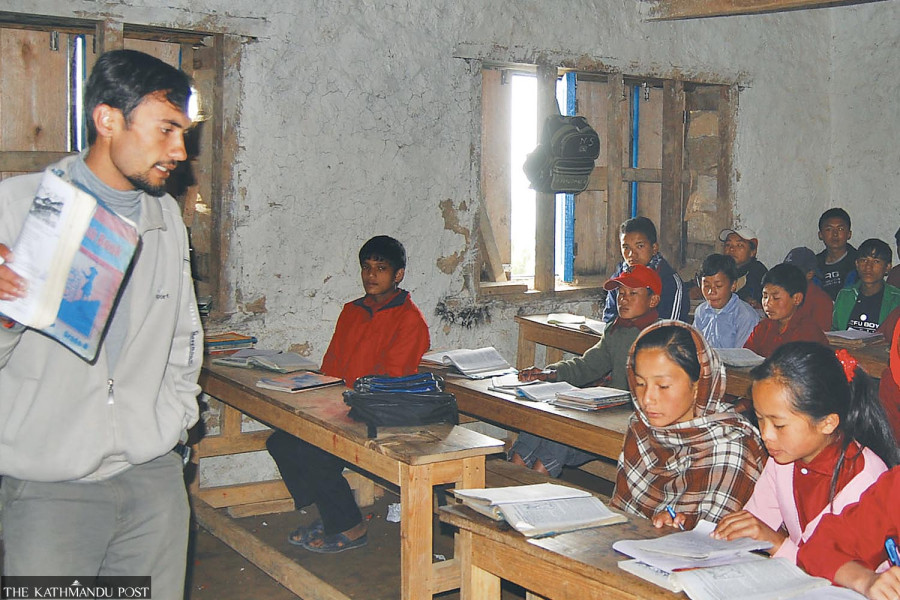
Students from grades 9 to 12 pay thousands of rupees in government-imposed charges every year, even as the constitution and the Act Relating to Compulsory and Free Education guarantee free education up to the secondary level. A teacher instructs a class at Nunthala Secondary School in Nunthala, Khotang, in this undated photo. Post file photo
Despite the constitutional guarantee of free education up to the secondary level, the government continues to charge students thousands of rupees in mandatory fees under various headings, generating more than Rs2.5 billion in annual revenue from students alone.
Article 31 of the constitution guarantees every citizen the right to free and compulsory education up to the basic level (grade 8) and free education up to the secondary level (grade 12). To enforce this provision, Parliament enacted the Act Relating to Compulsory and Free Education in 2018, followed by the Compulsory and Free Education Regulations in 2020.
Yet students and their parents must bear more than a dozen government-imposed charges throughout secondary school. The continued collection of these fees has raised questions over whether the state has fulfilled its promise of free education up to grade 12.
A student pays more than Rs5,000 to the government in various mandatory charges between grades 9 and 12. Every year, between 400,000 and 600,000 students enrol in those grades. Based on enrolment figures, the government collects more than Rs2.5 billion annually through registration, examination and academic certificate fees alone. It also continues to levy numerous additional charges that critics say are incompatible with the constitutional guarantee of free education.
According to the National Examinations Board, every student enrolled in both community and private schools must pay a registration fee of Rs300 upon joining grade 9.
When they reach grade 10, schools collect an examination application fee of Rs500 from each student and deposit it with the government. Narayan Pokhrel, information officer at the Board, said students must also pay Rs400 for subject registration in grade 11. Around 400,000 students enrol in grade 11 every year.
After paying fees in grades 9, 10 and 11, students are required to pay another Rs800 examination application fee in grade 12. Even after passing the examinations, they must pay additional charges to obtain their academic certificates for both grade 10 and grade 12.
While the Ministry of Education and Sports has not prohibited subordinate agencies from charging students, the Board and the Office of the Controller of Examinations continue to collect these fees, including from students attending community schools, where education is supposed to be free.
“The government itself instructs schools to collect registration, subject registration, examination application and certificate fees from students and deposit the money with the authorities,” the principal of a community school in Kathmandu told Kantipur.
Long queues of students can be seen every day at the Board's central and provincial offices to obtain academic certificates or correct errors in them. In many cases, schools collect the fees directly from students before forwarding them to the Board.
Sneha Rupakheti, who passed grade 12 this year, said she paid Rs1,500 to receive her transcript, migration certificate and provisional certificate. She said she had already paid another Rs2,000 in registration, examination application and subject registration fees between grades 9 and 12.
She also spent Rs1,500 to obtain her grade 10 certificate.
Parents have complained that some schools charge students more than the government-prescribed fees and retain part of the additional amount for their own expenses. Students and parents also allege that private schools routinely collect more than the fees fixed by the board.
According to information provided by the board, students in grades 11 and 12 are subject to fees under 20 different categories.
Students must pay Rs500 for a supplementary certificate and Rs500 each for duplicate copies of academic certificates. A permanent certificate costs an additional Rs1,000. The board charges Rs500 to authenticate an original certificate and another Rs500 to verify copies of mark sheets, grade sheets and certificates.
Students dissatisfied with their examination results must pay Rs1,000 to apply for re-totalling, which is verification of total marks awarded on an answer sheet. This year, around 32,000 grade 12 students submitted online applications for re-totalling after paying the fee.
Even when mistakes are made by board officials, examiners or teachers, students must pay to have their results reviewed. In this year's Secondary Education Examination (SEE), around 34,000 students applied for re-totalling, and the results of more than 1,800 were revised after errors were found.
Students who remain dissatisfied after re-totalling must pay Rs1,500 to view their grade 12 answer sheets. If they then seek a full re-evaluation, they must pay another Rs2,000.
The board also charges Rs500 to correct errors in names or dates of birth on certificates, Rs500 to trace a symbol number and Rs50 for a duplicate payment receipt, according to Pokhrel.
Students in grade 9 and 10 are also subjected to more than a dozen different government-imposed fees.
For grade 10, students must pay Rs500 each for a grade sheet, original certificate, migration certificate, verification of original certificate, verification of duplicate certificate and duplicate copy of lost certificate. Officials said these fees are deposited directly into the government's revenue account.
Students seeking to consolidate academic certificates must pay another Rs500.
The fees for re-totalling, viewing answer-sheets and re-evaluation differ between the SEE and grade 12 examinations. For the SEE, students must pay Rs500 per subject for re-totalling, while answer-sheet viewing and re-evaluation cost Rs2,000 each.
The Office of the Controller of Examinations also charges between Rs250 and Rs500 to correct names, surnames and dates of birth, including English-language dates of birth, on SEE certificates.
The National Examinations Board defends the charges, stating that they are essential to keep the examination system running.
Janga Bahadur Aryal, member secretary of the board, said the fees have long been collected as per decisions made by the board.
“The money collected from grade 11 and 12 students is deposited directly into the board's account. It is used to run the board's offices, manage staff, conduct examinations, publish results and carry out all of our operations. The government does not provide us with a separate budget,” Aryal said. “The money collected from students in grades 9 and 10, however, is deposited into the government's revenue account.”
The government collects around Rs180 million annually from grade 9 registration fees alone. It raises another Rs250 million from the same students through grade 10 examination application fees.
Officials at the Office of the Controller of Examinations said it collects around Rs600 million in revenue each year. Of that amount, roughly Rs350 millionis generated from the Secondary Education Examination, while the remaining revenue is deposited into the Ministry of Finance's revenue account.
Yet the Act Relating to Compulsory and Free Education explicitly prohibits such charges.
The law states that providing education up to the secondary level is the responsibility of the state. Section 4 of the Act provides that “the responsibility for providing education up to the secondary level shall rest with the State.”
The Compulsory and Free Education Regulations also stipulate that no fees should be charged.
Former education minister Bidya Bhattarai said she had tried to end the practice while in office.
In January 2025, Bhattarai secured a decision prohibiting the collection of fees from students. The proposal was endorsed by the National Development Problem Solving Committee, chaired by the prime minister, and forwarded to the Ministry of Finance. However, it was never implemented.
“On the one hand, the law guarantees free education. On the other hand, state agencies themselves continue to collect fees,” Bhattarai said.
“At the time, we agreed that registration fees for grades 9 and 11 should be scrapped immediately, while decisions on examination and certificate fees would be taken gradually,” she said. “But I was removed as education minister before the decision could be implemented.”
She said the ministry had proposed that students should register only once during secondary education and that the registration should be free.
“It is contradictory for the government to tell local governments and schools not to charge students in the name of free education while the federal government itself continues to collect money from them,” Bhattarai said.
She added that her ministry had also prepared a roadmap for implementing the Act Relating to Compulsory and Free Education.
The Office of the Auditor General has repeatedly questioned the legality of the fees.
In its 2024 annual report, the constitutional watchdog noted that despite constitutional and legal provisions guaranteeing free education up to the secondary level, the National Examinations Board continues to collect registration, examination and certificate fees from secondary school students.
Nepal has 27,010 community schools and 8,941 private schools. According to the Ministry of Education, around 5.2 million students study in community schools, and another 3 million attend private schools. The ministry said students in both public and private schools are required to pay these government-imposed fees.
Shiva Kumar Sapkota, joint secretary and spokesperson for the Ministry of Education, acknowledged that the government's fee structure should be revised to bring it into line with the Act Relating to Compulsory and Free Education.
“The ministry has been working to remove the provisions that allow these fees to be charged,” Sapkota said. “However, because these fees are also a source of government revenue, the issue does not fall under the Ministry of Education alone.”
He argued that the fees collected by the Board are determined under its authority as an autonomous institution.
Education expert Binay KumarKushiyaitsaid successive governments have failed to implement the Act Relating to Compulsory and Free Education.
“Under the constitution, no one should be charging students any fee up to grade 12,” he said. “Successive governments have failed. No government has shown the commitment, accountability or responsibility needed to ensure genuinely free education.”
Kushiyait said the government continues to rely on student fees because it has failed to allocate sufficient funding to the education sector.
He also pointed out that many community schools are forced to charge students and parents simply to cover operating expenses.
“Community schools serve the poorest children, Dalits, students from remote and marginalised communities, and children with disabilities,” he said. “Instead of charging them, the state should make every aspect of their education free and provide scholarships to encourage them to stay in school.”




 19.35°C Kathmandu