Gangrape charges for all four in Inisha case, but three likely absent during assault
Police investigation and forensic evidence indicate only one suspect may have been involved in the sexual assault.Youths demonstrate at Maitighar in Kathmandu earlier this month demanding justice for Inisha BK, a Deepak KC/TKP
District Government Attorney’s Office in Surkhet has filed a charge sheet against four suspects for their alleged involvement in gangrape and subsequent murder of Inisha BK. However, formal indictment reveals a startling rift between the investigative findings of the police and the prosecutors.
While a 41-page indictment filed by the District Government Attorney’s Office on March 29 lists 163 pieces of evidence, a close examination suggests a glaring lack of incriminating evidence against three of the four accused.
The Surkhet police had recommended charging ‘Birendranagar Pa’, pseudonym given to the main suspect, with rape and murder, while suggesting the other three face charges only for their presence at the scene and their failure to intervene to save Inisha. However, the government attorney has pressed for all four to be prosecuted for gang rape and murder. Despite this, the police themselves maintain that there is insufficient evidence to support such a claim.
On the morning of March 7, Inisha, aged 16, left her home under the watchful eye of a mother who believed her daughter was heading to early morning tuition classes. By 6:26 am, the 11th grader at Usha Balbatika School was captured on CCTV footage walking into the Janajagaran Community Forest in ward 4 of Birendranagar Municipality. She was accompanied by a boy her age, whom she considered her boyfriend. The walk would be among the final moments of her life.
Three hours later, at 9:30 am, Inisha’s body was discovered in a secluded corner of the forest, near the path leading to the Karnali Province Ayurvedic Hospital. Her body had been partially covered with a black jacket; her shoes and socks had been removed. Blood stained her clothing and the earth around her. A subsequent post-mortem report from Bheri Hospital in Nepalgunj confirmed a harrowing cause of death: excessive bleeding resulting from deep internal injuries to the genitalia—injuries the report noted were consistent with a ‘violent and forceful’ sexual assault.
“The nature of the injuries suggests an extremely violent encounter,” said Arbin Shakya, a senior officer at the forensic department at Bheri Hospital who conducted the autopsy. For Inisha the brutality of the act was fatal.
The teenager she was with, 'Birendranagar Pa', was apprehended at the scene. The following day, three other youths—pseudonymed as 'Birendranagar Dha', 'Birendranagar Na', and 'Birendranagar Pha'—were also taken into custody. All of them, aged between 16 and 17, are now facing charges of gang rape and subsequent murder under the National Criminal Code 2017 in the Surkhet District Court.
The prosecution has sought life imprisonment for all four. Under the prevailing legal provisions on minors, if convicted, they could face up to two-thirds of the adult sentence, amounting to a maximum of 16 years and eight months of incarceration.
Conflict of evidence and allegation
The District Police Office in Surkhet had initially recommended that ‘Birendranagar Pa’ be charged with both rape and murder, while the remaining three be charged with murder on the grounds of their presence at the scene and failure to intervene. Yet, the district attorney’s office escalated the charges, indicting all four for gang-rape and murder.
The main suspect said during police interrogation that he and Inisha were in a relationship. He claims that during a consensual sexual intercourse in the forest, Inisha began bleeding profusely and lost consciousness; he panicked and called his friends for assistance. He has consistently asserted that he alone was responsible for the events leading to her condition and that his friends were not present during the initial incident.
The other three defendants have provided corroborating accounts. They state they arrived only after receiving the main accused’s frantic phone call and found Inisha already unconscious. They claim they were hesitant to touch her for fear of being implicated, eventually sending ‘Birendranagar Dha’ to seek help from local villagers.
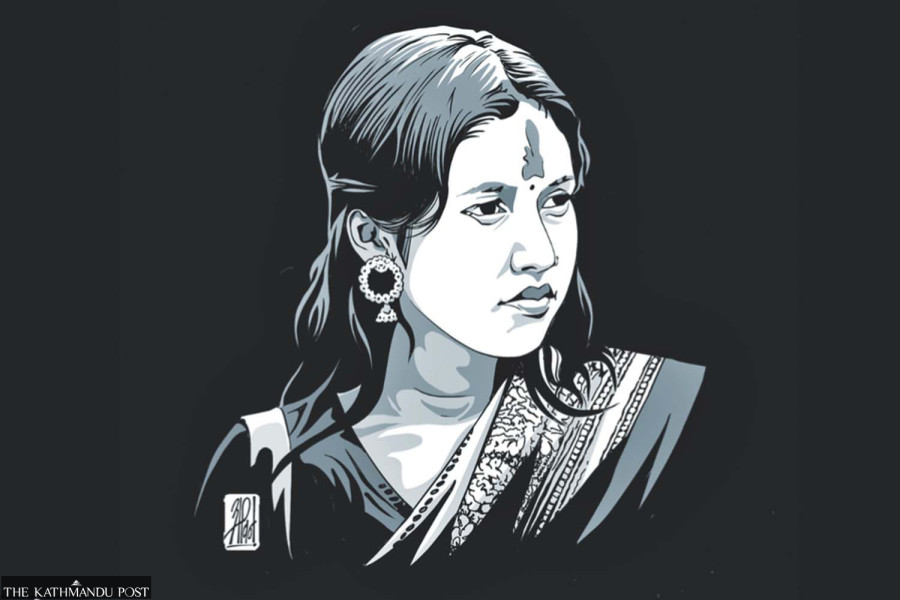
Post Illustration
This version of events is supported by the first witness on the scene, Ram Bahadur Damai, a forest watchman. Damai testified that he was at home at 9:30 am when ‘Birendranagar Dha’ arrived, pleading for help for an unconscious friend in the woods. “When I reached the spot with other villagers, I saw the main suspect sitting near the body with blood on his shirt,” said Damai. “The other two were standing some distance away holding bags.”
Crucially, none of the 33 witnesses whose statements are included in the indictment have provided direct testimony linking the three secondary defendants to the act of rape. While some relatives of the deceased mentioned hearing rumours of a gang rape, the physical and digital evidence paint a different chronological picture.
Indra Bahadur, who returned home from Dubai after hearing of his daughter’s death, said that the circumstances of the case were shrouded in mystery. “The reports provided are vague, and there is no clarity on what exactly is being investigated,” he said. “I am starting to fear that my daughter might not get justice.”
This anxiety over justice is also reflected on the streets of Birendranagar, the provincial headquarters of Karnali. The protests, which initially began to demand justice for Inisha, have become divided over the last few days. While one group is calling for the harshest possible punishment for all four suspects, another group has launched a counter-protest in support of three of the accused. Family members of those three youths maintain that, with the exception of the main suspect, the others had not even reached the forest at the time of the incident.
What evidence show
The Central Investigation Bureau (CIB) of the Nepal Police provided a technical report based on CCTV footage and Call Detail Records, which provides a minute-by-minute breakdown of the morning’s events.
This established timeline shows that the main suspect was with Inisha for nearly two and a half hours before any of the other defendants reached the vicinity of the forest. The technical evidence places the other three at their respective homes or on the road in the time window when the fatal injuries were likely sustained.
District Attorney Karna Bahadur Mahat defended the decision to charge all four with gang rape. He characterised the police report as ‘incomplete.’
“The medical report notes injuries so severe that it raises questions about whether a single individual could be responsible. If the police believe these three were involved in the murder, as their recommendation suggests, then how can they be excluded from the rape? If there was no involvement in the sexual assault, how does one justify a murder charge for those who arrived later?” argued Mahat.
Superintendent of Police Sudhir Raj Shahi, chief of the Surkhet District Police, said that their recommendation was based on an 18-day field investigation and objective data. “It is not mandatory for the court or the prosecutor to follow our recommendation blindly,” Shahi noted. “The government attorney has the right to file charges based on the initial First Information Report. We investigate; we do not adjudicate. Ultimately, the court will evaluate the strength of the evidence.”
“The government attorney’s office has the right to inquire about any gaps in the investigation, yet that question was never raised,” said Shahi. “The authority to frame the charges rests with the prosecutor, and ultimately, it will be up to the court to evaluate them."
Further complicating the prosecution’s case is the result of a polygraph test included in the evidence list. The report for the main accused suggests that his statement—wherein he claims sole involvement and denies his friends’ participation in the assault—showed “no signs of deception.”
What next now?
On Tuesday, the Surkhet District Court ordered all four defendants to be sent to a juvenile correction centre in Nepalgunj, roughly 100 kilometres away, to await their final verdict.
The final outcome of the case likely hinges on pending scientific evidence. DNA samples from the victim and the scene, along with viscera and bio-serological tests, have been sent for analysis. The results, which have yet to be returned, will confirm whether Inisha was the victim of a single assailant or a collective assault.
If DNA testing confirms that all or some of the accused were involved in a gang rape, it would significantly bolster the government attorney’s case. Conversely, if the results are inconclusive, the lack of evidence currently outlined in the indictment will serve as the primary grounds for the three suspects’ defence.
Nawaraj Dhakal, an uncle of one of the accused, expressed his frustration. “Our boys went to help a friend. To face gang rape and murder charges despite the CCTV evidence showing they weren’t there—how is this justice?”
How will the government attorney, who brushed aside the police report stating three of the individuals only reached the scene after the incident, now justify the decision to charge everyone with gang rape based on the limited evidence currently available?
This question is vital not only for the accused but also for Inisha's family. Her mother, who discovered her daughter’s body in the forest, said that they have been kept in the dark on the investigation’s findings. “I have had my suspicions from the very beginning,” she said.
For Inisha’s family, the wait is agonising. “I am beginning to fear that my daughter will not get justice,” said Indra Bahadur. With his work leave about to be completed, he faces the prospect of returning to Dubai without knowing who killed his daughter—and why.
The Inisha case has reignited old doubts over the quality of criminal investigations and victims’ rights in rural Nepal.




 22.06°C Kathmandu