From investigator to investigated: Gauri Karki commission report faces questions
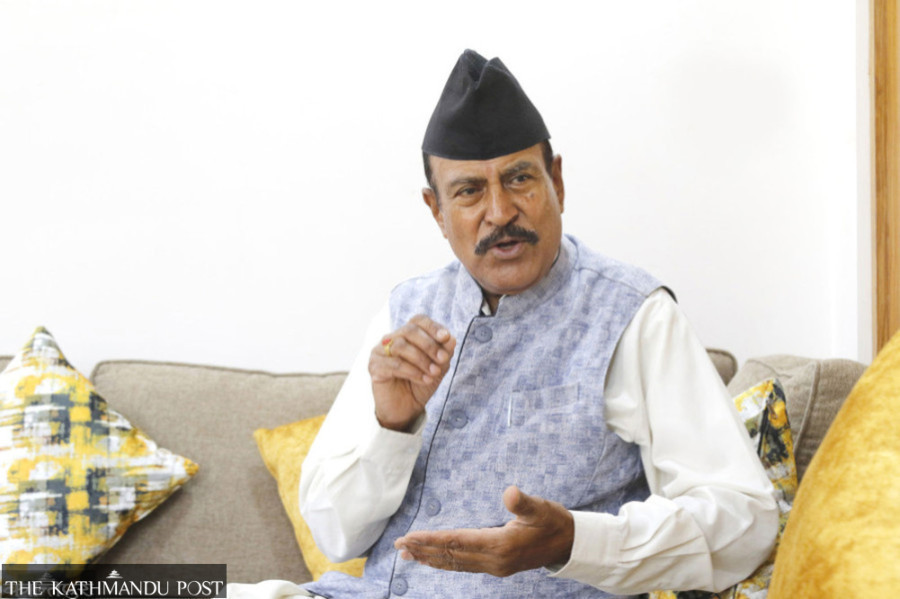
As police continue to pursue cases stemming from the commission’s findings, rights watchdog recommendations have cast fresh doubt on the integrity of the inquiry and its conclusions. Gauri Bahadur Karki Post file photo
Gauri Bahadur Karki led a government-constituted commission to investigate the incidents of last year’s Gen Z protests — on September 8–9. The commission submitted a report recommending action against a number of individuals.
Months later, the National Human Rights Commission (NHRC), which also separately investigated the Gen Z protests, recommended that Karki himself should be investigated.
Questions have now arisen over the legitimacy of the Karki commission’s report and its recommendations, which the government says it is in the process of implementing.
Experts point to the irony that a person tasked with investigating the events is now himself the target of an investigation related to the same events.
Bipin Adhikari, a constitutional law expert, says the situation raises primarily a moral question.
“The government should use this as an opportunity to conduct broader investigations,” Adhikari told Kantipur. “For now, it’s an ethical issue. If further investigation finds evidence of [direct] involvement, legal action could follow.”
The constitutional human rights body last week released parts of its report after investigating the killings on September 8 and the arson and vandalism that followed on September 9, recommending action against a number of individuals.
It has recommended action against KP Sharma Oli, Ramesh Lekhak, and Prithvi Subba Gurung, who were, respectively, Prime Minister, Home Minister, and Communications Minister at the time, for alleged human rights violations.
Karki is among dozens of individuals, including current Rastriya Swatantra Party lawmakers, whom the NHRC has said “should be further investigated.”
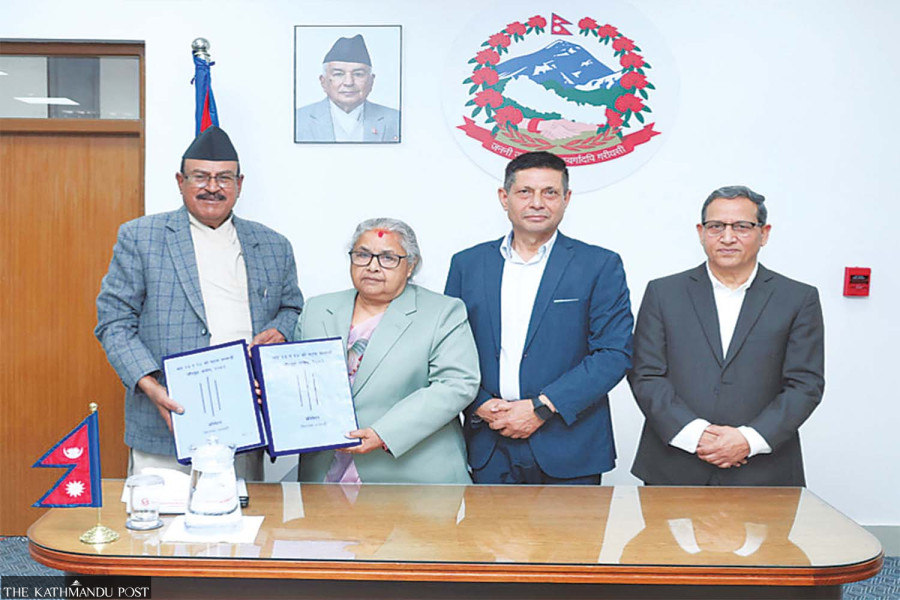
This photo from March 8 shows former chair of Special Court Gauri Bahadur Karki (left) handing over the Gen Z protest inquiry report to then Prime Minister Sushila Karki. Post file photo
The NHRC has raised questions about the roles of Karki, RSP chairman Rabi Lamichhane, former Home Minister Om Prakash Aryal, and others during the Gen Z movement.
“It has been observed — based on their social media posts, published news, and reports collected during the investigation — that these individuals made statements related to the Gen Z protests before, during, and after the demonstrations,” the recommendation states. “Considering that there have been various commentaries suggesting their statements may have played a role in inciting the protests, further investigation is necessary to determine whether they were involved in the human and material damage that occurred on September 8 and 9, whether their statements influenced or provoked protesters, whether public peace and order were disrupted, or whether their actions encouraged such disturbances.”
On September 8, spontaneous protests led by Gen Z began in Kathmandu against corruption and misgovernance. The protests were triggered by a sweeping ban on social media platforms by the Oli government.
During the unrest, Karki, a former Special Court judge, posted a series of Facebook statuses.
Referring to rumours that Oli had fled by helicopter, he wrote that airports and borders should be closed to prevent escape. He called certain individuals “traitorous criminals” and said they should be detained and investigated rather than killed.
On the afternoon of September 9, around 4:30pm, Karki wrote that former prime ministers Oli, Sher Bahadur Deuba, Pushpa Kamal Dahal, and other former ministers, lawmakers, and officials should not be allowed to leave the country and must be detained and investigated.
He also called for airports to be closed and private helicopters to be grounded.
“The Indian and Chinese borders must be closed. No one should be allowed to escape; they must be kept in custody. These traitorous criminals must not be killed, but action should be taken regarding corruption, unexplained wealth, and violations of the law,” he added.
After Oli resigned on September 9, President Ramchandra Paudel appointed former Chief Justice Sushila Karki as interim prime minister. Days later, on September 21, her government formed a judicial commission led by Gauri Bahadur Karki to probe excessive use of force by security agencies during the Gen Z protests.
His appointment as coordinator of the commission had come under scrutiny due to his earlier statements during the protests, with concerns that the report could be biased.
The Karki commission submitted its report to the Sushila Karki government on March 8, three days after the elections, recommending action against Oli and Lekhak for alleged criminal negligence causing death. On the first day of the protests, 19 people, mostly youths, were killed in police firing.
After the current Balendra Shah government was formed on March 27, both Oli and Lekhak were arrested to implement the recommendations of the Karki commission. Both were later released following a Supreme Court order.
Following the NHRC recommendation that Karki should also be further investigated, legal experts say the matter has now gained a clearer legal dimension.
Gopal Krishna Ghimire, former president of the Nepal Bar Association, says what was once considered an ethical concern has now become a legal issue.
“A high-level commission led by a sitting Supreme Court judge should examine the matter,” he suggested.
Mohna Ansari, a former member of the NHRC, says questions over Karki’s impartiality existed from the beginning, as he had already expressed opinions on the events before leading the commission.
“Since the NHRC has now recommended investigating him, the matter has become a legal issue as well,” she said.
Although Oli and Lekhak were released, investigations based on the Karki commission’s report are ongoing. It remains unclear how the NHRC’s recommendations will be implemented, especially as it has suggested retrospective measures to pursue human rights violation cases.
Kathmandu SSP Ramesh Thapa said the investigation into charges that Oli and Lekhak’s negligence caused deaths is in its final stage.
“We have sought more details. Once our investigation is completed, we will submit our report to the District Attorney’s Office,” Thapa told Kantipur.
Somkant Bhandari, chief of the District Attorney’s Office, said the decision on whether to file a case will be made after receiving the police report.
Following the formation of the judicial commission on September 21, a petition was filed against Gauri Bahadur Karki. However, on December 26, the Supreme Court quashed the petition, observing that the issue was more moral than legal.
Legal experts have suggested conducting an integrated investigation by bringing together the reports of the Karki Commission, the study conducted by security agencies, and the NHRC report.
They argue that a combined review would be more effective than separate processes, given that multiple bodies have made overlapping recommendations regarding key officials and further investigations into others.
“The NHRC is a constitutional commission. Its recommendations cannot be completely ignored,” Adhikari said. “Since it has recommended investigating even the head of the government-formed commission, it would be appropriate to study the entire sequence of events in an integrated manner.”




 23.95°C Kathmandu