Raped and left to die, teenager’s family wants answers
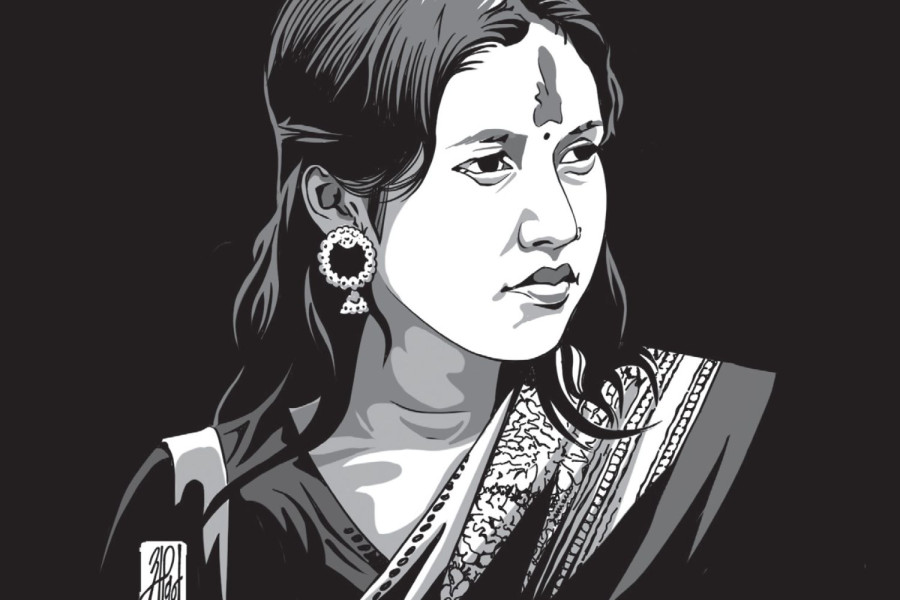
Inisa BK died after what police say was forcible sexual assault. Her father learned only after her death that the school had spoken to one accused’s family—and said nothing to him. Post Illustration: Abin Shrestha
Indra Bahadur BK had a simple explanation for why he left Nepal six years ago to work as a security guard in Dubai. His pension from the Nepali Army was enough to get by, he said—but just barely. His daughter Inisa had bigger plans: she wanted to be a doctor, or maybe an engineer, or perhaps an army officer. She changed her mind often, the way ambitious teenagers do. What didn’t change was her father’s conviction that she would need money to get there—and that he would have to go far away to earn it.
“I went abroad for her future,” he said. “But her dreams were stolen midway.”
Inisa BK, 16, was found unconscious in Janajagaran Community Forest in Birendranagar, Surkhet, on the morning of Saturday, March 7. She was rushed to the provincial hospital, less than three kilometres away, but was declared dead on arrival. The post-mortem report confirmed she died from severe hemorrhage caused by lacerations to her genitalia. Forensic specialist Dr Arvin Shakya of Bheri Hospital said the injuries were consistent with forcible sexual contact. Four minors have been arrested in connection with her death.
When the news reached Indra Bahadur in Dubai, he tried immediately to book a flight home. He couldn’t. The airport had been closed due to the ongoing conflict in West Asia. He was stranded for three days—unable to work and unable to grieve. He has since said he will not accept her body until he has justice. “The incident is being twisted and distorted in various ways,” he said. “Those responsible must be brought to the fullest extent of the law.”
***
To the people who knew her, Inisa was the kind of person who made an impression not through drama but through steadiness. She had passed her national school-leaving examination with an “A” grade the previous year and was studying science in Grade 11 at Usha Balbatika Secondary School in Birendranagar. She had initially enrolled in optional biology, aiming for medicine, before switching to computer science when she decided engineering might suit her better.
Her Nepali teacher, Indra Prasad Chapagain, who had taught her since Grade 9, recalled that she never greeted him with a casual “Namaskar” the way most students did. Instead, she would say “Pranam Gurudev”—a more formal, reverential form of address—and touch his feet with her hands, a gesture of deep respect. “In three years, I never heard a single complaint about her from anyone,” he said. He also remembered awarding her first prize in a handwriting competition when she was in Grade 9.
Her classmates described her in similar terms. Prakriti Bhattarai said Inisa never got angry at anyone, made friends quickly, and grew close to people easily. Sabhya Acharya said she had an instinct for togetherness—studying in groups, eating snacks together, dancing and singing collectively. “She always spoke with a smile,” Acharya said.
Inisa had grown up partly in Badakholi, Gurkot Municipality, before the family moved to Kathmandu and then to Birendranagar. The family’s move to Surkhet came after a painful chapter: the death of a five-year-old son, Isan, during the Kathmandu years, a loss the family could not bear to stay near.
Tila said they had admitted their son to a hospital in Bhaktapur for treatment, but he did not recover and died just two days after he was hospitalised. While the BK family was still coping with the grief of losing their son, another tragedy struck the family.
Tila suffers from asthma and has been on medication for the past two years. However, due to irregular meals and sleep, her health has been deteriorating. Her nephew Shankar said that she now needs support even to walk normally.
“On top of that, she has to keep going to the District Police Office to record statements,” he said. “Meeting visitors at the house and repeatedly recounting her ordeal has left her even more exhausted.”
In 2020, the family built a modest single-story concrete house in Birendranagar. Inisa lived there with her mother, Tila and her 10-year-old brother while her father worked abroad.
Neighbours say the family was woven tightly into the community. Most residents in their neighbourhood had also migrated from the Gurkot area, creating bonds of shared customs and familiarity. “We’ve lived together for five or seven years, always on good terms,” said neighbour Premkala Nepali. “I’ve even borrowed money from them two or three times in times of need.” Another neighbour, Kalpana BK, said, “No one imagined something like this could happen.”
***
The day before she died, Inisa and her mother, Tila, had made plans to travel to Gurkot together. On Saturday morning, Inisa said she wanted to go to a tuition class first and would be back within an hour or two. She left the house at 6 am.
Tila told her to return quickly.
By 9 am, Inisa had not come back. Her phone was switched off. Tila called Inisa’s computer teacher Madhav Sapkota’s phone—also switched off. Then, ten or fifteen minutes later, a call came from an unknown number. Inisa was unconscious in the forest near Shahid Park.
Tila rushed to the scene. “Her body was completely soaked in blood, her hair was dishevelled, the grass around her was trampled,” she said. “Her body had been covered with a black jacket. I couldn’t bear to look—I fainted right there.” Police had already arrived. Locals and neighbours carried Inisa to the provincial hospital. She was already dead.
CCTV footage shows Inisa and a 16-year-old boy, described by her friends as someone she had grown close to, walking hand in hand near the community forest shortly before the incident. Three of the four arrested minors were students at the same school.
The 16-year-old, arrested at the scene, gave a statement to police in which he said the sexual encounter was consensual and that severe bleeding began during intercourse, at which point he called three friends for help. “Inisa and I had been in a physical relationship for two years,” he told police. “That day too, after a long conversation, we both agreed. After we had sex, heavy bleeding started. She stopped speaking. I panicked.” He said his friends were reluctant to come and only arrived after repeated calls.
The family disputes this account entirely. They have filed a formal complaint against all four on charges of culpable homicide and rape, alleging gang rape. “The incident is being twisted and distorted,” Indra Bahadur said from Dubai. The police are currently recording the statements from the accused.
Police say the forensic evidence supports the family’s account. DSP Mohan Jung Budhathapa said rape was confirmed on the basis of both the suspects' statements and the post-mortem findings. “The hymen was found torn, leading to severe blood loss,” he said. “That is also consistent with the accused's own statements. On the basis of both pieces of evidence, we can say this was rape followed by murder.” Dr Shakya's post-mortem report found abrasion injuries on Inisa's back and lacerations to both the external and internal genitalia. “It appears forcible sexual contact occurred,” he said.
A Central Investigation Bureau (CIB) team has arrived in Surkhet to assist in the investigation. Samples have been sent to the central forensic laboratory for toxicological and bio-serological analysis. A polygraph team from the Karnali Provincial Police Office in Nepalgunj is also working alongside district investigators.
Superintendent of Police Sudhir Raj Shahi said they hope to complete the investigation in the next three to four days. Evidence collected in the case—mobile phones and other electronic devices from Inisha and the accused boys, as well as Inisha’s vaginal swab—has been sent to the Central Forensic Science Laboratory for toxicological and bio-serological tests.
“The deployment of an additional CIB team from Kathmandu reflects the priority given to probing the case,” says former deputy inspector general Hemanta Malla Thakuri.
Shahi, who himself has a background in CIB, said the mystery surrounding the death is likely to be clarified once the report is received.
What is not disputed is the time it took to get her help. Local resident Prem BK estimates that between when she entered the forest, the incident occurred, she lost consciousness, the boy called his friends, and they arrived, at least an hour to ninety minutes passed. “The prolonged blood loss is likely what cost her her life,” he said. A temporary police post had been established inside Shahid Park, but the forest has two entry points—one near the park, which sees regular foot traffic, and another near the provincial Ayurvedic hospital that is quieter and largely unmonitored. Locals believe the two entered from the quieter side.
The temporary police post is just a 10-metre walk from the incident site. On the day of the incident, six personnel were stationed there under senior constable Ram Bahadur Nepali. After the accused alerted the police, they immediately proceeded to the scene.
According to Nepali, since the area is part of a community forest and the incident occurred in a ravine, they were initially unaware of it. “When we realised we couldn’t manage the rescue and follow-up action alone, we asked the district police to send additional help,” he said. “Only then were we able to rescue the girl and send her to hospital.”
***
One detail has added a sharper edge to the family’s grief. Indra Bahadur said he learned only after his daughter’s death that school officials had spoken to the accused boy and his family multiple times before the incident—apparently aware of some concern involving him. Inisa's parents were never informed.
“If that was happening, why weren’t we informed?” Indra Bahadur said. “Why was it hidden from us?”
The school has not publicly responded to this allegation. In an interview with the Post, Principal Sushil Bhusal said the school administration was unaware of any romantic relationship between the two. He added that the school is ready to fully cooperate with the investigation.
“The school is prepared to provide any necessary support to ensure that the guilty do not escape punishment,” he said.
It is unclear what specifically prompted those conversations, or whether they were connected to the events that followed. But the question Indra Bahadur is asking—why a school’s concern about a student was not shared with another student’s family—is one that Nepal’s education system has rarely been forced to answer in cases like this.
According to Nepal Police data, an average of seven to eight rape cases are reported everyday in the country, amounting to roughly 2,200 to 2,300 cases annually. Activists say there is little public transparency on how many of these cases lead to prosecution or conviction.
Shanti Tiwari, a human rights activist, says the low conviction rate owes to deep structural barriers the survivors face. ‘‘Even when victims file complaints, they often encounter a hostile environment shaped by patriarchal attitudes,” she said. “The legal process is long and the victim herself is frequently scrutinised or blamed, which discourages survivors from pursuing cases and makes justice harder to get.”
Activists also point to impunity and political influence as persistent obstacles. Shyam Kumari Shah, chairperson of the National Alliance of Women Human Rights Defenders (NAWHRD), said weak investigations and the influence of those with “power, money and political reach” often affect how cases are pursued.
***
The morning Inisa left home, she told her mother she would be back by 8. She said they would go to Gurkot afterwards, together. Tila has barely eaten or slept since. She faints, her neighbours say, from time to time.
When he finally made it back to Nepal, Indra Bahadur said the same thing he had been saying since Dubai: he went abroad so his children could have a future. Inisa had told him she wanted to be a doctor. Then a soldier. Then an engineer. Then a nurse. He had kept earning, kept sending money home, kept believing she would figure it out.
“I was working to make those dreams possible,” he said. “But her dreams were stolen midway. Our dream world has been destroyed.”




 14.69°C Kathmandu