Nepal rights commission holds Oli, his ministers responsible for September violence
Commission recommends action against former prime minister KP Sharma Oli, former ministers and security chiefs. Calls for retrospective legislation and special court to prosecute rights violations.
The National Human Rights Commission has implicated then-prime minister KP Sharma Oli, the erstwhile home minister Ramesh Lekhak, then-minister for communications and information technology Prithvi Subba Gurung and top security officials for gross human rights violations in the September Gen Z protests.
The commission submitted its recommendations to the government on Wednesday, suggesting necessary actions against the 13 implicated and further investigation against 52 others, including Rastriya Swatantra Party chair Rabi Ramichhane.
Along with Oli, Lekhak and Gurung, the commission also recommended action against former Inspector General of Nepal Police Chandra Kuber Khapung, former Inspector General of the Armed Police Force Raju Aryal, and former chief of the National Investigation Department Hut Raj Thapa under Article 249 (2)(c) of the Constitution.
It further directed the government to maintain records of those found responsible so that they are barred from holding public office or government positions in the future.
Altogether, the commission recommended action against 13 individuals for human rights violations, including Oli and field commanders deployed around Parliament, Singha Durbar and Sheetal Niwas during the protests. Two groups, including the TOB group, were also recommended for investigation and legal action. According to the commission, inflammatory activities and violent behaviour by the TOB group led to the escalation of the September 8 protest.
The commission additionally called for an investigation into security personnel who opened fire during the unrest.
“The nature and condition of the September 9 incidents demonstrate that they occurred simultaneously across the country with a single objective,” the recommendation section states. “There appears to be no reason to disagree with the investigation committee’s conclusion that these incidents were organised criminal acts executed according to a plan.”
The commission recommended that almost all incidents of September 9 be treated as criminal offences and investigated accordingly.
The recommendations are based on the report prepared by an investigation committee led by NHRC member Lily Thapa, with a mandate to examine alleged human rights violations during September 8-9.
Invoking constitutional provisions
The commission identified Oli, Lekhak and Gurung, who led the government at the time, as human rights violators and recommended invoking Article 249 (2)(c) of the constitution against them.
The constitutional provision authorises the commission to recommend that court cases be brought against individuals or institutions responsible for violating human rights.
The report stated that Nepal’s current legal framework lacks provisions to prosecute crimes relating specifically to human rights violations and crimes against humanity. Citing a Supreme Court precedent in a case filed by Advocate Madhav Basnet against the Government of Nepal, the commission urged the government to formulate retrospective legislation.
Based on that precedent, the commission recommended introducing a new law to prosecute Oli, Lekhak and Gurung.
It also proposed possible punishments, including up to six months’ imprisonment, a fine of up to Rs300,000, or both. The report further recommended the formation of a special court to hear such cases.
In addition, the commission proposed barring those found guilty from contesting elections or holding politically appointed positions for at least six years, effectively preventing them from contesting the next House of Representatives election. It also proposed a minimum three-year ban on holding administrative responsibilities and a three-year foreign travel ban.
For cases that do not involve grave human rights violations, the commission recommended provisions for public apologies, reasonable compensation and pardon arrangements, provided victims consent, and courts approve such measures.
The report further stated that any public official facing prosecution for human rights violations should be automatically suspended once a case is filed.
Although the Thapa-led investigation committee submitted its report on March 20, the NHRC formally decided on Tuesday to forward recommendations to the government. The recommendations were sent to the office of the prime minister and the Council of Ministers on Wednesday.
“As it has been established that the then prime minister KP Sharma Oli, the then home minister Ramesh Lekhak, and the then minister for communications and information technology Prithvi Subba Gurung violated human rights, action should be taken against them under Article 249 (2)(c) of the Constitution of Nepal,” the commission’s full bench decision stated.
Oli identified as central figure
The report identified Oli as the main culprit, saying the government’s ban on social media triggered the September 8 protests.
According to the commission, Oli failed to respond effectively despite worsening security conditions and did not fulfil his constitutional responsibilities.
The report cited statements by former communications minister Gurung, who reportedly told investigators that ministers had advised lifting the social media ban but Oli refused.
“The ban on social media platforms triggered the September 8 protest, and the subsequent nationwide developments indicate that then-prime minister Oli was the primary catalyst,” the report stated.
The commission further observed that while most security agencies failed to contain the situation between the evening of September 8 and the afternoon of September 9, the Cabinet also failed to take timely decisions regarding the mobilisation of the Nepali Army.
“Despite the deteriorating situation, the council of ministers failed to decide on seeking assistance from the army, demonstrating that the sitting prime minister failed to discharge his legal responsibilities,” the recommendation states.
The commission also recommended departmental action against Nepal Police Inspector General Dan Bahadur Karki and Armed Police Force Inspector General Narayan Datta Paudel.
It directed the government to initiate departmental proceedings against field commanders involved in human rights violations under Article 249 (2)(e) of the Constitution and report the outcomes back to the commission.
Those recommended for action include Deputy Inspector General Om Rana, Senior Superintendent of Police Bishwa Adhikari, Armed Police Superintendent Jiban KC, former National Investigation Department director Krishna Khanal, former Kathmandu chief district officer Chhabi Lal Rijal and field commanders deployed around Baneshwar and the Parliament area during the protests.
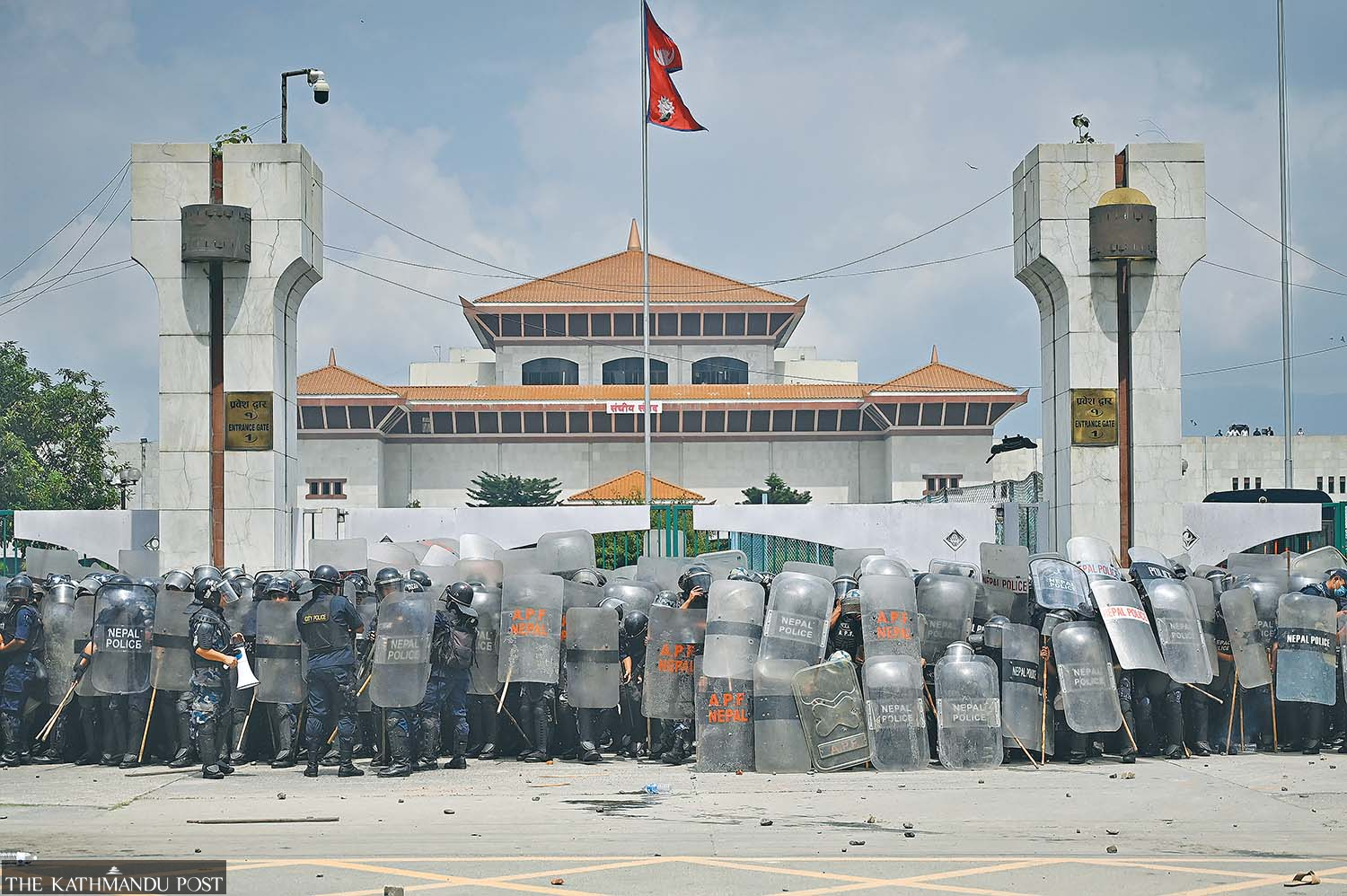
Seventeen unarmed youth protesters were shot dead around the federal parliament (pictured) at New Baneshwar on September 8 last year. The killings triggered nationwide protests the following day that escalated into many more deaths and widespread destruction across the country. Angad Dhakal/TKP
Questions raised over army role
The NHRC report also raised serious concerns over the role of the Nepali Army during the unrest.
According to the report, records showed that Kathmandu’s chief district officer had requested army assistance after the September 8 protests went beyond the control of security agencies. However, the commission stated that no significant assistance was provided.
“On September 9, while protesters vandalised and set fire to the Federal Parliament building, Singha Durbar, the presidential residence, the Supreme Court, government offices, residences of political leaders and commercial buildings, all security agencies remained passive spectators,” the report stated.
The commission said widespread public concern emerged over whether large-scale destruction could have been prevented had the army intervened earlier.
The investigation committee summoned Chief of Army Staff Ashok Raj Sigdel and other senior army officials for statements. However, the commission stated that the army did not provide the level of cooperation expected during the investigation.
According to the report, army officials, including Sigdel, submitted written responses through closed questionnaires only after the committee had already submitted its findings to the NHRC chairperson.
The commission criticised the army’s delayed response and its failure to appear in person during the investigation.
“Even after 76 people were killed and major state structures and commercial establishments were destroyed in arson, the army was deployed only at 10 pm on September 9,” the report stated. “The statements provided do not clearly indicate under which government decision the deployment took place.”
The report also questioned why army personnel stationed at Singha Durbar and Sheetal Niwas failed to make meaningful attempts to protect those premises despite already being deployed there for security duties.
“While the army claimed it could not deploy due to the absence of a government decision, its deployment at 10 pm on September 9 without a clear decision reflects inconsistency in its position,” the commission stated.
The commission concluded that the army failed to adequately protect national property and prevent widespread human rights, physical and financial damage.
As a result, it directed the chief of the army staff to prioritise the protection of national property and human rights in future operations.
The report also recommended cautionary measures against the then commanding officers stationed at Singha Durbar and the presidential palace under Section 5 of the National Human Rights Commission Act 2012.
Investigation sought against political leaders
The commission recommended investigations into nearly four dozen individuals, including former Supreme Court justice and chair of the Gen Z Incident Investigation Commission, Gauri Bahadur Karki; former prime minister Sushila Karki; former home minister Om Prakash Aryal; and several RSP lawmakers.
It also recommended inquiries into sitting RSP lawmakers who participated in the movement, including former home minister and RSP lawmaker Sudan Gurung.
The report said public statements and rhetoric from political leaders may have contributed to incitement and warranted investigation to determine whether they disturbed public order.
The commission also called for accurate documentation and assessment of damage to public and private property caused during the protests so compensation could be distributed appropriately.
It further recommended an investigation into organisers who obtained permission for peaceful demonstrations but failed to prevent violence.
The report described the September 9 incidents as criminal acts and called for detailed investigations to identify and prosecute all perpetrators.
Lamichhane under scrutiny
The commission also recommended an investigation into RSP chair Rabi Lamichhane, who was released from Nakkhu Jail on September 9, and those who accompanied him during his release.
According to the report, Lamichhane’s release led to subsequent attacks and vandalism at prisons and correctional facilities across the country.
The commission alleged that actions surrounding his release contributed to human rights violations by facilitating the release of prisoners and juvenile detainees.
It recommended investigation into then Nakkhu Jail chief Satya Raj Joshi.
“Prison officials and a large group were seen accompanying RSP chair Lamichhane during his release,” the report states. “Former lawmaker and RSP leaders Ganesh Parajuli, Hari Dhakal and others should be subjected to detailed investigation to establish responsibility and pursue legal action.”
Recommendations for reform
Beyond prosecutions, the commission proposed five broad policy, procedural and institutional reforms aimed at preventing similar incidents in future.
It recommended clear legal and policy guidelines regarding army mobilisation during violent protests resembling internal conflict situations.
The report also stressed the need for improved intelligence sharing and coordination among the National Investigation Department, Nepal Police and the Armed Police Force.
The commission called for a review of the Local Administration Act 1971 to determine whether riot control responsibilities should remain under political and administrative leadership.
Finding the National Investigation Department’s performance ineffective, the report recommended institutional strengthening and improved crowd-control training for police personnel with a focus on human rights standards.
The commission also stated that individuals identified as human rights violators should, regardless of their current positions, be assigned responsibilities involving human rights protection and awareness for at least six months.
International implications
Legal experts and human rights activists said the report carries significance both nationally and internationally.
Under Section 17 of the NHRC Act, the government has three months to implement the commission’s recommendations.
The report is also likely to be raised in international human rights forums, including United Nations mechanisms and Nepal’s Universal Periodic Review process.
Senior Advocate Raju Chapagain said the government could either formulate a separate law and establish a special court or proceed under existing laws using the commission’s findings as the basis for prosecution.
NHRC member Mihir Thakur said this was the first time the commission had explicitly recommended prosecution for human rights violations.
“The commission has clearly recommended legislation and a special court. The government is expected to implement these recommendations,” Thakur said.
He said the commission would wait three months, as required under the NHRC Act 2012, before deciding on further action.
“The ball is now in the government’s court,” Thakur said.
He argued that previous failures to prosecute human rights violations had entrenched impunity in Nepal, prompting the commission to recommend new legislation and special judicial mechanisms this time.
“There has been a tendency to limit accountability to departmental action, while retired officials escape consequences entirely,” he said. “That is why we recommended legal prosecution through new legislation.”
Human rights activist and former chair of Amnesty International Nepal, Charan Prasai, welcomed publication of the report but said shortcomings remained.
“Some individuals who failed in their responsibilities have not been adequately held accountable,” he said. “Still, the recommendations are significant. If implemented as binding measures, they would mark an important milestone.”
Prasai added that the report would hold long-term value internationally and would likely be cited by global human rights bodies.
Human rights lawyer Apurva Khatiwada, however, argued that naming too many individuals risked diluting accountability.
“When too many people are implicated, it creates an impression that no one is specifically responsible,” he said. “Recommendations need to be precise and supported by objective evidence.”
Former NHRC member Sudeep Pathak also questioned the depth of the investigation, saying the analysis section was detailed but the recommendations lacked the same level of rigour.
Even so, he described the report as constitutionally and internationally significant.
“If the government ignores this report, it will face serious national and international questions regarding its commitment to human rights,” Pathak said.
Advocate Subash Acharya criticised the report for not placing Oli, Lekhak and senior security chiefs directly under criminal investigation.
“Field commanders have been brought into criminal investigation, but those at the top of the command chain have only been labelled as human rights violators,” he said.
He also questioned the proposal for retrospective legislation, arguing that it may conflict with constitutional principles.
Stating that many individuals had been made suspects by recommending investigations against them, Acharya stressed the need for further inquiry. He said that the government should take the commission's report seriously, as the commission is mandated to protect citizens' human rights.




 15.33°C Kathmandu