Trees stand in the way of long-awaited blackbuck relocation to Chitwan
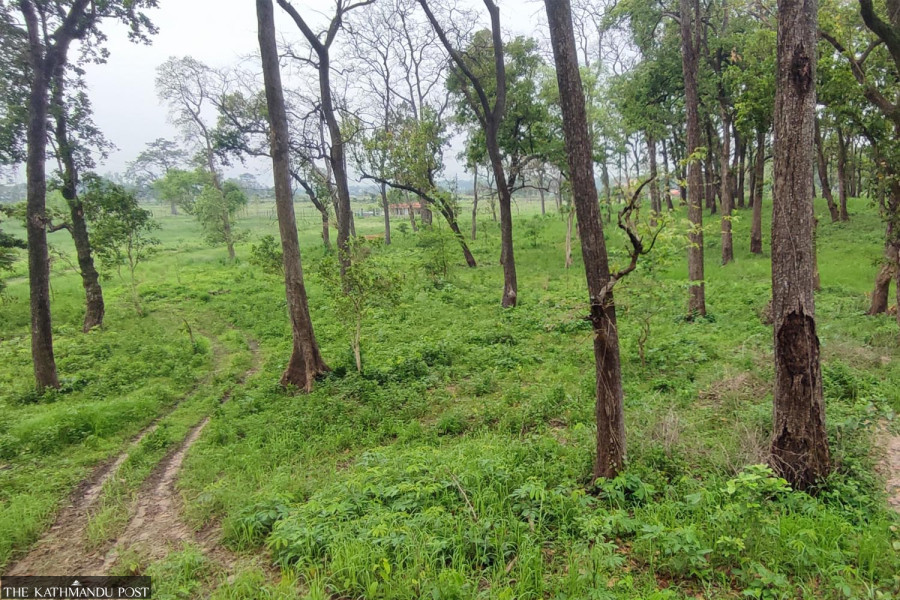
Officials say trees around enclosure could give leopards access to relocated blackbuck, reviving concerns shaped by past wildlife translocation failures in Chitwan. The forest area adjoining Tikauli Grassland where relocated blackbuck are planned to be kept. Ramesh Kumar Paudel/TKP
A long-running plan to bring blackbuck from Nepal’s western plains to Chitwan has hit an unexpected obstacle: trees.
The government is moving ahead with a proposal to relocate the antelope species from Bardiya and Shuklaphanta national parks to the Barandabhar forest near Tikauli Grassland in Ratnanagar, a project that has been in the works for nearly seven years. The initiative was recently included among the first policy decisions announced by Minister for Agriculture, Forests and Environment Gita Chaudhary.
Most of the groundwork has already been completed. Ratnanagar Municipality has spent nearly Rs30 million building a fenced enclosure, developing grasslands and ensuring a year-round water supply for the animals.
Yet the arrival of the blackbuck remains uncertain.
Forest officials say trees surrounding the enclosure could provide easy access for leopards, one of the species’ main predators, raising concerns that the relocated animals could be vulnerable from the moment they are released.
“The fence itself is strong, but leopards may be able to use nearby trees to get inside,” said Bishnu Prasad Acharya, chief of the Division Forest Office in Chitwan. “Removing those trees would significantly reduce the risk.”
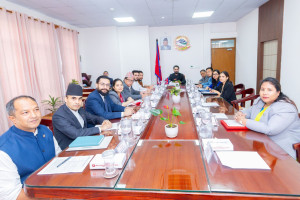
A three-member technical committee, formed after the minister decided to proceed with the relocation, recently inspected the site. The committee found that the enclosure, grazing area and water facilities met the basic requirements for blackbuck conservation, but identified surrounding trees as a potential threat.
According to Acharya, trees both inside and outside the fenced area stand close enough to the enclosure to allow leopards to climb and leap across.
“Leopards are excellent climbers and powerful jumpers,” he said. “When you are introducing a species into a new habitat, its security has to come first. From a technical standpoint, we believe the trees should be removed.”
The enclosure covers around 20 hectares of forest land.
Officials have identified 132 trees that may need to be cut, including 103 outside the enclosure and 29 within it. Most are mature sal trees, whose removal requires approval from the government.
The issue has become the final major hurdle in a project that local authorities had hoped would already be completed.
Ratnanagar Mayor Prahlad Sapkota said the municipality was working to complete the remaining procedures and hoped to receive the animals by mid-July.
The initial phase of the relocation is expected to involve 18 blackbuck, including 12 females and six males, sourced from Bardiya and Shuklaphanta.
“The project started during the tenure of my predecessor, and we have continued to push it forward,” Sapkota said. “The infrastructure is ready. The sooner the animals arrive, the better.”
Former mayor Narayan Ban said preparations began in 2019 after repeated visits to Bardiya to assess whether blackbuck could successfully be introduced to Chitwan.
“We studied the issue carefully before launching the project,” Ban said. “A great deal of work has already been done. It should not be delayed any further.”
Local authorities see the relocation as more than a conservation initiative. They also hope the blackbuck habitat will become a tourism attraction, complementing Chitwan’s wildlife offerings.
“We have invested in the infrastructure and are ready to manage the site,” Sapkota said. “It has conservation value and tourism potential.”
Conservation officials say Chitwan’s climate, terrain and vegetation are suitable for blackbuck. Wildlife management policies also allow species to be relocated to areas deemed ecologically appropriate.
Lessons from failed wildlife relocations
The blackbuck project comes against the backdrop of previous wildlife relocation efforts in Chitwan that produced disappointing results.
About a decade ago, authorities introduced wild water buffalo, known locally as arna, from Koshi Tappu Wildlife Reserve and swamp deer, locally called barasingha, from Shuklaphanta National Park into a fenced enclosure in the Padampur area of Chitwan National Park.
Neither population survived.
The arna relocation began in 2016, with 15 animals introduced, including three from the Jawalakhel zoo. Although several calves were born in Chitwan, repeated flooding and tiger attacks gradually wiped out the population. By 2022, all the animals had died.
The swamp deer project fared little better. Seven deer were brought from Shuklaphanta, but two died soon after arrival. Others were lost in the devastating floods of 2017.
For years, officials believed the entire population had been wiped out until a lone swamp deer was spotted in Kumroj forest last year.
Those experiences have made conservation authorities wary of repeating past mistakes.
“The history of wildlife translocations in Chitwan shows what can happen when risks are underestimated,” Acharya said. “That is why we want every possible safety concern addressed before the blackbuck arrive.”
For now, the enclosure stands ready. The grasslands have been prepared, water sources secured, and fencing completed. But until a decision is made on the trees, the blackbuck are likely to remain in western Nepal.




 26.08°C Kathmandu
1.jpg)