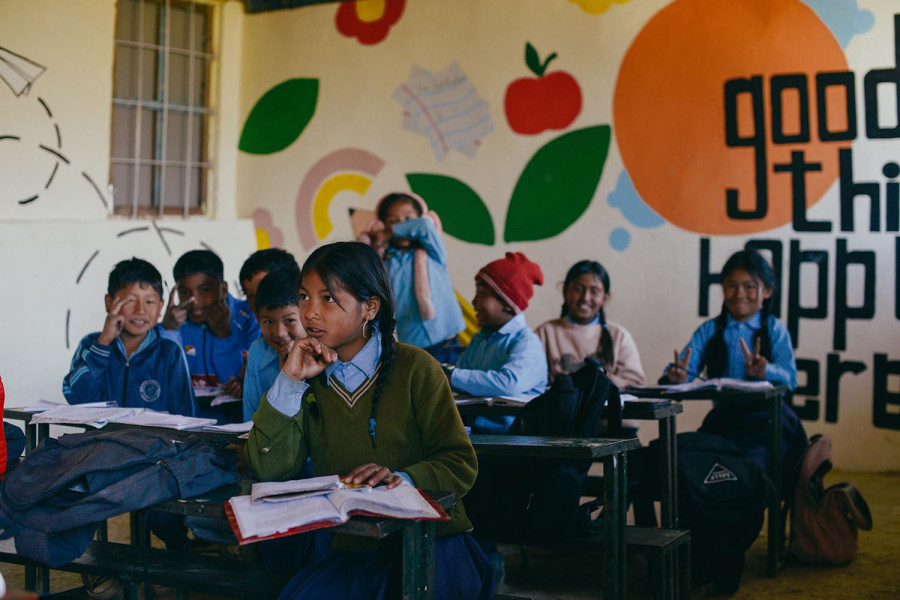
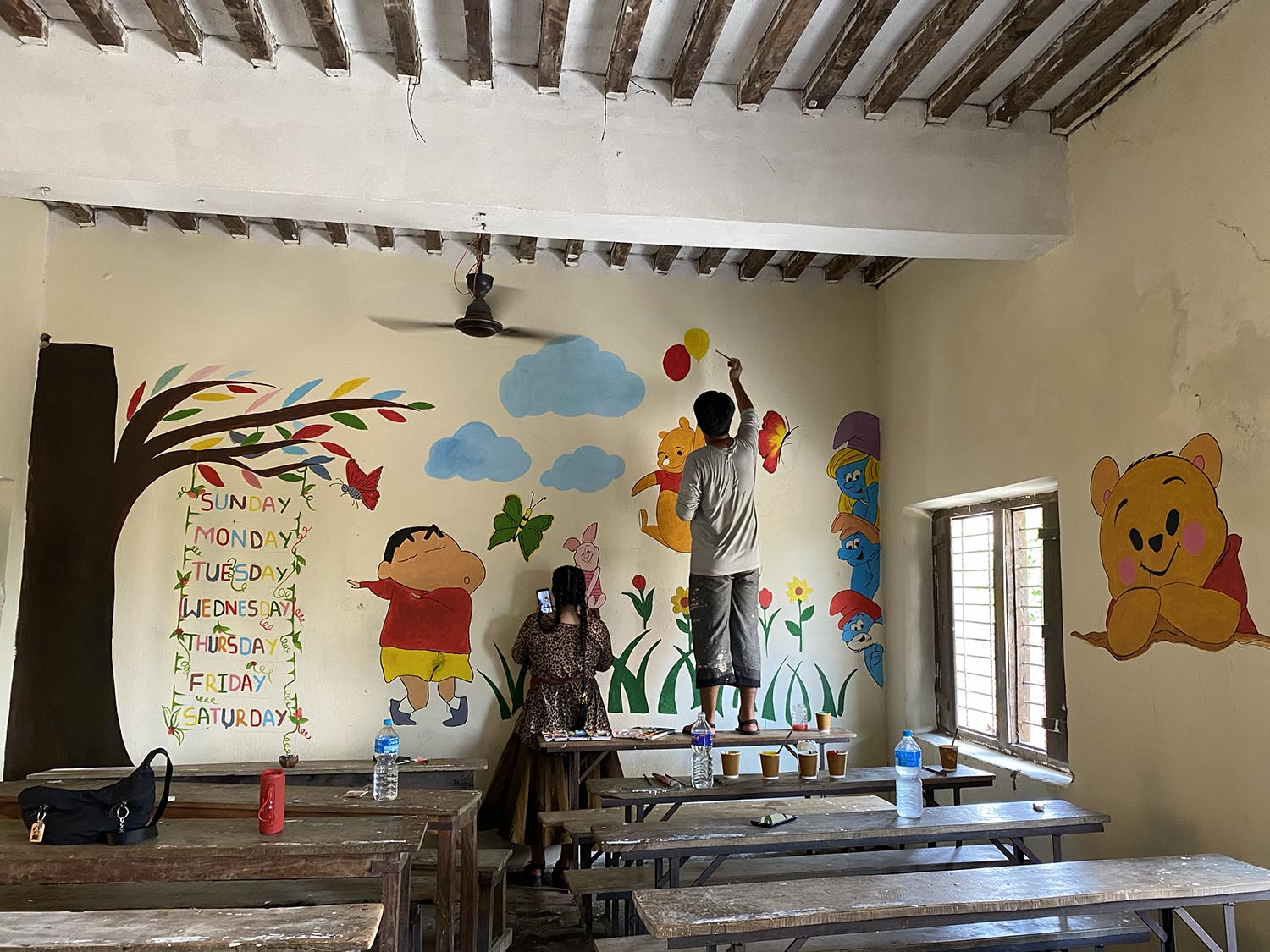
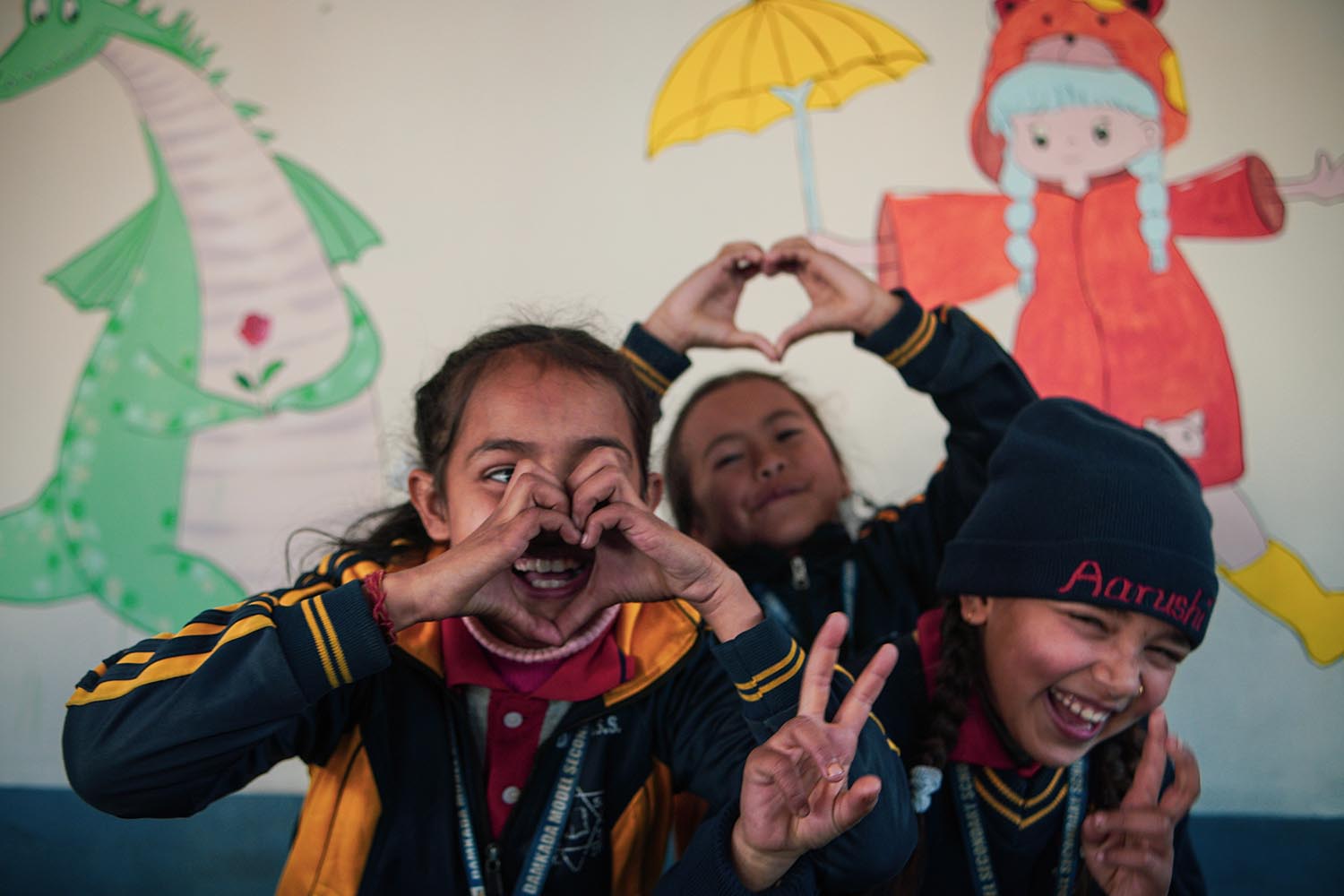
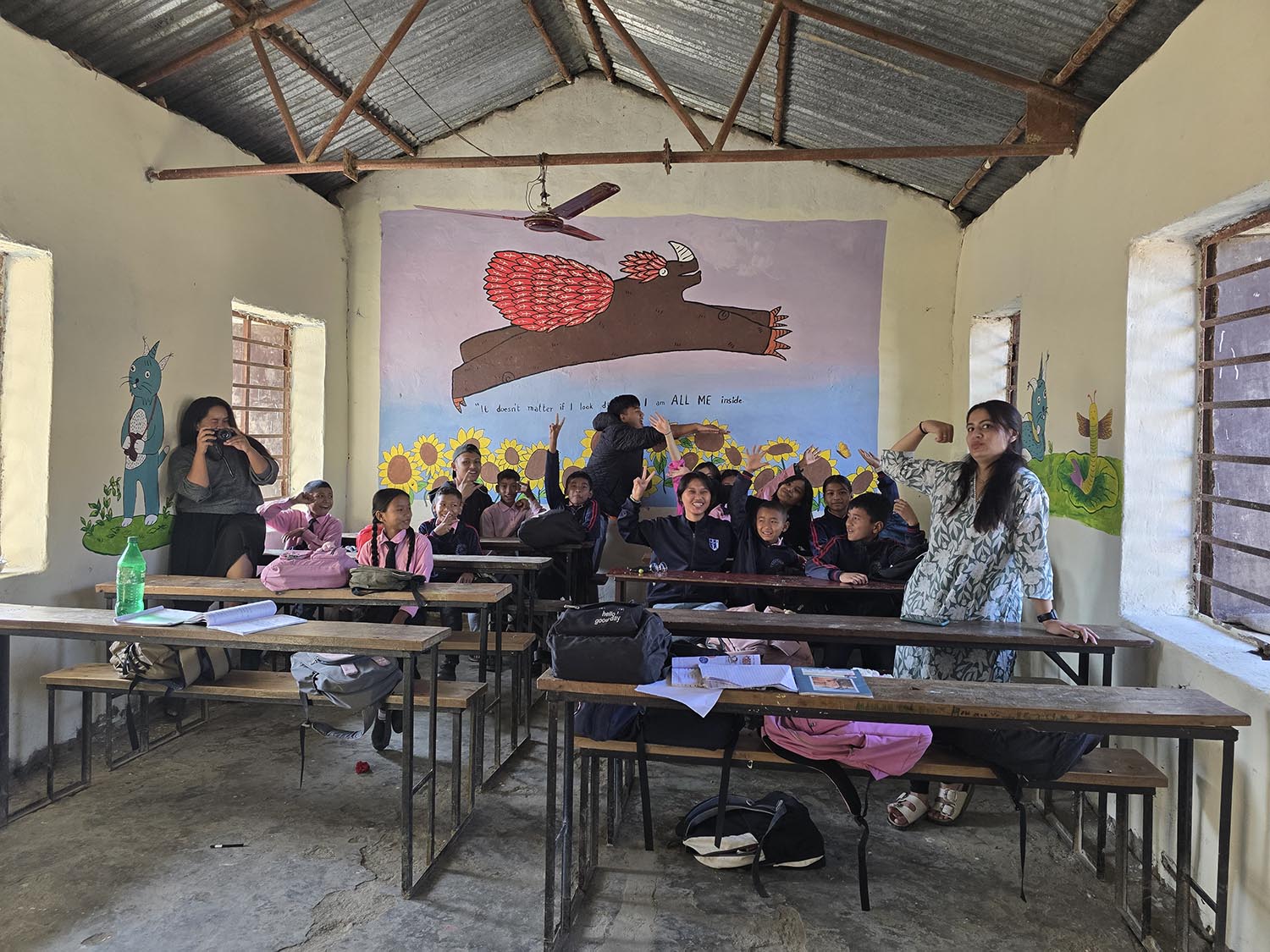
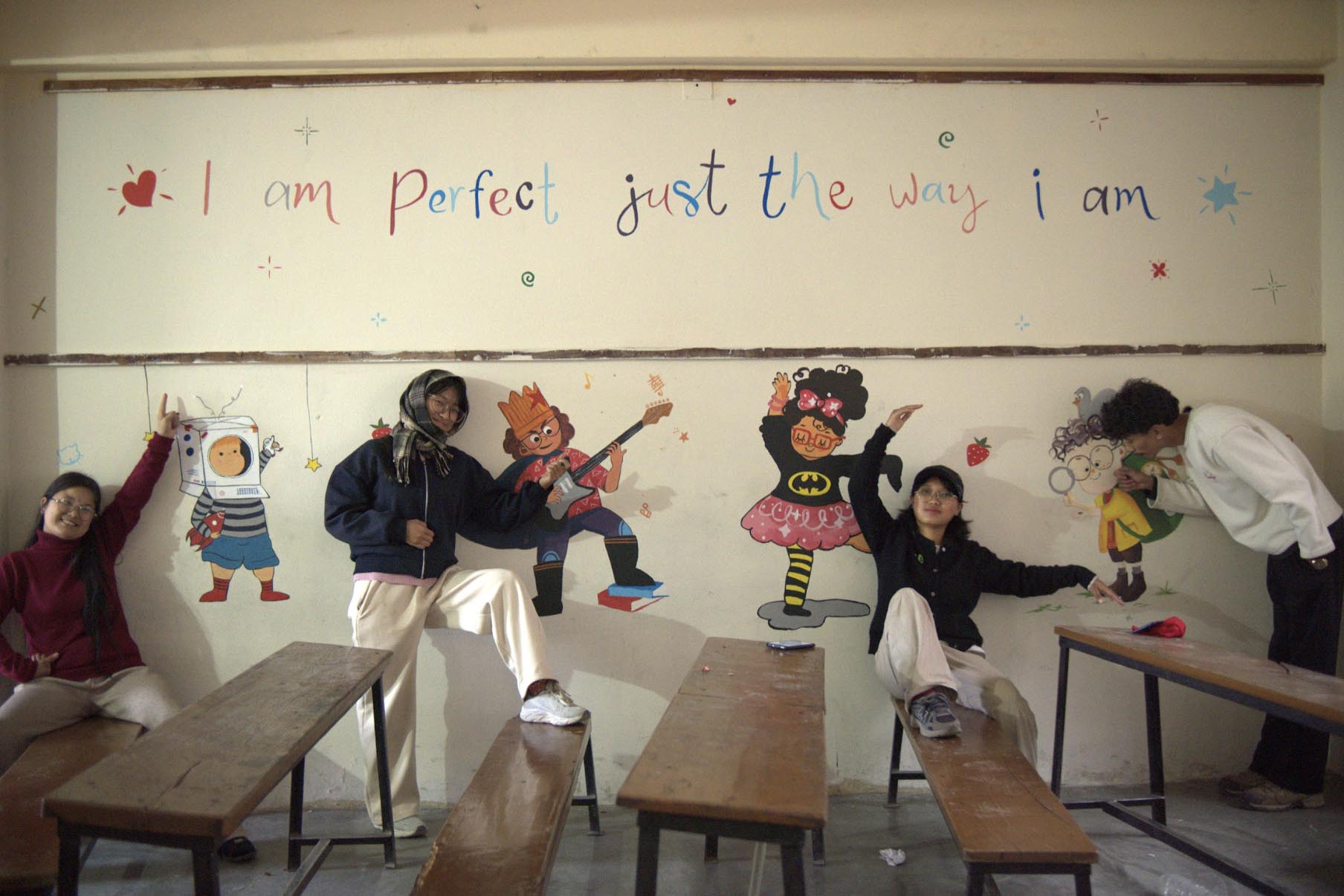
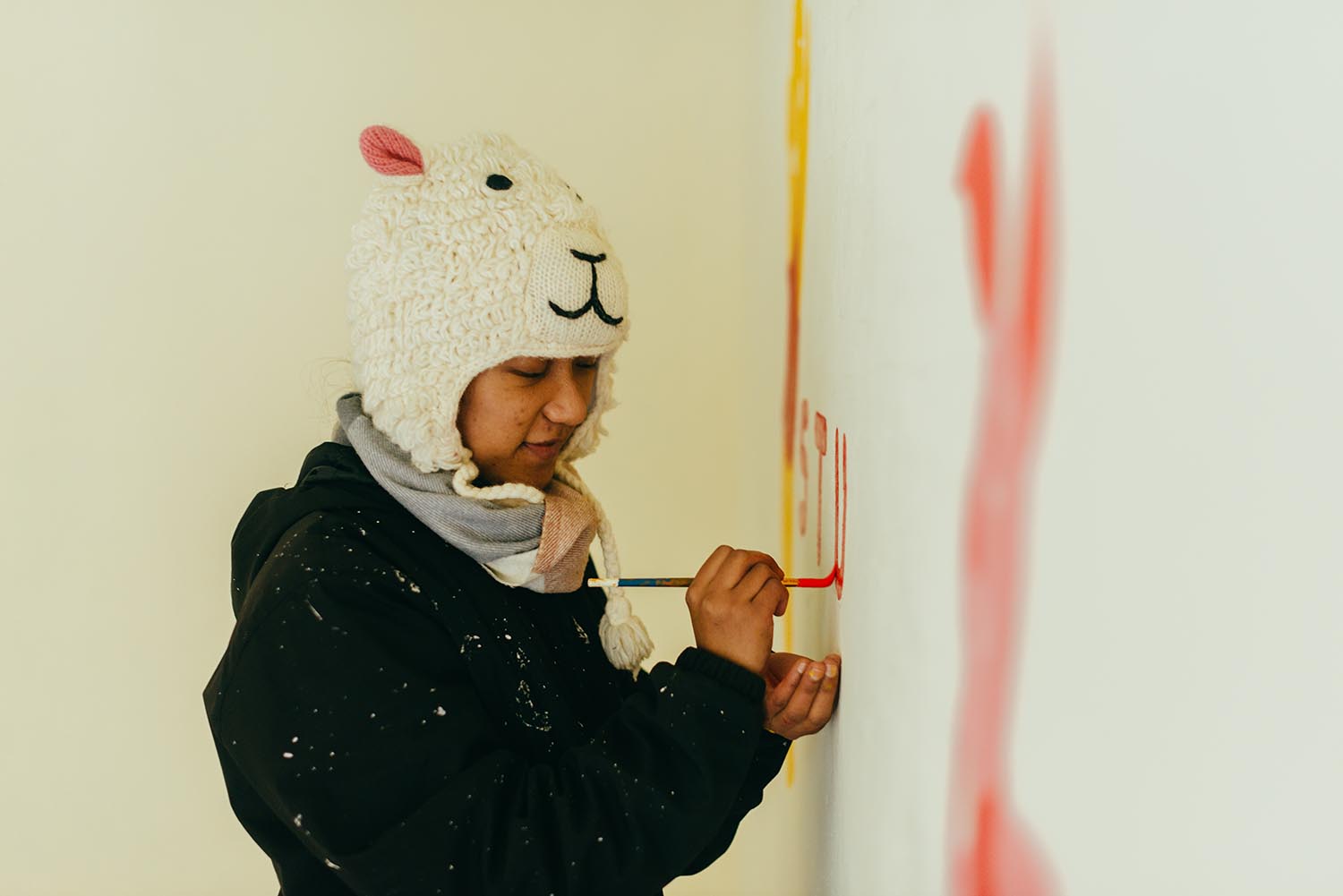
Project Rangichangi is transforming government schools with murals, creating joyful spaces for learning while empowering young artists. Photos: Courtesy of Project Rangi Changi
Many government schools in rural areas have dreary classrooms with broken benches and piles of dust, lacking a ‘childlike’ element. Such a condition is not caused by a lack of resources but neglect.
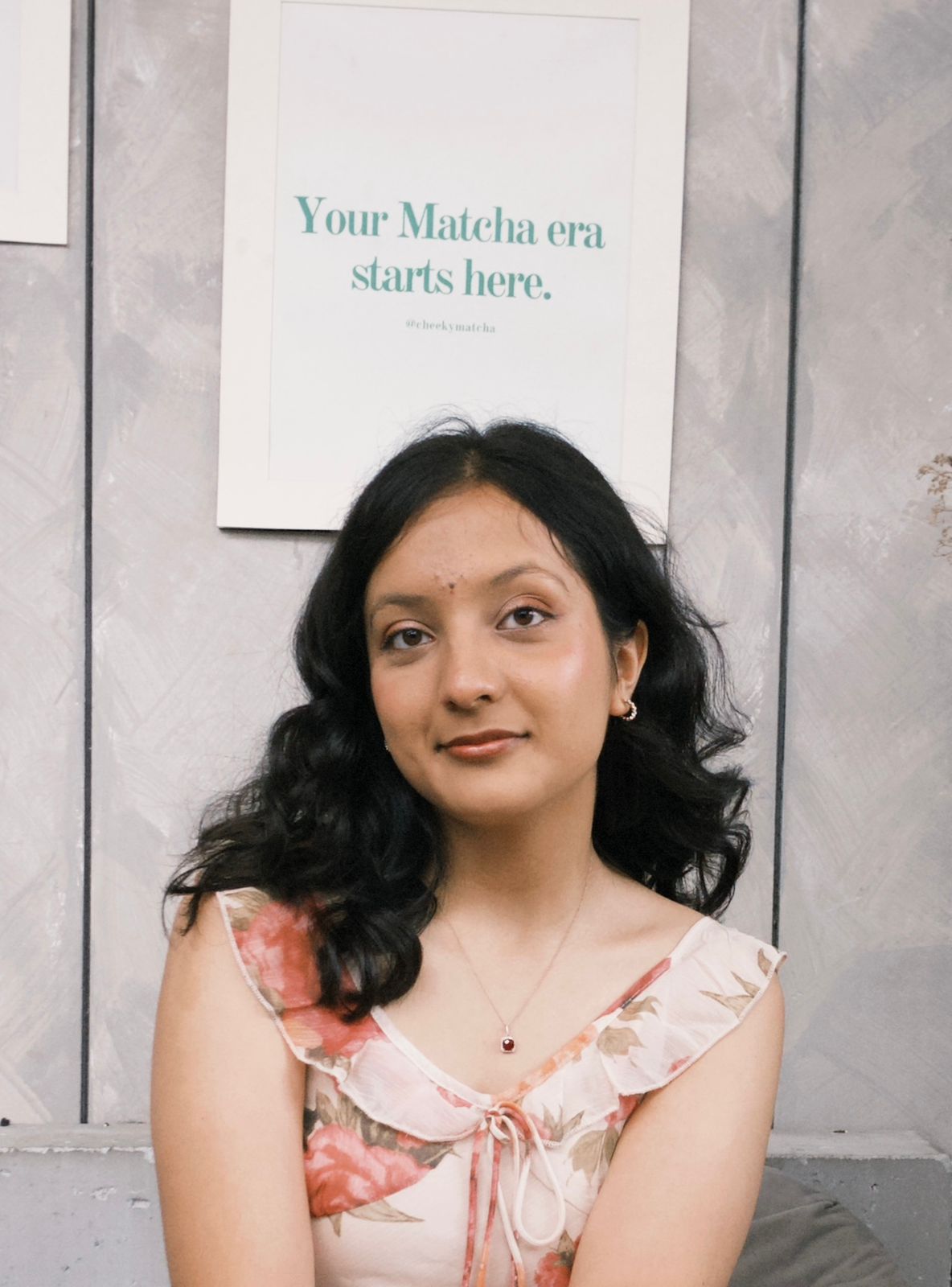
“Classrooms are the only place children can confide, have fun and just be themselves. Being in such classrooms, playing with colours can be a source of education and entertainment,” says Samita Rana Magar, the founder of Project Rangichangi—an initiative that paints murals in government schools, especially in rural areas.
When Magar worked at Shree Narayansthan Secondary School in Asine-3, Okhaldhunga, setting up a library, she noticed a visible discomfort among students in their empty classrooms; they gravitated towards the library more because of its vibrant setup.
Having been passionate about social work throughout her life, she mostly worked with children and education. After spending two years in Okhaldhunga, sharing everyday life with the students, she realised this could be her ‘dream job’. After she returned to Kathmandu, the idea of doing something impactful for the students in Okhaldhunga never left her.
The idea came to her in September 2024. Magar, along with her friends Dollie Shah and Abhisekh Sarangkoti, approached Shree Narayansthan Secondary School to transform their classrooms with a series of paintings from cartoonish symbols of people from diverse backgrounds to a mural of Siddhicharan Shrestha, who was originally from Okhaldhunga.
Gradually, Project Rangichangi expanded across seven provinces, and its motto became ‘seven provinces, seven schools’.
To date, they have worked across six schools from different provinces, except Karnali. The project’s impact has transformed more than 2,000 students’ outlook on what a classroom can look like.
To appreciate artists’ work, a thank-you stipend is provided at the end of their 10–12-day session.
The process of recruiting artists and volunteers for the project is simple: interested individuals register beforehand and are then selected to participate. To appreciate their work, a thank-you stipend is provided at the end of their 10–12-day session.
Participants receive accommodation and meals from the schools they work with. “At times, we were fortunate enough to stay in guesthouses, but other times we had to share rooms with several team members,” says Magar.
The condition of the classrooms is often too poor to begin with, just painting. Volunteers and artists first clean the space. In some cases, they also have to repair the walls, highlighting the difficult reality of many public schools in Nepal.
The murals Rangichangi creates are educational, but not the kind most people would deem them to be. “The teachers in the schools sometimes used to request us to paint mathematical formulas, but our approach was not synonymous with that kind of learning.”
Starting at the primary level (grades 1, 2, and 3), the artists and volunteers create animals and birds and place greater emphasis on the environment. As children in these grades are just starting out in their education, Rangichangi believes in instilling empathy by helping them relate by personifying animals or depicting them as cartoons.
Overall, the goal of these murals is to encourage playful learning while fostering a better atmosphere for children to study.
Then, for children in grades 4 to 6, the murals highlight emotional and behavioural learning. According to Magar, children in this age group are becoming increasingly conscious of their image. Thus, the murals contain affirming phrases such as “I am a superhero,” spreading a message about healthy self-esteem.
In upper-level classes starting from grade 8, as students are more mature and aware of their environment, global warming, sustainability, and local challenges are among the themes presented through paintings. For instance, in Janakpur, one concern was littering; murals against littering were created to tackle the problem.
“After the transformation, stepping into the classroom feels like stepping into a new world. The vibrant colours and lively atmosphere make me feel good and energised to teach. Seeing the kids happy and excited to learn has uplifted the entire environment,” claims Sumitra Rai, a teacher at one of the schools Rangichangi worked with.
Overall, the goal of these murals is to encourage playful learning while fostering a better atmosphere for children to study.
Simultaneously, the project is also empowering artists.
“My artistic journey began in my early teens, and now, as a mixed-media artist and mural instructor, I enjoy exploring various art forms, especially watercolour and ink. Joining Project Ranjichangi Sudurpachim was a significant step for me, as I deeply admired its purpose. Contributing to social work in a rural area and creating inspiring murals for Khandeshwari’s classrooms were rewarding experiences. I played a role in composing murals and bringing our vision to life,” says Bijeta Thapa Magar, a participant at the project.
Khila Bohora, 26, a mother of two and a local artist from Darchula, was a part of Rangichangi. After participating in the project, painting murals, she found additional opportunities to work as an artist.
“Project Rangichangi has left a powerful impact across Api Rural Municipality. It also opened new doors for me as an artist. I never had the opportunity to study art professionally, so working alongside young and professional artists was an amazing experience,” says Bohora.
Bohora’s work was recognised by local bodies, which gave her the opportunity to work as a mural artist at Api Cultural Diversity Park.
Now, Rangichangi has further expanded to offer art workshops and dance classes for children, as well as mindfulness management training for school teachers.
A key challenge for Rangichangi is raising funds for each school visit. So far, Magar’s networking has helped raise the project budget. But for a social initiative that does not aim to create profit, the main issue lies in the financial aspect.
Magar expresses, “I love to see children smile because of the colours around them; that is what Project Rangichangi’s goal is. Through children’s positive reactions towards their classrooms, it feels as if my inner child comes out with them.”
Through Rangichangi, the atmosphere of these schools has added colour to learning. A youth initiative that started only one and a half years ago has achieved this by bringing together individuals and turning them into a creative community.




 25.87°C Kathmandu