Once the heartbeat of Nepali democracy, now a ghostly shell
The BICC building housed the Constituent Assembly and parliament after 2008. Due to destruction during Gen Z protests, federal parliament secretariat decided to end the lease. The facade of Birendra International Convention Centre in New Baneshwar pictured on Monday. Angad Dhakal/TKP
The parliament building at the Birendra International Convention Centre (BICC) in New Baneshwor remains in ruins six months after vandalism and arson during the Gen Z protests last September, with no reconstruction work initiated so far.
Broken glass still litters the premises, while charred structures remain uncleared. Employees are reluctant to enter the compound, fearing the collapse of fire-weakened structures. The site, once a major national venue, now resembles a wasteland, strewn with burnt four-wheelers and motorcycles belonging to various ministries and the Department of Roads.
Despite the passage of time, there is no concrete plan for cleanup or reconstruction.
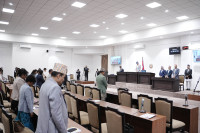
The Federal Parliament Secretariat, which had been leasing the facility since May 27, 2008, following the Constituent Assembly elections, has decided not to renew the lease agreement. It was at this venue that Constituent Assembly members took their oath of office, and Nepal was declared a republic on May 28, 2008. Since then, it served as the meeting place for both the House of Representatives and the National Assembly.
With the building now unusable, preparations are underway to shift parliamentary meetings to the under construction new parliament building at Singha Durbar. The BICC is managed by the Special Structure Operation and Management Development Committee under the Ministry of Urban Development, which is currently operating from undamaged auxiliary buildings.
A historic venue
Ekram Giri, spokesperson for the Federal Parliament Secretariat, said the BICC had long been the only viable venue for parliamentary sessions.
“The compound is spacious and this made security management easier,” he said. “The technology was relatively good, and the Secretariat later added amenities such as high-speed internet.”
He noted that the location was ideal due to its proximity to the Tribhuvan International Airport, as well as its ample parking space and greenery. “Internationally, it stood as an imposing parliament building,” he said, adding that the new complex at Singha Durbar offers limited open space.
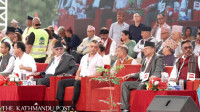
Giri said Kathmandu lacks a comparable hall. “We will never forget this building; the Constitution of Nepal was issued from here, the republic was declared here, and the peace accord between the then Maoist party and the government was endorsed here,” he said.
The lease was terminated effective from September 9, 2025, after the roof collapse rendered the building unusable. The Secretariat had been paying an annual rent that rose from Rs70 million to Rs170 million. Moving to a government-owned facility will eliminate rental expenses.
Construction history
Dipendra Bikram Singh, senior programme coordinator at the management committee, said the centre was built with Chinese assistance. Construction began in 1989, and the facility was handed over to Nepal in 1993.
“It was built at a cost of Rs1.15 billion to host large-scale conventions and exhibitions,” Singh said, adding that the late King Birendra had sought such a venue to host major events like the SAARC Summit.
The complex included eight halls of varying capacities. The largest, Sagarmatha Hall, was expanded to seat 601 members of the House of Representatives. Other halls included Nuptse Hall, used by the National Assembly, and Lhotse Hall, a multipurpose space for committees and political parties, along with Gauri and Shankar halls for administrative use.
Uncertain future
Narayan Prasad Mainali, spokesperson for the Ministry of Urban Development, said the need for the building had diminished following the dissolution of Parliament after the Gen Z movement.
“The Department of Urban Development and Building Construction is currently assessing the damage. While the walls remain intact, the central roof has collapsed,” he said, adding that the decision on reconstruction would likely be taken by the new government.
Minister for Urban Development Kumar Ingnam said rebuilding the structure is not an immediate priority.
“Given the high costs and the construction of a new parliament building, the burnt facility is not at the top of our priorities,” he said.
For now, the damaged complex stands as a stark reminder of the recent political upheaval.




 19.15°C Kathmandu