Escaping poverty at home, Nepali women fall into the Gulf trap
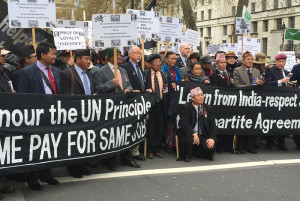
Thousands of women outside Nepal government’s records are confined by restrictive Kafala rules. A migrant domestic worker joins a parade in Beirut, to support the rights of migrant workers in Lebanon, April 29, 2012. Reuters
Sabina Gurung, 32, travelled to Kuwait in 2021 to work as a domestic help. By 2024, after around three years on the job, she began asking her employer for permission to return to Nepal. Each time, the response was the same: “Not until we find someone to replace you.”
Soon after, her employer’s responses turned into threats and violence. When she ran out of options one evening, she called the Nepali embassy in Kuwait for help. She was doing her duties as per the contract, but her employer held her passport to make sure she couldn't leave. This is a common practice under the Gulf's Kafala sponsorship system, which ties a migrant worker’s legal residency directly to the employer who sponsors the visa.
Under Kafala, workers generally cannot change jobs, leave the country, or renew their legal status without the employer’s permission. For domestic workers, many of them women from countries like Nepal, leaving a job can mean losing wages, housing, legal status, and even the right to remain in the country.
For domestic workers, the workplace is also a private home. The employer is the landlord, the sponsor and the gatekeeper.
Thousands of Nepali women travel to Gulf countries each year, hoping for higher wages to support their children’s school fees and ageing parents’ medical treatments.
According to Nepal's Department of Foreign Employment, 30,870 women received new labour permits for Gulf states—the United Arab Emirates, Qatar, Saudi Arabia and Kuwait—in 2023, about 16 percent of the 193,534 Nepali workers there. In 2024, the number rose to 34,402 women, many from districts including Jhapa, Morang, Makawanpur, Sindhupalchowk, and Kathmandu.
Gurung’s story is familiar. Less attention is paid to the risks workers face when they try to assert the rights promised in their contracts.
And the risks faced by women in domestic work are different from those faced by male workers.
Gurung went to Kuwait in her late twenties, hired as a domestic helper through an agent on a visit visa. The contract promised kitchen work for two years. But when the family grew and had more children, her duties expanded: childcare, extra cleaning, longer hours—without renegotiation, without additional pay.
Her salary was often withheld for months. When she finally asked to go home, her employer refused.
‘‘They told me they would take me back to the agent,’’ she says. ‘‘If I made a small mistake, they would threaten to fire me, threaten to never let me go back to Nepal. I always felt unsafe and wished I were a man, because I could work as a labourer outside the home and still feel free.’’
The threats escalated into violence. She was beaten. And still she could not leave.
What was supposed to be a two-year contract stretched into nearly four years before the embassy intervened and helped her return home.
The pattern is not new.
Bijaya Rai, who founded the migrant workers’ group Aprabasi Mahila Kamdar Samuha (migrant women workers groups) after her own years working abroad. Standing at a factory machine doing the same work as men, she earned far less, nearly half their hourly wage. “The boss called it the rule. Nobody questioned him,” she told the Post.
Not every woman who migrates to the Gulf ends up in domestic work.
Sulochana Gautam, from Sankharapur Municipality in Kathmandu, found factory work through a formal, government-approved channel and returned home after a year and a half due to health problems.
‘‘When you go through a company with official documentation, it is much safer,’’ she said. ‘‘You have insurance and your rights are documented.”
But she acknowledges that many women do not have that option. For many leaving rural Nepal, domestic work through informal agents is often the only available path.
Nepal's ban on women migrating for domestic work in the Gulf, first introduced in 2017, did not stop them from migrating. Instead, many women began travelling through informal routes, and this way they were left without the safeguards of official contracts, insurance, and government protections.
Women travelling through those routes describe a very different Gulf altogether: unpredictable working hours and little recourse when problems arise.
“My neighbour’s mother recently died,” Gautam said, “but her daughter, who is in the Gulf, couldn’t attend the funeral because the employer would not release her before the contract ended.”
‘‘They don't get the 8-8-8 rule,’’ Gautam said—eight hours of sleep, eight hours of work, eight hours of rest, a standard factory worker can at least point to on paper.
For domestic workers, the concept rarely applies.
Aveeshna Basnet works in Kuwait and is a barista at Starbucks under Alshaya Group, one of the largest franchise operators in the Gulf Cooperation Council (GCC). She earns 275 Kuwaiti dinars (around Rs130,000) a month.
Her contract allows her the right to quit the job after three years and join another if she finds a higher paying job one.
Workers who migrate through official channels generally have clearer protections than domestic workers who rely on agents.
Her husband, Uttam Chalise, works in the same city as a chef at a smaller company. His employer holds his passport, but he can get it back if he wants to leave.
For Chalise, the pressures of migrant life are mostly economic. Rising prices for basic goods are his concerns. “Most of the time I think about how expensive things are getting,” he said.
Experiences like theirs highlight a divide within migrant labour itself.
Workers in companies, restaurants, factories, or retail chains usually have formal contracts and work in workplaces that fall under labour regulations. However, women in domestic work rarely have that option.
‘‘A lot of workers arrive with little education and little information about their rights,’’ Basnet said. ‘‘They come out of desperation to support their families, but the reality is often not what they were promised.’’
Many women she sees struggling are those who came through agents—brokers who charged fees, promised salaries that never materialised, and whose accountability ended at the airport.
‘‘Women in domestic work have very little security,’’ Basnet said. ‘‘I believe it is better to stay in Nepal and carry loads than to come here unprepared.’’
The difference, then, is not that men have it easy. Wage theft, dangerous working conditions, passport confiscation, and contract substitution are problems across Gulf labour migration.
But men in construction and service jobs work in spaces that are, at least in principle, subject to labour inspection. They live in labour camps or shared housing, interact with co-workers and can sometimes seek help outside the workplace.
A woman working inside a private home often cannot.
For domestic workers, the vulnerability is not incidental. It is structural, built into where they work, who they work for, and how the sponsorship system functions in practice.
Sexual violence, verbal abuse, withheld pay, and confinement are therefore not isolated incidents but predictable outcomes of a system that places one worker almost entirely under the authority of one employer, with no witnesses.
Rai has spent years advocating for such women. She says the lasting protection must come through law.
Nepal has yet to ratify the International Labour Organisation Convention 189, which sets minimum labour standards for domestic workers, and Convention 190, which requires member states to act against violence and harassment at work.
‘‘These women help sustain Nepal’s economy through remittances,’’ Rai said. ‘‘But we still cannot give them the most basic legal protection.’’
Officials at Nepal’s Department of Foreign Employment say the government’s ability to intervene is often limited by how workers leave the country.
Chandra Bahadur Shiwakoti, spokesperson for the department, said, “We don’t have reliable data on how many Nepali domestic workers are in those countries. Many leave without labour permits, so they remain outside the formal system.”
As a result, the department rarely receives formal complaints from domestic workers in Gulf countries.
“If someone migrates undocumented, how will they come to us with a complaint?” he said.
For now, the gap between policy and practice remains wide. Advocates like Rai say that until stronger legal protections are in place, many Nepali women will continue leaving for domestic work abroad through whatever routes they can find.
Aarya Chand is a reporter at The Kathmandu Post covering social issues. Before moving to the social beat, Chand was an intern covering culture and lifestyle for the Post.




 14.4°C Kathmandu