Nepal risks losing up to 132,000 jobs, $1 billion after LDC exit
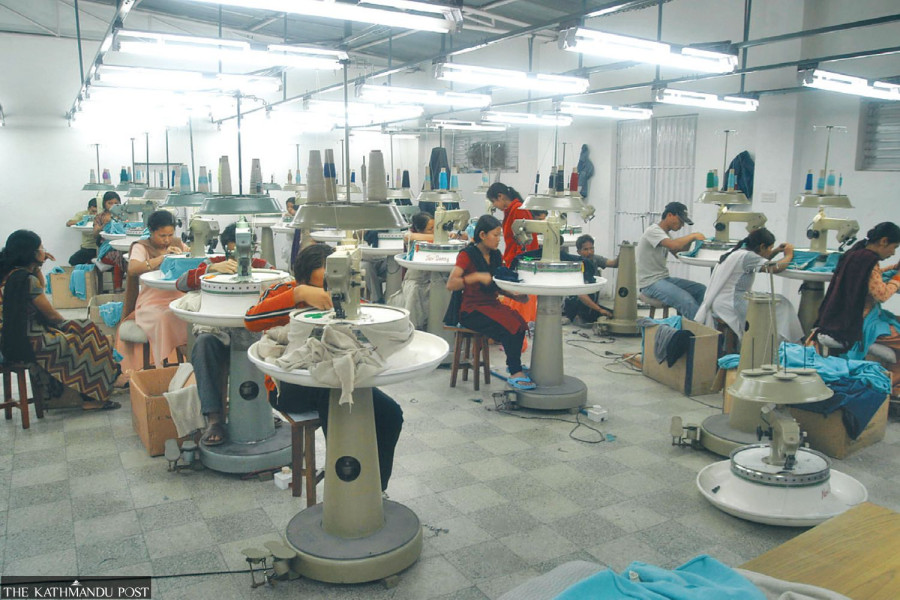
ILO warns reduced exports after November may cost jobs, mainly for women, unless Nepal boosts competitiveness. Nepal’s export-oriented manufacturing sectors, including apparel, may face heavy losses after the country exits the LDC club and loses preferential market access, an ILO report has warned. POST FILE PHOTO
Nepal may lose 132,000 existing jobs—about half of them held by women—and incur nearly $1 billion in economic losses over five years following its graduation from the Least Developed Country (LDC) to a developing country in November 2026, a report unveiled on Monday said.
The job losses—67,000 among men and 65,000 among women—would largely stem from export declines linked to the end of LDC-specific trade benefits.
The report, Employment Impact Assessment on Nepal’s LDC Graduation, released by the International Labour Organisation (ILO), warns that both exports and jobs are at risk and urges Nepal to prepare for a smooth transition. It says that to offset potential income and employment losses, Nepal will need to increase investment and strengthen its economic competitiveness.
According to the report, the largest decline in employment is expected in the manufacturing sector, where around 142,000 jobs could be affected. This trend may place additional pressure on the government to not only create new manufacturing jobs but also recover the employment losses anticipated in the sector.
The share of female manufacturing jobs lost is estimated to be almost equal to that of male workers, despite women already having significantly lower labour force participation rates. The findings point to the vulnerability of women workers in labour-intensive export sectors.
More urban jobs are projected to be lost than rural ones, and the share of urban jobs lost among women is almost double that among men. These patterns could trigger reverse migration of urban women to rural areas, where employment is typically informal, less productive and often unpaid.
Numan Özcan, director of the ILO Country Office for Nepal, said the country’s transition out of LDC status in November this year represents a major turning point.
“But it’s not the end. It is a transition into a more competitive environment with fewer international support measures and higher expectations,” he said. “That can sound very technical, but it can also become very real and very personal.”
“Maybe not for the people sitting in this meeting room, but for business owners, factory workers, and workers in small shops, hotels, transport or the informal economy. It can become very real and personal,” he said speaking at the report-unveiling event in Kathmandu, Monday.
“The real test is how Nepal can translate graduation into better jobs, stronger enterprises and greater economic security for everyone.”
Özcan said the report provides evidence to help shape Nepal’s smooth transition strategy.
“It looks beyond trade headlines and numbers and asks the question that matters most: what happens to businesses and workers and their jobs?” he said. “It combines stakeholder consultations with economy-wide modelling to examine how changing market access, tariffs and competitiveness could affect growth and employment.”
The report estimates export losses of around 2.5 percent to 4.3 percent of total exports, depending on markets and products. The losses are expected to hit export-oriented manufacturing sectors, particularly apparel, textiles and carpets, which already face high transport costs and stiff international competition.
“In a worst-case scenario, without adequate mitigation measures, up to 132,000 jobs could be at risk over the next five years,” Özcan said.
Women, who are strongly represented in garment and textile industries, may be among the first to be affected. Informal workers, who already lack protection and job security, are also highly vulnerable.
He added that trade competitiveness today is not determined solely by tariffs.
“Trade today is shaped by compliance requirements, rules of origin, due diligence, quality standards and increasingly expectations around labour conditions and environmental performance,” he said.
“In other words, competitiveness and decent work are not two separate conversations. They are very closely linked.”
Nepal is exploring new trade arrangements, including access to the European Union’s Generalised Scheme of Preferences Plus (GSP+), which offers developing countries preferential market access in exchange for implementing international conventions on labour rights, human rights, environmental protection and good governance.
For Nepal, this pathway requires continued progress on international labour standards, including ratifying ILO conventions that the country has yet to adopt, such as those related to freedom of association and labour inspection.
“This is about signalling to investors, buyers and citizens that Nepal is serious about fair competition built on rights and quality—not on a race to the bottom,” Özcan said.
Through simulated policy scenarios, the report suggests that targeted investments could help offset GDP losses and generate employment, particularly through improvements in trade facilitation, tourism and the information and communication technology sector. However, the report emphasises that policy choices and timing will be critical.
“The core message is that graduation is manageable, but only with early, coordinated and inclusive action,” Özcan said.
He outlined four key priorities: protecting workers through stronger labour market policies, including re-skilling, up-skilling, job-matching services and expanded social protection; strengthening enterprise competitiveness through productivity gains, quality upgrades and deeper integration into global value chains; investing in people—particularly women and young workers—so that skills development aligns with future growth sectors; and using social dialogue to ensure a fair transition involving government, employers and workers.
Jyotsna Shrestha, chairperson of the Employers’ Council and vice-chair of the Federation of Nepalese Chambers of Commerce and Industry (FNCCI), said Nepal’s exit from the LDC category is a matter of national pride reflecting decades of development progress.
“However, from the perspective of the private sector, this transition also raises serious questions about preparedness and competitiveness,” she said.
“For many industries, particularly export-oriented and labour-intensive sectors, the preferential market access available under LDC status has played an important role in sustaining exports and employment.”
As these preferences are phased out, Nepal’s products will face tougher competition in international markets.
“The report itself indicates that more than 100,000 jobs could be at risk in the coming years, especially in the manufacturing sector that employs a large number of women workers,” Shrestha said.
“This is a concern the private sector cannot ignore.”
Shrestha said many businesses are already grappling with structural challenges, including high logistics costs, limited infrastructure, policy uncertainty and regulatory complexity.
“Nepal’s industries compete not only in the global market but also with neighbouring economies that often have stronger production ecosystems,” she said.
“Therefore, when we discuss LDC exit, we must also discuss how Nepal will protect and strengthen its productive sectors during this transition.”
From the perspective of employers, she outlined three priorities: improving competitiveness of domestic industries through better infrastructure, reliable energy supply, trade facilitation and stable policies that encourage investment; ensuring a smooth transition in international trade arrangements, including securing access to mechanisms such as GSP+, to protect export industries and jobs; and strengthening collaboration between government and the private sector in shaping industrial and export policies.
“At the same time, we recognise that LDC exit also creates opportunities,” Shrestha said. “It can encourage Nepal to move towards a more diversified and competitive economy and create new jobs.”
Prakash Kumar Shrestha, vice-chairman of the National Planning Commission, said Nepal’s graduation from LDC status marks the beginning of a new development phase.
“It comes with both opportunities and challenges, and the transition must be smooth and effective,” he said.
He said the report is particularly important because it highlights the employment dimension of the transition.
“Employment is a critical issue in Nepal,” he said. “Every year, around 400,000 to 500,000 young people enter the labour market, and job opportunities are limited. That is why many youths seek employment abroad.”
Without mitigation measures, the country could face a nominal GDP loss of $851 million in 2026 and cumulative real GDP losses approaching $1 billion over the next five years.
The loss of 132,000 jobs would disproportionately affect the manufacturing sector, especially textiles, where nearly half of the projected job losses would be among women.
“Women are more concentrated in these sectors,” Shrestha said. “Given that women’s labour force participation is already lower than men’s, this finding demands serious policy attention.”
“These results are evidence-based warnings that should guide proactive policy action.”
He said that although transitional trade arrangements—such as extended preference schemes and potential access to GSP+—could provide temporary relief, they are time-bound and conditional.
“Stricter rules of origin, compliance requirements and higher standards will require improvements in productivity,” he said.
“Our productivity levels are low, and our regulatory systems and institutional capacities also need strengthening. Therefore, our approach should not be limited to preserving preferences.”
Instead, he said, targeted investments in trade facilitation, tourism and ICT could help offset GDP losses and significantly reduce the employment impact of LDC exit.
Sangam Prasain is Business Editor at The Kathmandu Post, covering tourism, agriculture, mountaineering, aviation, infrastructure and other economic affairs. He joined The Kathmandu Post in October 2009.




 15.26°C Kathmandu