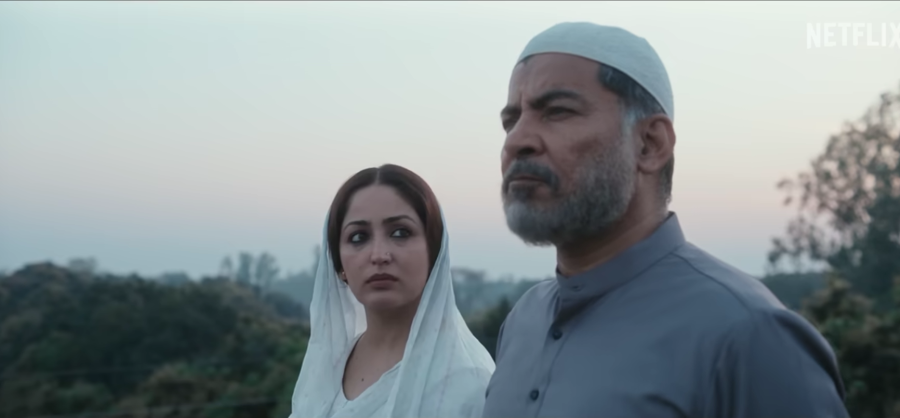
When a pressure cooker is not working to its full capacity, what does a normal person do? Fixing it is the right answer, but the character Abbas Khan in ‘Haq’ replaces it as if it’s completely useless. This small detail does not seem noticeable at first when Abbas’s wife, Shazia Bano, enters her new home after marrying. But it entails how Shazia’s fate is going to treat her, even worse than the pressure cooker’s.
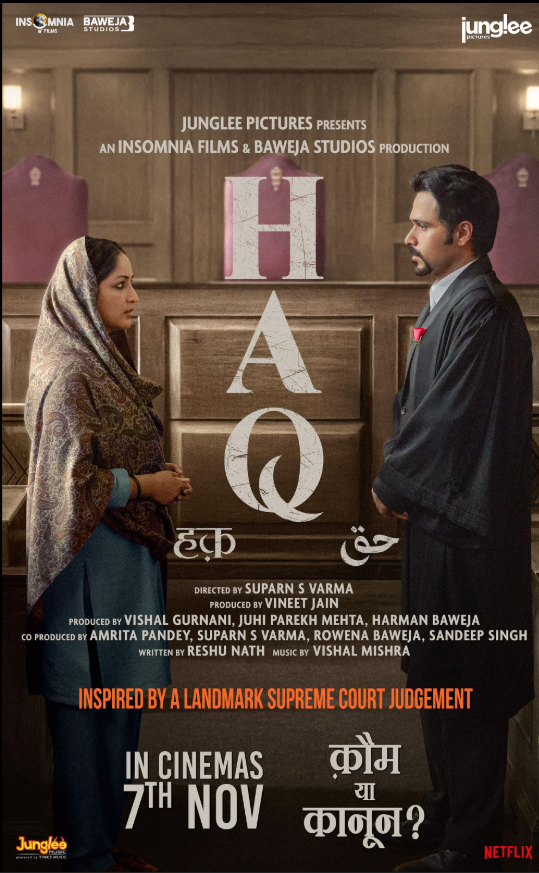
‘Haq’ is a 2025 Indian film directed by Suparn Verma, who is best known for his series ‘The Family Man’. Yami Gautam Dhar plays Shazia Bano, a devoted housewife, and Emraan Hashmi plays Abbas Khan, one of the top lawyers in the city of Sankhani, India. Sheeba Chadda plays one of the most important roles, Bela Jain, a powerful supporting character.
The first segment of the movie builds up to an intimate Muslim wedding of Abbas and Shazia. After finally being a married woman, Shazia sees her domestic life through rose-coloured glasses. One cannot say she fully romanticises her life with Abbas, given the extravagant acts of love and service he showers on her.
One such act is his transfer of a small piece of land from his own property to his wife shortly after a dispute with a neighbour.
Together, they have three kids, who are mostly seen with their mother because Abbas is unavailable due to his busy work. Even though his work is the primary source of financial support for his family, his emotional dissonance slowly becomes evident in their lives.
One day, Abbas leaves for Murree, Pakistan, for his work. Shazia tries to telephone him every day, but he doesn’t reply for months. Little did she know that he had actually gone to marry Saira, a girl he had been in love with for years.
Shazia is astonished when he returns with his second wife. Emotionally stunned, she cannot accept this truth. Even so, she pushes herself to include Shazia in household chores and buys essentials for her. But that does not remain for long.
As the walls between Shazia and Abbas solidify, she realises that leaving for her hometown with her children would be the best option at the time.
At first, Abbas sends meagre maintenance, but after some time, he leaves Shazia to fend for herself and the kids. This leaves her with no option but to seek justice from the law. But the same person she is fighting against is a renowned lawyer himself.
Bela Jain then becomes a voice for Shazia, demanding fair maintenance. In the long process of hearings, Abbas divorces Shazia using the triple talaq to escape his financial responsibility and further damage to his reputation.
The matter before the court concerns Muslim Personal Law and Section 125 of the Code of Criminal Procedure. Abbas attempts to portray himself as a victim, suggesting that Shazia disrespects her own religion and therefore that her claim for maintenance is invalid. Such claims cast her in a negative light in society's eyes, prompting her to question whether pursuing justice is worth the struggle. Despite this, she overcomes her inner turmoil with the support of her progressive father, whose guidance exemplifies what fatherhood should be, ultimately securing the right to receive INR400 per month.
This film draws from the real-life story of the landmark Supreme Court judgement of Mohd Ahmed Khan and Shah Bano Begum. In 1978, Khan threw Shah Bano Begum out of his household. After she requested maintenance, Khan divorced her and paid Mehr (an amount promised to Muslim women when they marry as a form of financial security), along with additional money. He argued that this application for maintenance should be dismissed. In 1985, after a long fight, the court ruled that the obligation to pay maintenance still applies to husbands even when personal laws are involved. The Shah Bano case raised critical questions about the rights of a divorced woman. Even after winning, Bano faced heavy social criticism that affected her personal life, unlike in the movie, where the actual aftermath is not clearly depicted. ‘Haq’ also sparked initial debates about the fictionalisation of a real-life story, one which defined a crucial point for Indian law.
The film’s cinematography is curated to match the aesthetics of the 1970s in India. The low-saturation colour grading, in which most colours are not very vivid or bright, can be correlated with Shazia's situation, in which she is emotionally burdened most of the time. Also, the scenes look very realistic. The streets, interior designs and public settings use naturalistic visual styles.
Haq’s emotional rawness is what makes it an impactful watch. Yami’s ability to act out the resilience of her character feels empowering as a woman. After egoistical disagreements between Shazia and Saira, Saira silently sides with Shazia, reminding them that womanhood remains above personal issues. The firstborn child of Shazia, not even embracing his father with the slightest physical touch in a moment of emotional vulnerability, symbolises the hurt caused by Abbas to his own kids.
On the contrary, Emraan’s cold-hearted statements, in which he disregards his first marriage in the courtroom, make viewers feel genuine anger. Overall, the movie has evoked a wide range of emotions on screen.
One dissatisfying part about this movie was the ending. Throughout the movie, Abbas is portrayed as a bad husband and father, yet he does not face serious consequences for his actions. It simply ends with Shazia getting her justice. The ending feels underwhelming in a sense. Nevertheless, the film’s message still remains clear due to its dramatic courtroom scenes.




 21.42°C Kathmandu