A staircase, stained, narrow, and smelling of neglect. A mother covers her nose before stepping inside what is supposed to be her family’s new beginning.
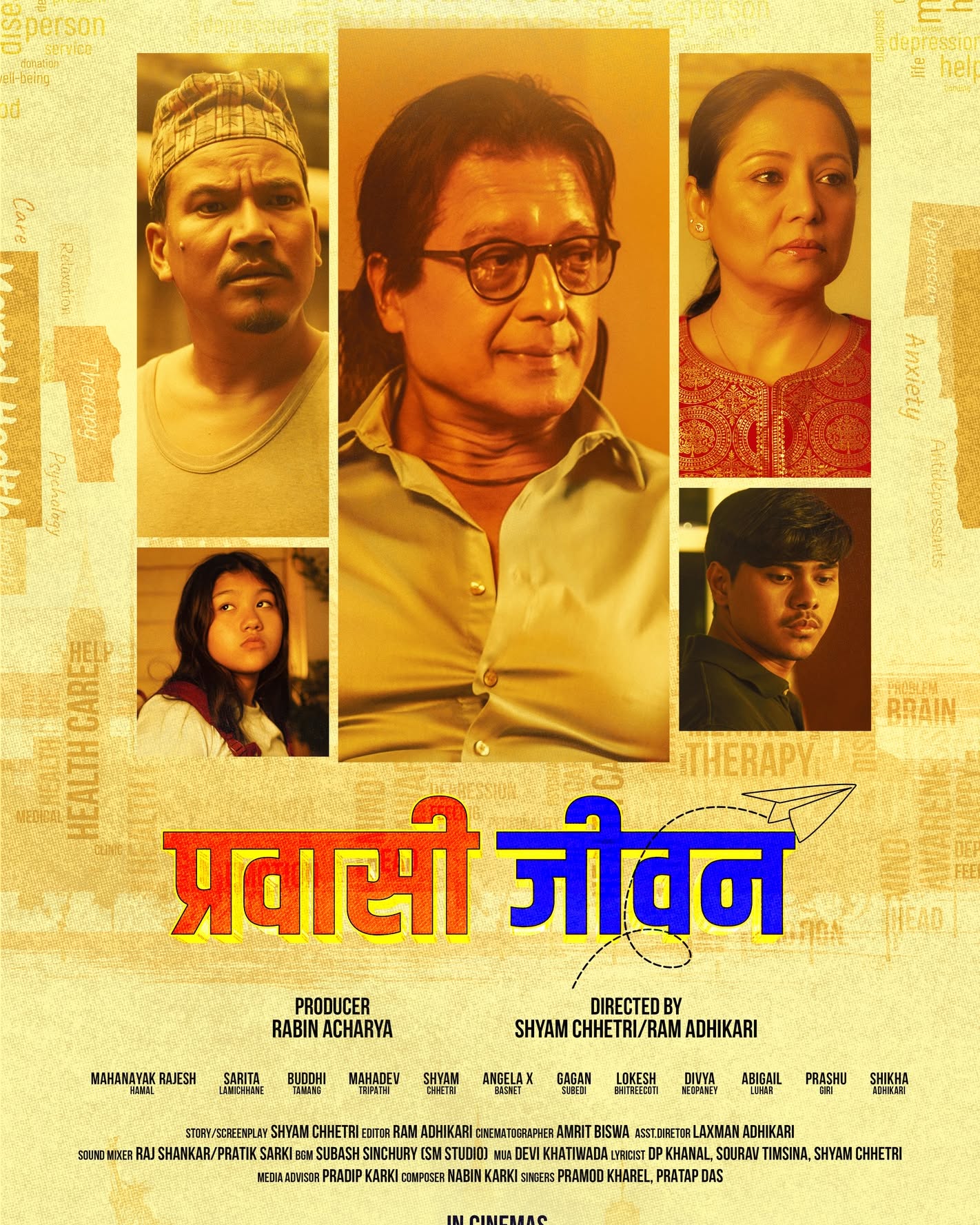
‘Prawasi Jiwan’ opens with discomfort. The film frames migration as arrival into uncertainty. It is dedicated to immigrants and to those lost to mental illness, and that dedication shapes its emotional core.
Mental health, rarely centred in Nepali cinema, is one of the film’s primary concerns. The story is structured around therapy sessions: a hesitant refugee, Prayash, sits across from a therapist played by Rajesh Hamal, unsure whether to speak. That detail matters. For a Bhutanese Nepali refugee, seeking therapy is itself an act of rupture from silence, from stigma, from inherited ideas about endurance. The film situates this encounter as significant within the community, and in doing so, it acknowledges how access to mental health care is not only personal but cultural.
The narrative unfolds through recollection. There is one animated sequence about his past. This segment, however, raises an unexpected question. Their texture resembles AI-generated imagery. Whether they are AI-assisted or not, the ambiguity reflects our present moment. Today, audiences often get perplexed regarding who creates the images they see. Authorship is unstable. Hence, the animated visuals are confusing and questionable.
Similarly, the film’s visual symbolism is deliberate. On the flight to the US, the family carries cloth bags instead of suitcases. One bears the large blue letters ‘IOM’, referencing the International Organisation for Migration. These are not props chosen at random. A suitcase often signals tourism or upward mobility; a cloth sack signals displacement and a modest economic background.
The camera lingers on the cramped interiors of their apartment. No window. Tight hallways. Shared fatigue. The promise of the West appears confined. Yet the film resists turning the US into a villain. Instead, it shows how systems, language barriers, workplace hierarchies, peer pressure, and personal decisions intersect. The protagonist’s mental decline is not attributed to a single event but to an accumulation. This is where the film is most precise: it treats mental illness as structural as much as psychological because it is shaped not just by stress, trauma, pessimistic thoughts, but also by the systems he lives in, including financial pressure, social expectations, and the way society treats immigrants.
On the other hand, the performances are uneven. Some actors, excluding Rajesh Hamal and Buddhi Tamang, struggle with emotional modulation.
The film also examines community bonds. Bhutanese refugees in America connect quickly, even as strangers. They share rides, meals, and advice. The diaspora becomes a parallel home. Likewise, a neighbour offers guidance and companionship, suggesting that solidarity can emerge in foreign landscapes. These gestures counterbalance isolation.
Contrastingly, the film depicts suicide directly. The image of a body hanging from a tree is shown without mediation. Here, the film enters contested territory. In film theory, the idea of ‘suggestive representation’ argues that what is implied can be more powerful than what is shown.
By contrast, explicit depiction risks desensitisation or triggering audiences. Given that the film is dedicated to those lost to mental illness, a more symbolic approach might have respected both impact and care. The audience does not need graphic confirmation to understand loss. Suggestions can create deeper engagement because it invites interpretation.
The motif of the gun, embedded in the narrative, adds another layer. In the US, firearms are normalised within certain contexts. For someone arriving from a refugee background, that normalisation can feel destabilising. The film does not sensationalise gun culture; instead, it frames it as ambient anxiety. Safety remains conditional.
However, the final act introduces tension between realism and aspiration. Within three years, the protagonist Prayash is shown as economically secure, with a large home and visible markers of success. No clear explanation is offered for this transformation. The gap between struggle and achievement feels abrupt. Cinema often compresses time, but compression requires coherence, which the film lacks.
This raises a broader question: should immigrant narratives conclude with material success? An open ending, one that acknowledges progress without closure, might have aligned better with the film’s earlier complexity. Recovery from mental illness is rarely linear. A migrant may still carry memories of displacement. By resolving both through visible prosperity, the film adopts a conventional arc that contrasts with its earlier restraint.
Another aspect that feels underexplored is access to therapy itself. The film shows the protagonist receiving professional counselling in the US. However, therapy in America is expensive, especially for immigrants or refugees who are financially struggling. The film does not clarify whether he has insurance, community support or refugee assistance coverage. This absence creates confusion.
For a character who struggles to afford basic stability, regular therapy sessions appear logistically difficult. By not addressing this, the film misses an opportunity to examine yet another structural barrier migrants face. The healing feels emotionally convincing, but economically unclear.
Lastly, it was released a few days before the election period. Its themes: mental health, migration, and the Bhutanese refugee experience are highly relevant. One wonders whether the timing was intentional, as if the film is asking: Should these be the issues our candidates focus on?
Sanskriti Pokharel, a former reporter and sub-editor at the Post, is a final-year student of Journalism, Mass Communication, and English Literature at St. Xavier's College, with experience in media, research, and communication.




 15.41°C Kathmandu