Upper house passes tourism bill with tougher Everest rules
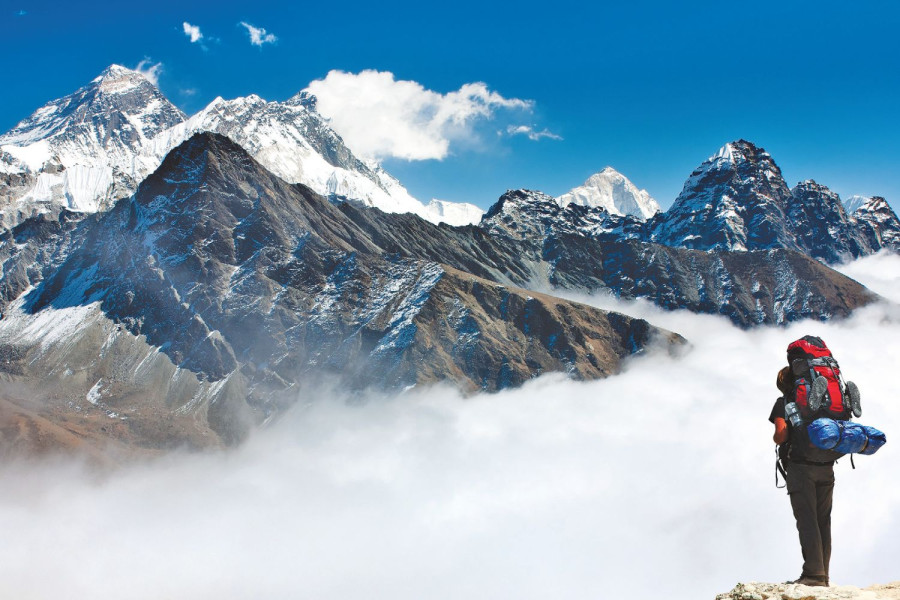
Bill requires climbers to meet health and experience standards, mandates insurance, sets up environment fund. A trekker savours the view of Mt Everest (right) and surroundings in this undated photo. Reuters
Nepal’s National Assembly has passed the Integrated Tourism Bill, a wide-ranging piece of legislation that introduces stricter rules for mountaineering, tighter safety and insurance provisions, and a permanent environment fund aimed at cleaning up the country’s high mountains, including Mount Everest.
The upper house unanimously endorsed the proposal tabled by Tourism Minister Anil Kumar Sinha on February 9. Addressing lawmakers, Sinha said the bill seeks to diversify and systematically regulate Nepal’s tourism sector while strengthening safety and environmental standards in mountaineering.
Mountaineering rules have been incorporated into the tourism bill for the first time to strengthen enforcement, as earlier provisions were issued temporarily and resulted in weak implementation, according to officials at the tourism ministry. Nepal’s top court has also ordered the government to seek sustainable solutions to keep Nepal’s mountains clean and prevent deaths.
The bill will now move to the House of Representatives (lower house) to be elected through the March 5 elections.
After endorsement by the lower house, the legislation will return to the National Assembly before being sent to the President for authentication. Tourism ministry officials estimate that, if the process proceeds smoothly, it could take at least three months for the bill to become law.
One key provision of the bill is the introduction of mandatory, recent health certification for all members of a climbing team.
While applying for a climbing permit, each member—including the liaison officer, sirdar (team leader), mountain guide and other support staff—must submit a health certificate issued within the previous month. Authorities say this measure aims to reduce preventable deaths and medical emergencies at high altitude.
For mountains requiring prior approval, climbers must submit an application to the Department of Tourism along with a detailed mountaineering plan, prescribed fees and supporting documents.
Based on the application and its attachments, the department may grant a climbing permit specifying the approved route and conditions. Permission will not be granted to any individual whose health condition is deemed unsatisfactory, either for climbing or accompanying a team.
The bill also introduces a significant experience requirement for aspiring Everest climbers.
A permit to climb Mount Everest will be issued only after an applicant provides proof of having previously summited at least one mountain higher than 7,000 metres in Nepal.
Officials say this provision is intended to curb the growing number of inexperienced climbers attempting the world’s highest peak, a trend often blamed for congestion, accidents and strain on rescue services.
Additional provisions in the bill cover climbing seasons, application fees, permit conditions, required expedition services, standards to be maintained during expeditions, and age and experience thresholds for climbers.
A major highlight of the legislation is the formation of an Environment Protection and Mountaineers’ Welfare Fund. The government will establish the fund to ensure social security for climbers and mountaineering support staff, as well as to finance environment protection efforts in high-altitude regions.
Climbers, teams and other individuals or institutions may contribute to the fund. Importantly, the mountain garbage management fee collected at the time of issuing climbing permits will be deposited directly into the fund by the department.
Since 2014, Nepal has required every climber ascending above base camp to bring back at least eight kilograms of solid waste or forfeit a $4,000 deposit. The proposed law seeks to convert this refundable deposit into a non-refundable fee, thereby creating a permanent pool of resources dedicated to conservation and cleanup activities.
The move comes amid growing domestic and international criticism that Mount Everest is turning into a dumping ground due to decades of accumulated waste left behind by climbers. In December last year, the government unveiled a comprehensive five-year Everest Cleaning Action Plan (2025-2029), marking the first time it adopted a long-term, policy-backed framework to address waste management on the mountain.
In recent years, portions of public funds were allocated for Everest clean-up campaigns led by the Nepali Army. While those operations removed large volumes of waste, officials familiar with the process said they also generated controversy over financial transparency and accountability.
Questions were raised within the government about expenditure details, procurement practices and the absence of a sustainable waste management strategy. According to sources, such concerns prompted the government to introduce a formal action plan supported by a dedicated fund, instead of relying solely on periodic clean-up drives.
Under the new bill, the non-refundable garbage fee will directly support this long-term cleaning plan and broader environment protection measures in mountain regions.
The legislation also formalises procedures related to climbing certificates. If a mountaineering team completes an ascent and applies for certification, the Department of Tourism must issue certificates after verifying the completion of the climb based on available evidence. However, climbers who fail to apply within the prescribed time limit will forfeit their eligibility to receive a certificate later.
If a climber has set a record as specified in the approved climbing plan, the department may mention such details in the certificate. Sirdars, mountain guides and support staff who are confirmed to have summited may also receive certificates specifying their roles in the expedition.
The bill further states that if any member of a climbing team is required to pay compensation, a climbing certificate will be issued only after the compensation has been settled or recovered. In cases where an expedition is abandoned or a permit revoked, the royalty paid will not be refunded.
However, the law provides flexibility in extraordinary circumstances. If an expedition cannot be carried out due to armed conflict, external aggression, natural disaster or epidemic, and the royalty has already been paid, the department may, within two years, adjust the amount against a previously approved permit or another mountaineering expedition.
Search, rescue and medical responsibilities are also clearly defined. In the event of an accident, disappearance due to loss of contact, or serious health condition of a tourist, the travel and tour agency or trekking agency concerned will bear responsibility for search, rescue and treatment management.
If the agency is unable to conduct rescue operations or if coordination with other government bodies is required, the department will coordinate with relevant agencies upon request. The department will also monitor agencies involved in rescue and treatment operations.
In cases where a tourist is engaged in tourism activities without affiliation to a travel or trekking agency, the department will arrange search, rescue and treatment as necessary. In emergencies, it may mobilise trained personnel equipped with appropriate equipment.
The bill also introduces a legal provision for declaring a climber dead. If a person who has gone mountaineering remains out of contact and cannot be located even after a search conducted for one year, that person may be legally declared dead.
Insurance requirements have been strengthened as well.
A trekking agency managing a mountaineering expedition must, before commencement, obtain insurance from a company licensed under prevailing law. Coverage must include personal accident insurance, medical treatment insurance, search and rescue insurance, and insurance for management of dead bodies. Insurance must cover expedition members, liaison officers, sirdars, mountaineering guides and support staff.
If a team intends to climb more than a mountain in a single season, it must obtain a lump-sum insurance policy covering a period of up to three months.
Officials say the Integrated Tourism Bill represents one of the most comprehensive overhauls of Nepal’s mountaineering governance framework in years.
Sangam Prasain is Business Editor at The Kathmandu Post, covering tourism, agriculture, mountaineering, aviation, infrastructure and other economic affairs. He joined The Kathmandu Post in October 2009.




 14.5°C Kathmandu