



 27.61°C Kathmandu
Tue, Sep 29, 2026
Health
Health workers on alert for possible patient surge on election day
Officials urge public to exercise caution, use masks, and avoid crowds as poll coincides with peak influenza season.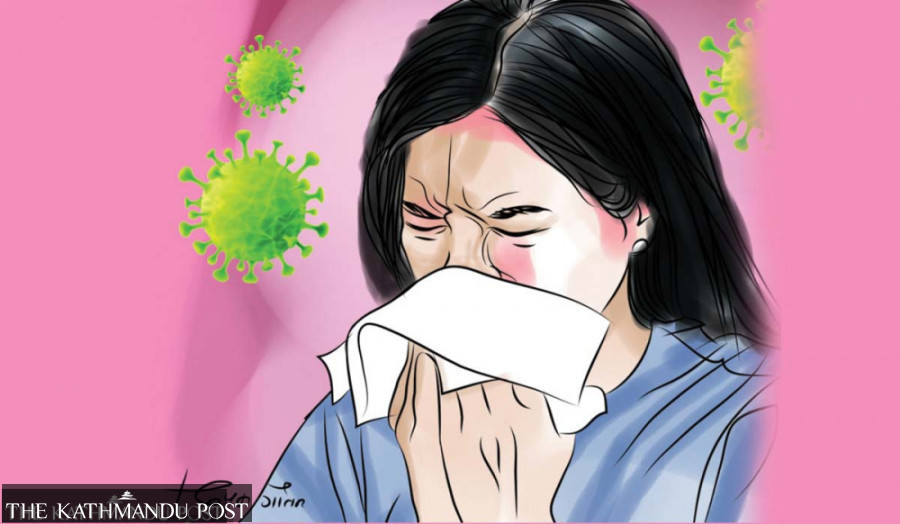
bookmark
Post Report
Published at : February 26, 2026
Updated at : February 26, 2026 06:39
Kathmandu
The Ministry of Health and Population has alerted health workers serving in emergency departments at health facilities about a possible influx of patients on election day and asked them to prepare accordingly.
Past experiences show that the likelihood of scuffles, brawls, and fighting is high before, during, and after election day, which increases pressure on hospital emergency rooms, officials say.
“Health workers serving in hospital emergencies will not be taking leave on election day, and other health workers, including doctors, have been asked to remain in touch with their hospital administrations that day,” said Dr Samir Kumar Adhikari, joint spokesperson at the ministry.
“Health camps will not be organised at polling stations on election day, unlike in past elections.”
The government has declared public holidays on March 4, 5 and 6 to allow voters to return home and cast their votes. Health officials say that other services, including outpatient care and non-emergency surgeries, will be suspended during the election holidays.
“As many people are expected to return to their home districts for the March 5 parliamentary election, the number of road traffic accidents could also increase,” said Adhikari. “We have asked health workers to prepare accordingly, and would also like to ask the general public to be cautious and be safe.”
This time, the Health Ministry had asked the Election Commission not to deploy health workers on election duty. But despite the request, health workers have been deployed for election work. Health officials say the presence of health workers at polling stations would help improve coordination with health facilities in the event of accidents or violence.
Along with the risk of a surge in hospital emergencies, the risk of spread of communicable diseases, including flu and other respiratory viruses, will be high due to crowding and increased mobility, according to health workers.
“The risk of infection from respiratory viruses increases in crowded places,” said Dr Amrit Pokhrel, an official at the Epidemiology and Disease Control Division. “We request everyone to avoid crowds, wear masks and protect elderly people from the risk of infection.”
Public health experts and virologists in Nepal say March is the peak season for respiratory infections, and they warn that the number of new cases could surge after elections.
“Health facilities have already been witnessing a surge in the number of patients with fever, flu, cough and other respiratory complications,” said Dr Sher Bahadur Pun, chief of Clinical Research Unit at the Teku-based Sukraraj Tropical and Infectious Disease Hospital. “The peak season for respiratory illnesses is approaching, and we also have the election in between.”
Every year, during the change of seasons, thousands of people across the country get infected with influenza viruses, which surge twice a year, in February-March and in October-November. Doctors say elderly people, children, and those with underlying health conditions—heart disease, renal problems, cancer, and diabetes, among others—are vulnerable to getting severe.
“Even if elderly and comorbid people avoid crowds, young people, who are most active, could pass the infection to vulnerable groups,” said Pun. “People should think of their elderly parents at home and take precautions so as not to carry infections back from crowded places.”
Seasonal influenza caused by regular viruses—A(H1N1), A (H3), influenza B (Victoria) and some others, are responsible for the current surge, according to doctors. Although the presence of a newly emerging variant of influenza A (H3N2), also referred to as subclade K(J.2.4.1), which has drawn global attention but has not yet been confirmed in Nepal, experts warn that it poses a potential risk.
Doctors say seasonal influenza is also highly contagious. It mainly affects the lungs and quickly spreads in communities. They warn that if seasonal influenza is left untreated, it can cause pneumonia, which can be fatal.
Most Read from Health
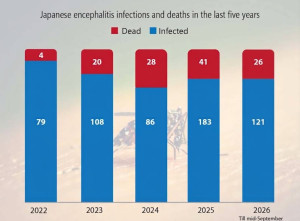
JE is killing more adults in Nepal as vaccination only covers children
Flood survivors face water shortages, disease risk in crowded holding centres
24 days after flood, hunger grips three Rasuwa wards
Four die in three weeks as scrub typhus spreads in Salyan
Seven die of scrub typhus in one month in Salyan
Editor's Picks

What triggered the Rasuwa flood? Scientists piece together a complex chain of events

The floods keep coming. Nepal keeps starting over

In a settlement destroyed by the Bhotekoshi flood, a disabled couple offer strangers the little they have

Nepal working on detailed assessment as Bhotekoshi flood reconstruction could cost up to $5 billion

Rabindra Dhant gave Nepal a reason to smile. Now his camp wants real action behind the praise
E-PAPER | September 29, 2026

×