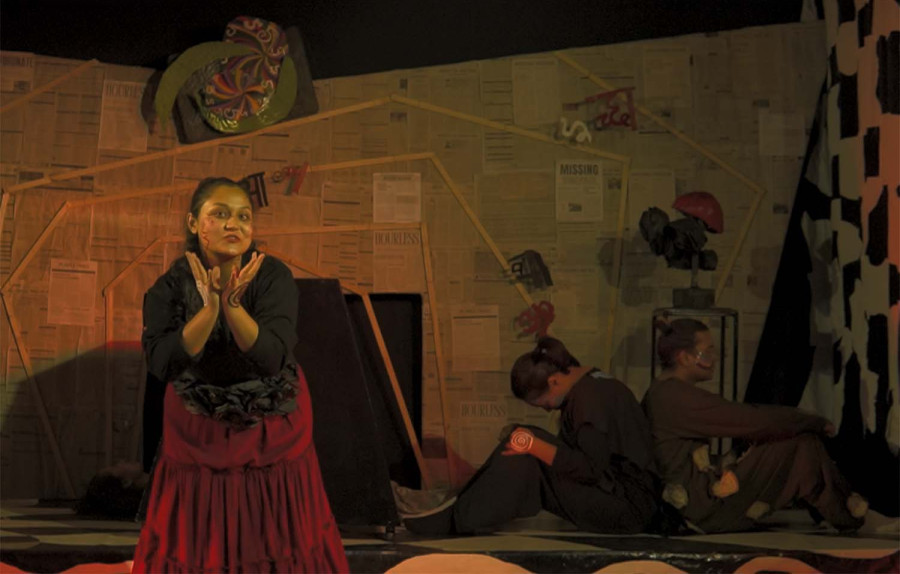
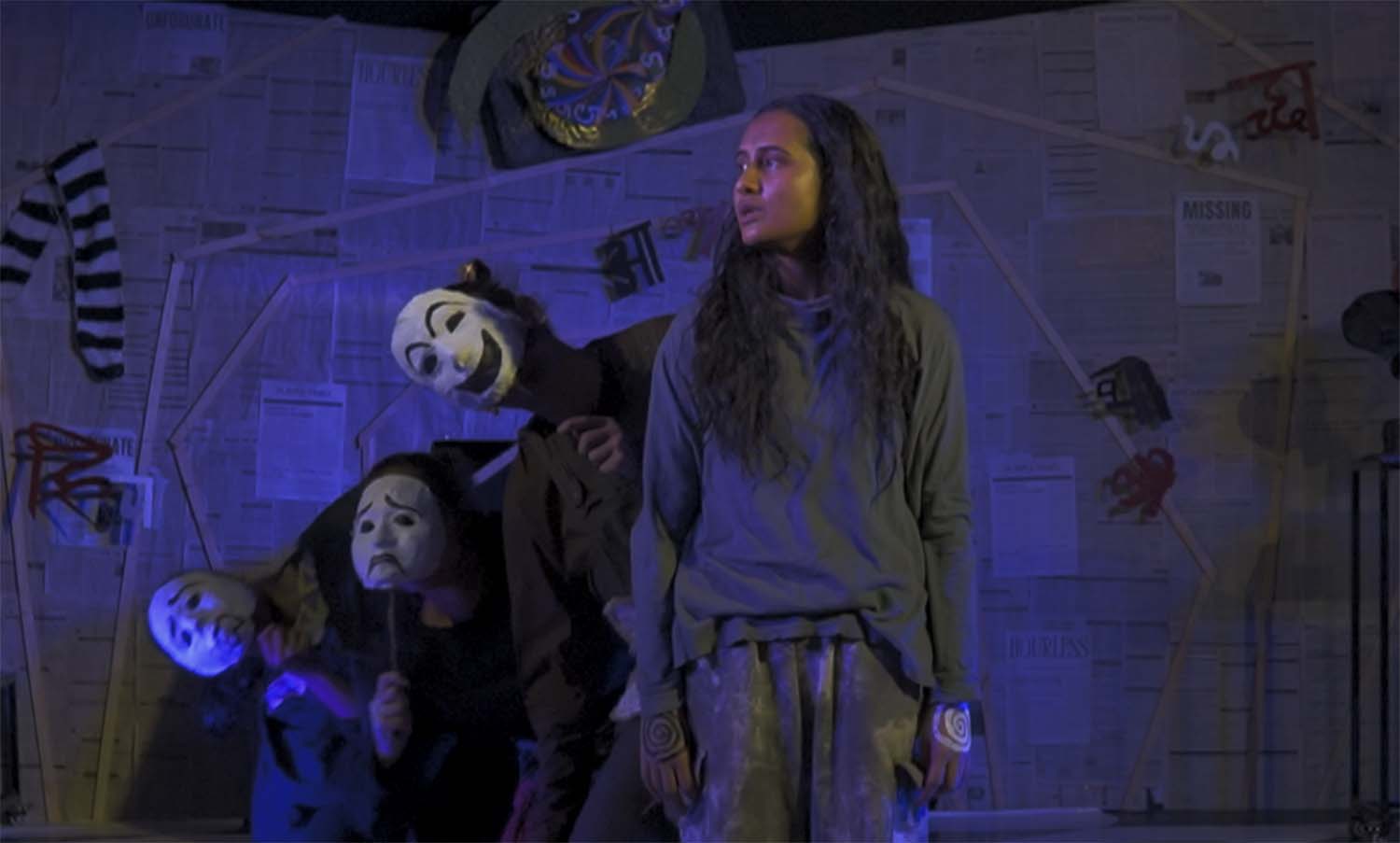
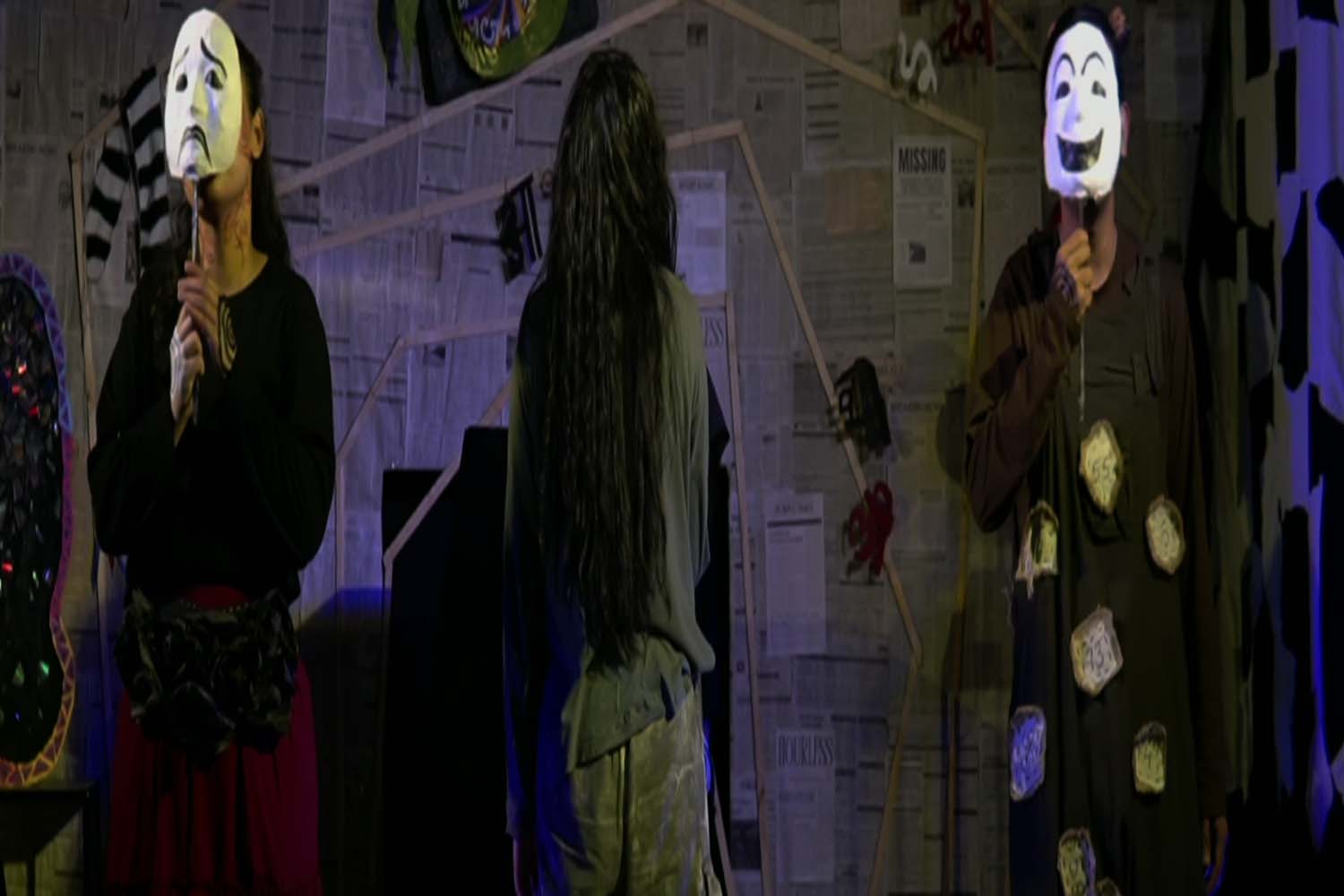
A student-led production at Thames International College explores mental distress and the fragile space between survival and identity. Characters Better (front), OK, and Fine during the play. Courtesy of Gobinda Prasad Dhakal
Yatana’s Chamber is unsettling. Monochrome is dismantled, rebuilt, and dismantled again. ‘Seto-Kalo’, a one-act play presented by the students of Thames International College, depicts Yatana’s distressed and uncertain state of mind, quietly underlined by a silver thread of hope.
Moving beyond the conventional and cultural approaches of Nepali theatre, ‘Seto-Kalo’ converges on the human psyche. An experiment that is deeply engrossing and invites viewers to reflect on themselves. “Navigating through mental distress where there are only the stark extremities of black and white and no grey,” describes Aagya Khanal, the director.
The stage itself projects Yatana’s mind, which is minimal, monochromatic, and suffocatingly enclosed in thoughts and emotions. Every prop feels like a fragment of her consciousness.
For Yatana, ‘Ok’ and ‘fine’ are the least appealing words. Personified, ‘Ok’ is a clock played by Suraj Gelal, and ‘Fine’ is a mirror covered with black fabric, played by Reshmi Maharjan. Fragility looms over each corner of this chamber, navigating the uncertainties of passing time.
Better, played by Ishani Thapa, enters the stage with a propelling rebellion. A black-painted vase with a red rose. Through each dialogue, she strives to reclaim her authenticity, her own colours.
“When asked about how we are, we simply reply with ‘Ok’, ‘fine’ or ‘better’ regardless of what we feel. Their true meaning is lost,” says Ramal Shrestha, playwright of ‘Seto-Kalo’.
Musical performances amplify the play’s psychological essence.
“Yatana ko sikar”, these characters call themselves—a torment’s prey. They are entrapped in the chamber, conditioned to the darkness to the extent that they gradually find peace in it. Yatana defines their existence. Time is interchanged—her days start at 5:55 pm. The mirror, which is bound to reflect silhouettes, is covered. Colours are overlaid with monochrome, white is black and black is white.
Human beings are not merely dots. They carry an enormous baggage of the past, which dictates their existence and decisions in the present. Yatana’s restrictive authority was the tip of an iceberg. To understand her extremities, the audience is gradually introduced to her childhood.
Icchya was a child, weighed down by a haunting trauma. Avoidant parenting leads to her distorted self-image, fragile self-esteem, degraded emotional regulation, perception and memories, leaving a scar that continues to shape her present. Repressed emotions compel her to encounter hallucinations and disorganised thinking.
“Through Ichya, I wanted to portray the consequences of abandonment—the absence of parental support and emotional guidance on a child,” says Shrestha.
Knots of Oon (Yarn) played by Samyami Chaudhary in Yatana’s chamber, wait to be untied. Bagman, played by Elixir, unpacks Yatana’s baggage of the past. The unresolved emotions were lost in her childhood. While unfolding the memories, he says:
“Ichya nai yatana ho, yatana nai ichya ho.”
Desire is a torment, and torment is the desire.
Shrestha, himself a fourth-year psychology student, was particularly drawn to the story. Having Schizophrenia as the central ideation for the play, he analysed the personal and social lives of schizophrenic patients, visiting them and interacting with them.
Rahasya, also played by Elixir, appears in Yatana’s life as an uncomfortable force—‘a figure who remembers what she forgets and gently anchors her’. Shrestha also draws parallels between Rahasya and patriarchy—forceful, manipulative and intrusive.
Props and costume design, remain central to Yatana’s chamber, marking a provocative visual narrative.
A schizophrenic mind experiences impairments in motion perception and visual processing, like in the continuous movements on a zebra crossing. Encountering Rahasya adds to her discomfort. The moment briefly blurs the boundary between reality and perception, evoking the visual disorientation often experienced during schizophrenic episodes.
Writing about mental distress demands deep emotional regulation and confrontation of vulnerability. “I could feel my restless breath while developing the character background, Yatana,” shares Shrestha. And embodying it through acting requires a deeper encounter with the character’s mental processes, keeping aside one’s own. Dahal’s performance shifting from vulnerability to sudden emotional turbulence lingers even beyond the walls of the auditorium—a commendable aftermath.
The characters’ movements anchored stories in each progression. Within Yatana’s chamber, the audience, with unusual silence in between the scenes, interacted with the play as though they were witnessing a part of themselves being displayed.
Characters hum the rhythms and songs of the dialogue, with the lyrics amplifying the play’s psychosocial essence. Props and costume design, too, remain central to Yatana’s chamber, marking a provocative visual narrative. Lights, however, could follow a distinct pattern, keeping the characters in focus and visually displaying their emotional intensity through spotlights. Regardless, Nushahang Tumbahangphe maximised the utility of the available resources.
With Nepali theatres circling the religious, political and cultural narrations, ‘Seto-Kalo’ moves beyond these circumferences. It traces remnants of hope inside a disturbed mind. “Through the play, we are trying to bring the conversations of mental health to the Nepali theatre landscape,” says Shrestha.
____________________
Seto-Kalo
Director: Aagya Khanal
Playwright: Raman Shrestha
When: Until April 4
Where: Thames International College (Auditorium), Old Baneshwar




 16.76°C Kathmandu