Ramesh asked his wife Pramila to vote. On election day, he died in Kuwait
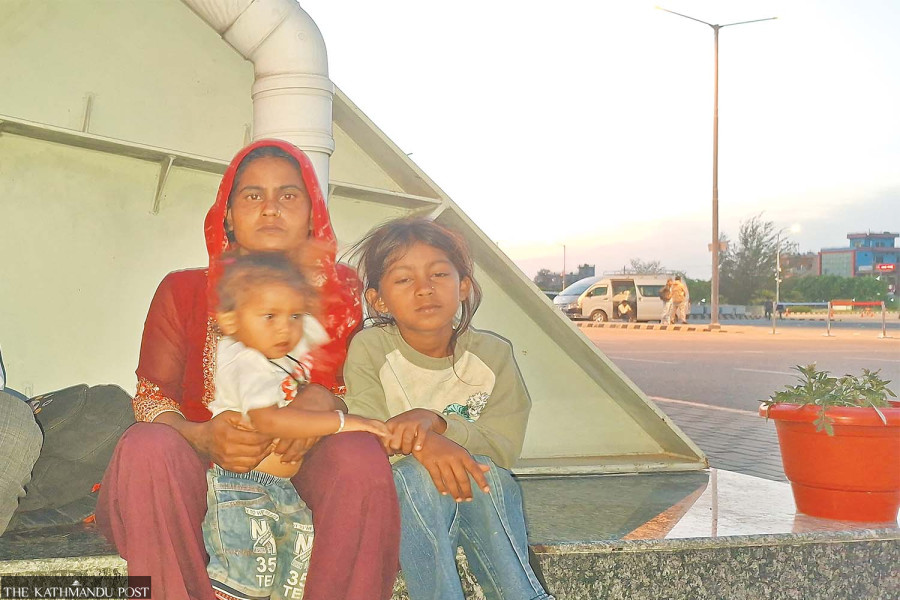
Family is devastated after a migrant worker returns home in a casket.Pramila Kumari Ram with her children at Bhairahawa Airport on Wednesday. Post photo
As evening fell at the Gautam Buddha International Airport on Wednesday, Pramila Kumari Ram from Siraha waited anxiously outside the arrival gate. For most, an aircraft landing represents a reunion or the start of a journey, but for Pramila, it was the grim end of a dream turned nightmare.
Pramila had travelled from ward 1 of Sukhipur Municipality with her father-in-law, maternal uncle and two young children to collect the body of her husband, Ramesh Kumar Ram (Mochi). Ramesh, who had migrated to Kuwait 21 months ago to secure a better future for his family, returned home—not with the gifts he had promised, but in a wooden casket.
“He (Ramesh) called me on the night of March 4. He was on a train returning from his shift to his quarters. He joked with our youngest son and asked about everyone’s health,” recalled Pramila, with a steady steady voice despite the exhaustion of a 12-hour bus journey. “His last words to me were, ‘Go and cast your vote [in the parliamentary elections] properly tomorrow (March 5).’ I did exactly as he asked. I went to the polling station in the morning. By 4:00pm that same day, I got the news that he was dead.”
Ramesh was one of nine Nepalis whose bodies were flown into Bhairahawa on a chartered Kuwait Airways flight. The group included migrant workers who had died of various causes, ranging from heart attacks to workplace accidents. The flight also carried several Nepalis who had been deported or left stranded in Kuwait.
According to Ramesh’s father, Rambabu, the death was sudden. “He never mentioned any illness. His friends told us that after returning from duty, he complained of severe chest pain. They rushed him to the hospital, but he died during treatment,” said Rambabu. “He was our only hope. We have no land, only our small house. Now, the pillar of our family is gone.”
The arrival of the bodies at the Bhairahawa-based international airport is a stark reminder of the recurring tragedy in Nepal’s labour migration sector. Many migrant Nepali workers return home in coffins every year.
Many families like that of Pramila were waiting anxiously at the airport. The bereaved relatives were increasingly worried about the logistical hurdles when international flights were diverted or delayed. On Wednesday, the flight, originally scheduled for an afternoon landing, did not touch down until 7:30 pm, leaving grieving families in a state of heightened anxiety.
“When is the plane coming? Where are the officials?” Pramila asked every passerby, clutching her one-year-old son, who played with a water bottle and kept calling out for “Baba” — his deceased father.
The Foreign Employment Board (FEB) facilitated the repatriation. Kamal Acharya, section officer at the board’s secretariat, confirmed that his office would handle the transport of all nine bodies to their respective home districts.
“As Ramesh had a valid labour permit, his family is eligible for Rs1 million from the Migrant Workers’ Welfare Fund. Additionally, his children will receive an annual educational stipend of Rs15,000 each until they turn 16. His family will also receive Rs1.4 million from the [Nepal-based] Reliable Life Insurance Company after tax deductions from Rs1.5 million term policy,” said Acharya.
Among the other deceased was Khushiram Chaudhary from ward 2 of Duduwa Rural Municipality in Dang. His nephews arrived to collect his body. Khushiram died on March 14, but his wife and children remain stuck in Kuwait. “They couldn’t get tickets to accompany the body,” said one nephew. “They are devastated and hope to return in the coming days.” According to him, Khusiram died of a heart attack.
The other deceased identified by the board included Samjhana Gole of Sindhupalchok, Basanta Rai of Khotang, Kopila Dhami of Udayapur, Yamuna Sunar of Surkhet, Krishnaraj Budha of Salyan, Ramesh Nepali of Tanahun, and Manju Moktan Pakhrin of Sindhuli.
The government has been often criticised for the slow disbursement of compensation and the lack of mandatory health screenings for workers before departure. For Pramila, however, the policy debates are secondary to her immediate reality.
“The embassy called to say the body was coming, and the board told us to meet them here at the airport,” she said, looking at her seven-year-old daughter. “The responsibility of the entire family is now on my shoulders. I honestly don’t know how I will carry it.”




 18.95°C Kathmandu