First lower house meeting begins with argy-bargy between ruling and opposition parties
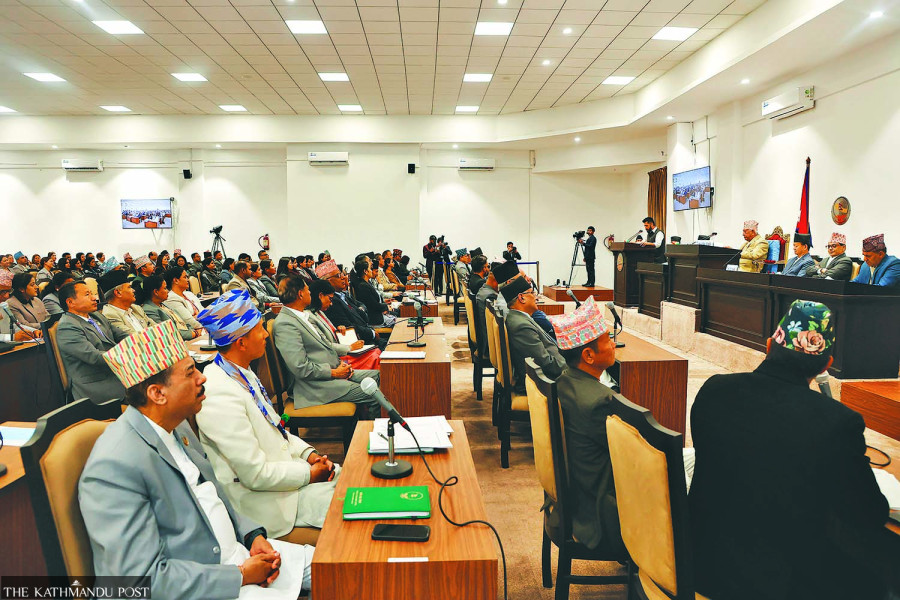
As RSP chair Lamichhane criticises previous governments, opposition says it’s disingenuous to show them in poor light.Rastriya Swatantra Party chair Rabi Lamichhane (in far corner) speaks at the House of Representatives meeting in Singha Durbar, Kathmandu, on Thursday. Hemanta Shrestha/TKP
The first session of the newly elected House of Representatives commenced on Thursday with an exchange of blames and statements between the ruling and opposition parties.
Even before the House entered regular proceedings, CPN-UML lawmakers stood in protest to register their reservations over the arrest of party chair KP Sharma Oli, and Nepali Congress leader Ramesh Lekhak. The incumbent government on Saturday arrested them for alleged negligence and recklessness that led to the deaths of dozens during the September Gen Z movement.
Following the UML’s reservations, a cross-party meeting of top leadersaddressed the opening meeting of the session.
In his address, Rastriya Swatantra Party chair Rabi Lamichhane lashed out at traditional parties, claiming that their governments had failed to bring change due to lack of transparency and accountability. He said, unlike its predecessors, the RSP government would refrain from wrongful practices such as amending laws or issuing ordinances to protect allies and implicate opponents. “There would be no discrimination based on political beliefs,” he said.
He also urged opposition parties to monitor them round-the-clock and correct them if they stray from the right path.
“The momentum of good governance will not stop,” he said. Answering claims of UML leaders that the arrests of Oli and Lekhak were political vendetta, he said, “The right to justice belongs to martyrs and their families, and it cannot be labelled as revenge.”
He also demanded that the officials appointed on political recommendations by the erstwhile government voluntarily step down.
Reassuring the private sector, Lamichhane said the business environment, ridden by middlemen and mafias, would now improve. “Government policies will no longer be drafted on anybody’s influence, and decisions will not be made under anyone’s pressure,” he said. “The government will ensure equal opportunities, transparency, and business freedom.”
During his address, Lamichhane also apologised to the Dalit community on behalf of the entire House and the government for centuries of discrimination and oppression. Calling untouchability not only a social mistake but an “organised crime,” he said no Nepali should have to feel inferior because of their caste.
Countering Lamichhane, opposition leaders said wrong narratives were being woven that nothing had happened over all these years while they were in power.
Addressing the House, Nepali Congress leader Bhishmaraj Aangdembe said roads in villages, widespread availability of electricity and drinking water, building of health posts, the expansion of banks and financial institutions, and communication services now in people’s hands—they were all the results of the policies pursued by previous governments.
While acknowledging that progress had fallen short of public expectations due to weakness in governance, he argued that the narrative claiming nothing had been achieved was not true.
Referring to the Parliament building and Singha Durbar that were gutted during the Gen Z uprising, he expressed serious doubts about the investigation into the incident. He contended that the probe commission had investigated only the events of September 8 while ignoring the incidents from the next day.
Most critical—and mocking—of the government was UML parliamentary party leader Ram Bahadur Thapa. Speaking about the RSP’s victory, he said institutions such as the Nepali Army, the Barbara Foundation, and others had played ‘decisive roles’ in the win.
“On September 8 and 9, a ‘colour revolution’ was successfully carried out under the undeclared leadership of the RSP. The ‘blue revolution’ was legitimised by the general elections,” he said. “In this unprecedented victory, facts show that several actors played decisive roles internally—primarily the Nepali Army, the bureaucracy, the Sushila [Karki] government, the Karki Commission, the Barbara Foundation NGO, and other institutions and figures. Therefore, I would also like to extend many congratulations to these institutions and individuals on behalf of the UML.”
The first meeting of the House unanimously endorsed a proposal to conduct its business under the House of Representatives Regulations, 2022, until a new set of rules is adopted, in line with Article 104 of the Constitution. It also nominated lawmakers Aaren Rai, Ganga Chhantyal, Tariq Ali Bhat, Basana Thapa, Bishwaraj Pokharel, Yagya Bahadur Bogati, and Balawati Sharma to chair meetings in the Speaker’s absence.
In the 275-member House of Representatives, the RSP holds 182 seats. The Congress has 38 seats, UML 25, Nepali Communist Party 17, Shram Sanskriti Party seven, and Rastriya Prajatantra Party five seats. Mahabir Pun is the lone independent lawmaker in the House.
Binod Ghimire covers parliamentary affairs and human rights for The Kathmandu Post. Since joining the Post in 2010, he has reported primarily on social issues, focusing on education and transitional justice.




 22.06°C Kathmandu