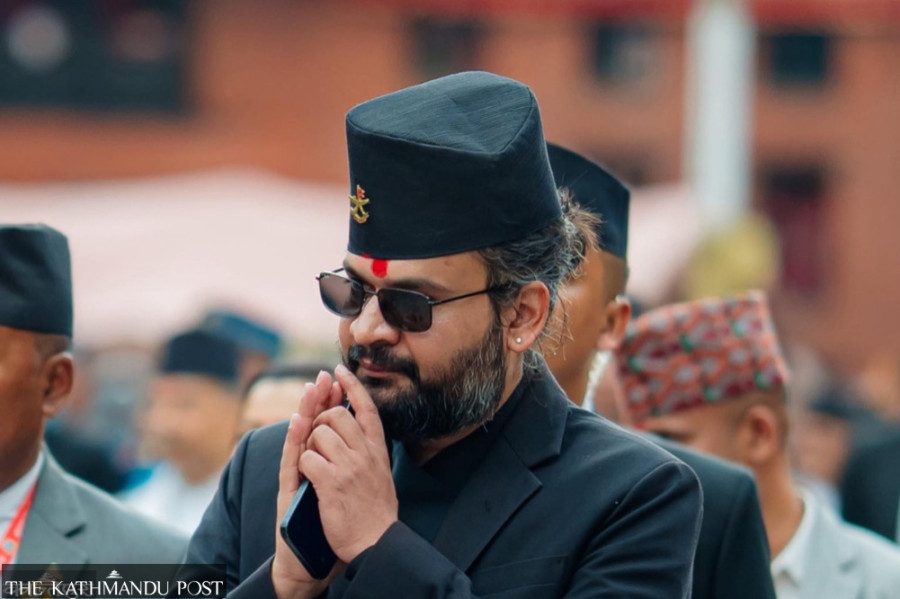
Soon after taking office last week, Prime Minister Balendra Shah made public a 100-point course of action, outlining the new government’s policies mostly for immediate implementation.
The House of Representatives elected from the March 5 vote also convened on Thursday, expediting the business of the new administration. Speaking in the House, RSP President Rabi Lamichhane said the new government would learn from the mistakes of past administrations and would focus on delivering on its campaign promises.
In this spirit, at least one provincial government, led by the traditional parties, has also tried to capture the sentiment of the federal government.
Yam Lal Kandel, the chief minister of Karnali Province who is a CPN-UML leader, on March 30 directed provincial ministers and secretaries to put an end to outdated working styles after the central government accelerated its reform agenda with a 100-point work plan released on March 28.
Speaking during a discussion held at the Office of the Chief Minister and Council of Ministers in Birendranagar, Kandel directed a focus on budget implementation, project selection criteria, and procedures. Kandel expressed dissatisfaction over delays and sluggish progress in budget execution. He also directed provincial ministers and secretaries to end outdated work practices.
“You need to find the answers to why the budget hasn’t been implemented effectively,” he said. “Your responsibility is not just to point out problems, but to solve them,” Kandel added. “Change the old style and learn to work in new ways; people expect results, and the work should reflect that.”
He noted that overall progress in spending has been weak so far and instructed the relevant ministries and agencies to make immediate improvements.
On the first day of his tenure, March 27, Prime Minister Shah held a brief meeting at the Office of the Prime Minister and Council of Ministers in Singha Durbar with ministers, the chief secretary, and secretaries. He stressed that the administrative machinery must work in line with the government’s policies and spirit.
Saying that the federal government would adopt a different working style, Prime Minister Shah asked the bureaucracy to embrace the change. In a similar vein, some provincial governments have also issued directives to their ministers and officials, much like those given by the federal government.
As Karnali Chief Minister Kandel pushes administrative reform in line with Prime Minister Shah’s plan, experts warn that without stronger cooperation between federal and provincial governments, meaningful progress will remain elusive.
Although a decade has passed since Nepal adopted federalism, previous central governments have failed to draft some of the key laws needed to strengthen the system. For instance, the bureaucracy that Prime Minister Shah and Chief Minister Kandel have directed to reform still operates largely under the federal government. Provincial governments have yet to gain real autonomy over the administrative machinery.
Experts warn that if both levels attempt to direct the same bureaucracy, it could create confusion and conflict.
Voters gave the RSP a near two-thirds majority in the lower house, believing its promises of good governance and efficient service delivery. The RSP, which secured 182 seats in a 275-strong assembly, has formed a single-party government led by Shah.
After much political instability in Janakpur, Madhesh Province has a seven-party ruling coalition led by Krishna Prasad Yadav of the Nepali Congress. The partners include the CPN-UML and the Madhesh-based parties. In the remaining six provinces, the governments are led by the Congress and the UML. The RSP, formed just ahead of the 2022 elections, did not take part in the provincial elections and has no stake in provincial assemblies and governments. Provincial elections are due next year.
While the federal government is led by RSP senior leader Shah, provincial governments are led by the traditional parties—the Congress and the UML—who have lost much of their strength in the federal parliament.
Analysts, therefore, believe that they may assert their influence through provincial governments, which could even mean resistance to the centre's reform agenda.
Political analyst Chandrakishore suggests that provincial leaders may prioritise their party agendas rather than fully supporting the federal government's initiatives. This political rivalry could weaken coordination.
“Since provinces still depend financially and for legislation on the federal government, when different political parties control the two layers of government, the reform agenda might be caught in a dispute,” Chandrakishore said.
He further adds that without strong institutional coordination and clear legal frameworks, reform efforts could deepen political and administrative tensions rather than improve governance.
Surendra Pandey, the chief minister of Gandaki Province who is a Congress leader, said the federal government has not formally reached out to the provincial governments.
It has just been a week since the formation of the central government, and “we expect that the prime minister will soon call a meeting with the chief ministers,” said Pandey.
There won’t be any issue for the provincial government to work with the central government should the cooperation be within the legal framework, Pandey told the Post.
After the election, traditional parties—often criticised for failing to deliver people-centred governance despite being in power several times—saw their strength shrink sharply after the recent election, leaving the RSP with the challenge of proving its promises through action.
Prime Minister Shah has also reached out to the Members of Parliament from all parties, holding discussions province-wise to learn about local issues. According to the Prime Minister’s Office, he has even created WhatsApp groups to establish a communication channel with MPs from each province following those discussions.
For analysts like Chandrakishore, the main hindrances will be an unclear division of authority, the absence of some important federal laws, weak coordination bodies, financial dependence of provinces on the federal government, and an incomplete administrative system under federalism.
Because of these issues, cooperation between the federal and provincial governments becomes difficult in practice, even though the constitution encourages them to work together.
The framework for cooperation between the federal and provincial governments in Nepal is mainly defined in the Constitution of Nepal, especially through Article 232. “The relations between the Federation, the States, and the local level shall be based on the principles of cooperation. co-existence and coordination,” reads the article.
Though the article of the constitution empowers all tiers of government, its Schedule 6 also maintains how powers are divided. This schedule gives provinces authority over issues such as provincial police and peace and security, provincial highways, and provincial civil service, among others. However, many of these powers still require federal framework laws, which have created implementation problems.
Concurrent powers of federal and provincial governments enshrined in Schedule 7 of the constitution are another contentious area. It mentions that both federal and provincial governments can pass legislation related to education, health services, the environment, electricity, forests, and natural resources, among others. But when both governments make laws on the same subject, federal law prevails if there is a conflict, which sometimes weakens provincial authority.
The government has yet to decide its way forward in coordination with the provinces, says Minister for Federal Affairs and General Administration Pratibha Rawal.
According to her, after the formation of the government in Kathmandu, she is currently reviewing the work being carried out in relation to local governments. Discussions regarding provincial governments will come afterwards.
“There is no disagreement that the provincial level needs to be strengthened,” Rawal told the Post. “Our ministry still has to work on determining how to move forward.”
For Khim Lal Devkota, an expert in federalism and local governance, the real problem lies not in the constitution but in the people within the government machinery who have delayed laws, such as those related to the civil service and school education, that are needed to fully implement federalism.
Some may view constitutional clauses as being against federalism but if the government is willing and the bureaucracy cooperates, these barriers can be overcome, Devkota stressed.




 14.81°C Kathmandu