School reconstruction nears completion a decade after 2015 earthquake
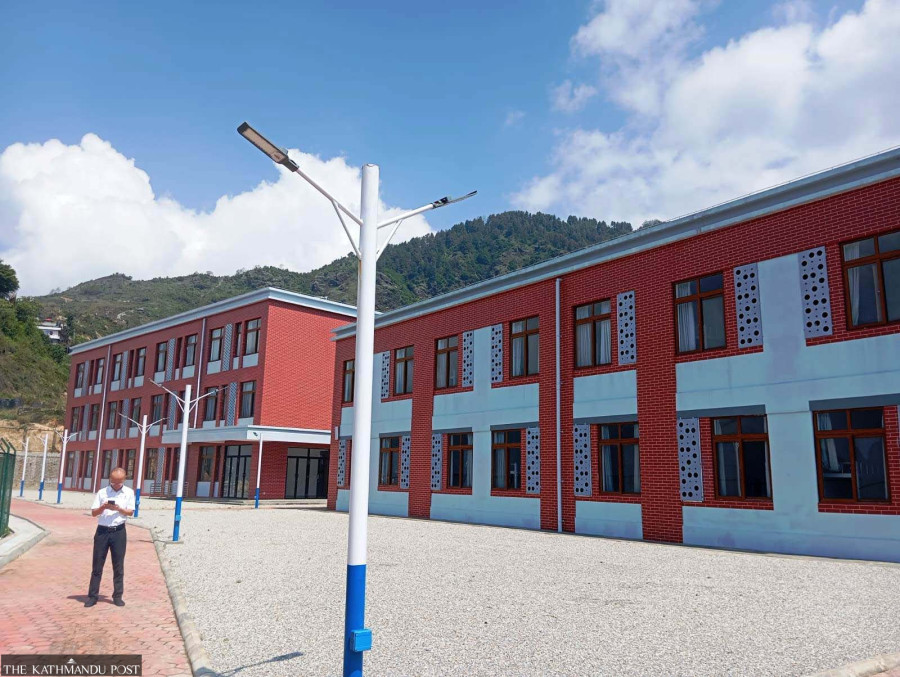
Modern facilities have replaced thousands of classrooms destroyed in Sindhupalchok, transforming learning conditions in some of Nepal’s most remote communities. Ugrachandi Secondary School now has 12 classrooms, a hostel, a canteen, a playground and boundary fencing, serving around 350 students. Anish Tiwari/TKP
A decade after the 2015 earthquake and its aftershocks devastated Sindhupalchok, the reconstruction of school infrastructure across the district is nearing completion. From remote Himalayan settlements to mid-hill villages, modern school buildings now stand where the disaster destroyed 3,620 classrooms in 528 schools.
According to the District Project Implementation Unit (Education), reconstruction has been completed in almost all schools, with only a handful of projects yet to be finished.
Baikuntha Subedi, chief of the unit, said around 200 schools were rebuilt with support from donor agencies and non-governmental organisations, while the government funded the rest. Most major reconstruction works were completed between 2018 and 2020, with additional classrooms and remaining structures now being built through provincial funding.
“Recently, two schools were rebuilt with Chinese assistance in Listikot of ward 1 of Bhotekoshi Rural Municipality and Budepa of ward 2 of Barhabise Municipality, near the Nepal-China border,” Subedi said. “Almost all other school buildings across the district have already been completed.”
The two schools, Ugrachandi Secondary School and Sunkoshi Secondary School, were rebuilt at a cost of approximately $6.95 million, or nearly Rs1 billion.
The project was implemented by China Railway First Group Company Limited. Liu Chao, the project manager, said construction began in December 2022 and was completed at the end of 2025.
“Despite the difficult terrain and adverse weather conditions, we completed the project on schedule,” Liu said.
Ugrachandi Secondary School now has 12 classrooms, a hostel, a canteen, a playground and boundary fencing, serving around 350 students. Sunkoshi Secondary School has 13 classrooms along with a hostel, canteen, playground and compound wall, and accommodates about 400 students.
Subedi said close coordination between reconstruction agencies and local governments helped speed up rebuilding efforts. However, 28 schools undergoing mergers were excluded from reconstruction plans.
Dorje Lama, a local community leader, said the new infrastructure is expected to improve access to education in high-altitude settlements.
“Students previously faced disruptions because of unsafe buildings and long travel distances,” Lama said. “The hostel facilities now make it much easier for children coming from far-flung areas.”
Several other schools have also been transformed. Ganesh Secondary School in Yamunadanda, ward 4 of Sunkoshi Rural Municipality, has gained a new building, while Thangpaldhap Secondary School in Panchpokhari Thangpal Rural Municipality received a modern facility built at a cost of Rs67 million. Bhimeshwari Secondary School in Bhimtar of Indrawati Rural Municipality has also recorded a significant increase in enrolment since moving into its new building.
Separately, the non-profit organisation Chhaya Nepal said it has completed the construction of 13 schools in Sindhupalchok, Gorkha, Rasuwa and Dolpa districts.
For thousands of students who spent years studying in temporary learning centres after the earthquake, education is now taking place in safe and modern classrooms.




 15.28°C Kathmandu