The Ministry of Infrastructure Development has recently introduced a draft bill that seeks to revamp road safety in Nepal through a regime of significantly escalated traffic fines. While the intention to curb the nation’s alarming rate of road fatalities—currently standing at 28 deaths per 100,000 people—is noble, the proposed penalties have sparked a national debate. With fines ranging from Rs500 for jaywalking to a staggering Rs100,000 for unauthorised vehicle modifications, the legislation represents a move from nominal deterrents to what some experts describe as prohibitive, and perhaps unrealistic, financial burdens.
The fundamental purpose of a traffic fine is to modify behaviour before a tragedy occurs. Proponents of the bill argue that the current flat-rate fines, often as low as Rs500, lack the psychological weight required to instil discipline in a chaotic transport environment. By introducing tiered penalties for speeding—where exceeding the limit by more than 60 percent triggers a maximum fine—and substantial penalties for driving under the influence (DUI) of up to Rs50,000, the state aims to align its enforcement with international standards, which prioritise absolute deterrence.
However, a law is only as effective as its feasibility. Critics point out the stark disconnect between the proposed fines and the economic reality of the average citizen. In a country where many earn between Rs25,000 and Rs30,000 per month, a single Rs50,000 fine for a speeding violation could be catastrophic. When a penalty exceeds the monthly salary of the driver or, in some cases, the total value of the motorcycle they are riding, the law becomes a catalyst for economic ruin. As witnessed in Bangladesh, the sudden imposition of extreme penalties can lead to public revolt, nationwide strikes, and eventual legislative backpedalling.
Furthermore, it is difficult to justify penalising a motorist for lane violations when they are frequently forced to swerve into adjacent lanes to avoid deep, unrepaired potholes. Lawmaker Gyanendra Shahi’s recent demand in the House of Representatives for ‘equitable accountability’ strikes at the heart of this issue. Shahi proposed that if the state expects citizens to pay heavy fines, the state itself must be held to account: Rs100,000 for potholes not fixed within 24 hours and Rs50,000 for non-functional streetlights. The state must provide the infrastructure—including clear signage, functioning traffic lights, and smooth road surfaces—before it can ethically levy life-altering fines for the failure to navigate them perfectly.
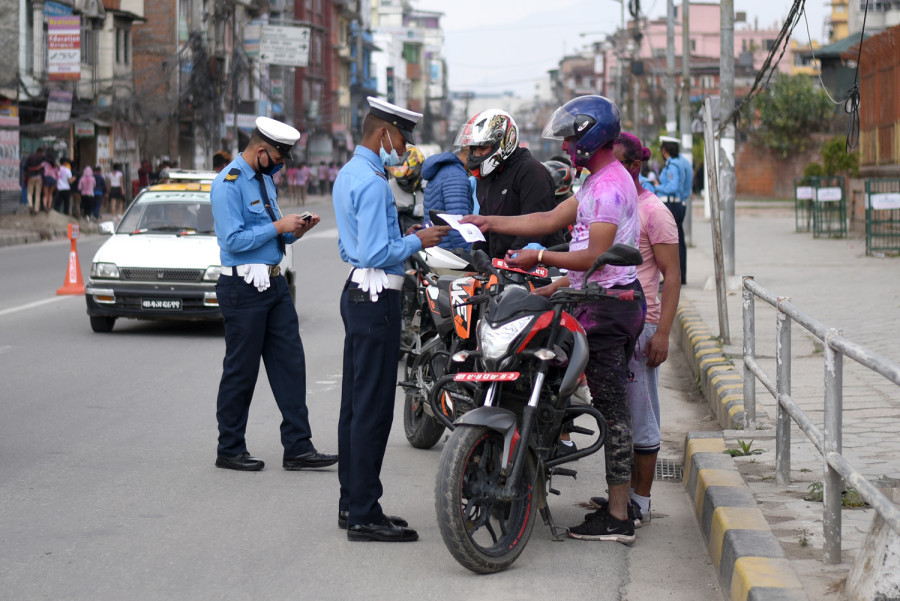
There is also the pressing concern of systemic integrity. Empowering traffic officials of Assistant Sub-Inspector (ASI) rank to impose massive fines on the spot may inadvertently fuel corruption. History in other developing nations, such as Kenya, suggests that when official fines are exorbitantly high, violators are more likely to offer a smaller bribe to an officer to escape a ruinous legal penalty. Without a robust, automated digital system to record violations and collect payments, these high fines risk becoming a tool for personal leverage rather than public safety.
To find a middle ground, the government might look to Nepal’s own successes and international best practices. The ‘MaPaSe’ campaign against drunk driving succeeded through ‘non-financial inconvenience’—confiscating licences and requiring mandatory attendance at safety lectures. Additionally, the European ‘day-fine’ system, where penalties are indexed to a person’s daily disposable income, offers a model of social equity. This ensures that a wealthy executive and a delivery driver feel the same relative sting for the same violation, preventing the law from becoming a ‘tax on the poor’ while allowing the rich to purchase the right to speed.
While stricter rules are necessary to save lives, they must be liveable and aligned with the nation’s infrastructure and economic capacity. A law that generates panic rather than discipline is unlikely to succeed. For the new transport bill to truly transform Nepal’s roads, it must move forward as a partnership between the state and the citizen—one where safer roads and fairer fines go hand in hand. Only then can the country achieve the road discipline it so desperately requires without sacrificing the principles of fairness and accountability.




 28.31°C Kathmandu