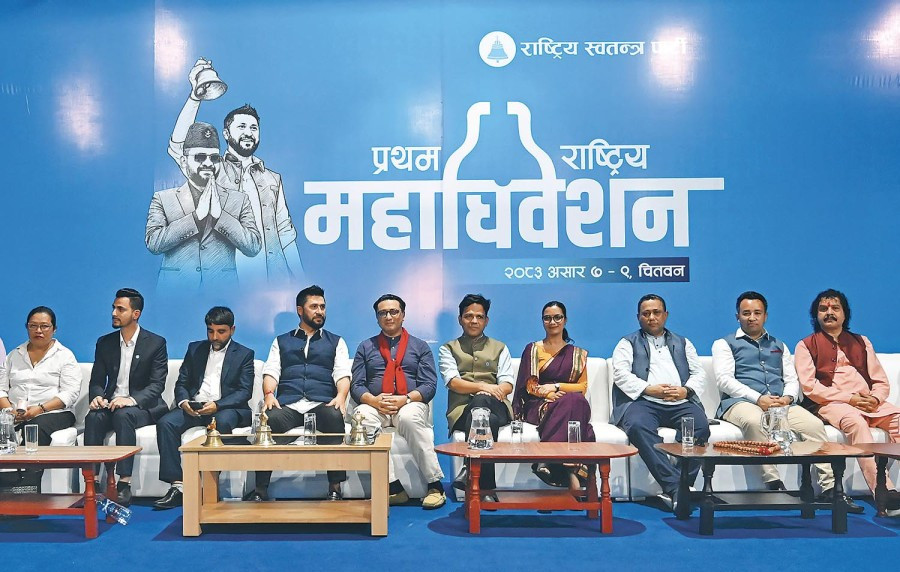
A revelation during the ruling Rastriya Swatantra Party’s (RSP) first general convention in Chitwan has ignited a necessary, albeit complex, debate on the boundaries of political mobilisation in Nepal. The disclosure that 35,257 individuals under the age of 18 are currently listed as party members is a matter that demands both rigorous legal scrutiny and a nuanced understanding of an evolving political landscape. While the opposition, led by the Nepali Congress, has been quick to demand a formal probe, it is essential to look beyond the immediate partisan friction to examine the systemic challenges of youth engagement in Nepali politics.
At the heart of the controversy is a clear legal boundary. Under Section 14 of the Political Parties Act 2017, the minimum age for party membership is set at 18 years, aligning with the age of voter eligibility. The Act Relating to Children, 2018 is explicit in its prohibition of using minors for political objectives, with Section 7(7) stating that children shall not be recruited for political purposes. On the surface, the presence of minors—comprising approximately 6.7 percent of the RSP’s 523,465 members—appears to be a breach of these statutes.
The RSP’s defence rests on a claim of ‘technical error’. The party asserts that many applicants mistakenly entered their birth years using the Gregorian (AD) calendar instead of the Bikram Sambat (BS) system prevalent in Nepal. This discrepancy reportedly distorted the automated data extraction used for the organisational report. While this explanation warrants verification, it highlights a unique irony: the RSP’s reliance on direct, online registration portals has created a transparent data footprint that traditional parties have historically avoided. This has inadvertently brought the issue of underage political alignment into the formal, traceable realm of party registries.
To view the RSP’s predicament in isolation would be to ignore the ‘shadow cadres’ that have long defined Nepali politics. Traditional parties have for decades utilised student wings to mobilise youth. These organisations routinely enlist 16- and 17-year-olds in higher secondary schools, grooming them as a politically socialised base before they reach the legal age for formal party membership. As these sister organisations operate via decentralised networks, their minor members remain off the books, shielding the parent parties from the very legal scrutiny the RSP now faces. The RSP, by campaigning against the politicisation of educational institutions and refusing to establish such intermediary student wings, has removed the traditional buffer that previously obscured the political participation of minors.
On one hand, the RSP has positioned itself as a modern alternative, advocating for the removal of political flags from schools and the dismantling of student unions. On the other hand, its digital-first approach has attracted a Gen Z demographic eager for political involvement. This has led to accusations of hypocrisy from opposition lawmakers, who question whether the party is sending conflicting signals by recruiting minors while simultaneously discouraging student politics in academic settings.
The Election Commission and the National Child Rights Council should indeed investigate the matter. However, this investigation should not merely be a punitive exercise against a single entity but a broader assessment of how all political parties interact with those under 18. If the RSP’s claim of a technical glitch is accurate, the immediate cancellation of minor memberships—as promised by the party leadership—should be a sufficient corrective measure, provided it is verified by an independent audit.
Ultimately, the right of children to be educated about democratic values and governance must be protected. However, this education must remain distinct from formal, legal enlistment in political parties. The current controversy serves as a reminder that as political structures evolve from analogue to digital, the transparency of the data will invariably expose the inconsistencies between long-standing political practices and the rule of law. It is incumbent upon all parties to ensure that their enthusiasm for recruitment does not supersede their obligation to uphold the constitutional protections afforded to the nation’s youth.




 14.4°C Kathmandu