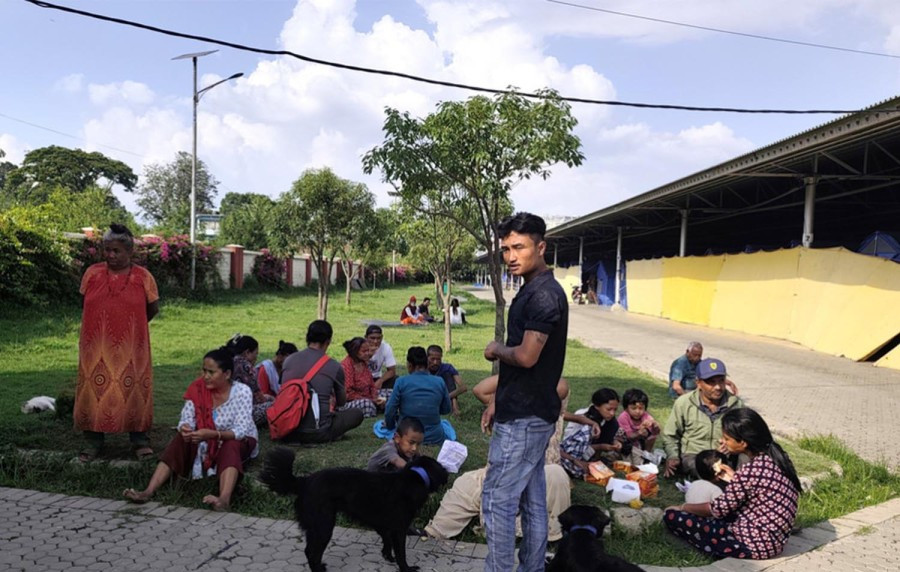
The plight of families who were evicted in April as part of the government’s drive to clear encroachments from public land and riverbanks across the Kathmandu Valley has only worsened with a deadline to vacate the holding centres in the Kathmandu, Bhaktapur and Kavrepalanchok districts. These were the places designated by the government for their temporary settlement. However, even two months after their homes were uprooted, authorities are yet to arrange a clear and credible path to permanent housing as promised. Now, those who have been staying in holding centres awaiting long-term solutions have been asked to vacate the centres. This method is just as flawed as the hasty, poorly planned eviction in April.
Authorities have announced a support package that includes a one-time relief payment of Rs25,000 and a monthly housing allowance of Rs15,000 for up to three months to those verified and found eligible as displaced informal settlers. This allowance may ease their financial pressure, but it doesn’t guarantee the permanence they seek, as it remains unclear what will happen to them after three months. For squatters who have repeatedly been uprooted—from their ancestral homes, to most recently from squatter settlements along the Bagmati, Bishnumati and Manohara riverbanks—the recent directive forces them to face renewed trauma.
Finding accommodation in an increasingly expensive rental market in Kathmandu Valley is a gruelling task. Families have reported that landlords are hostile to displaced families, making the task even more difficult due to widespread caste-based housing discrimination in the Valley. Even if they find a room to rent after weeks of search, it cannot accommodate a large family; renting flats is expensive. Many families living in holding centres have elderly people, those grappling with illness, newborns and postnatal mothers, adding to their difficulty of finding accommodation that meets their needs. The government assistance too is far from enough. With many settlers’ incomes gone, they have no other means to support a large family and children’s education.
Nepal has long struggled to address the problem of landlessness. Several governments have been formed and toppled in the past decades, but they haven’t delivered much beyond periodic evictions and temporary relief. The current administration had the opportunity to break that cycle. However, its haphazard and poorly planned eviction of squatters, lack of communication with displaced families about its plans and asking them to fend for themselves suggests that even this government, which was formed with a historic mandate, has not shown due regard for landless people and those of lesser means.
Officials claim that families have been asked to leave the holding centres to identify genuine landless families and resettle them within three months. But the question remains: Why did the officials adopt a wait-and-see approach over these two months, and why didn’t they communicate their plans effectively to the displaced families in that time? The government has repeatedly stated that it didn’t evict squatters to render them homeless but to secure their housing rights. Such commitments are essential, but citizens also have the right to know when they will be delivered. If the families are asked to leave temporary shelters only to face further homelessness or another cycle of displacement, the government’s image as the protector of the basic rights of all its people will come into question.




 14.4°C Kathmandu