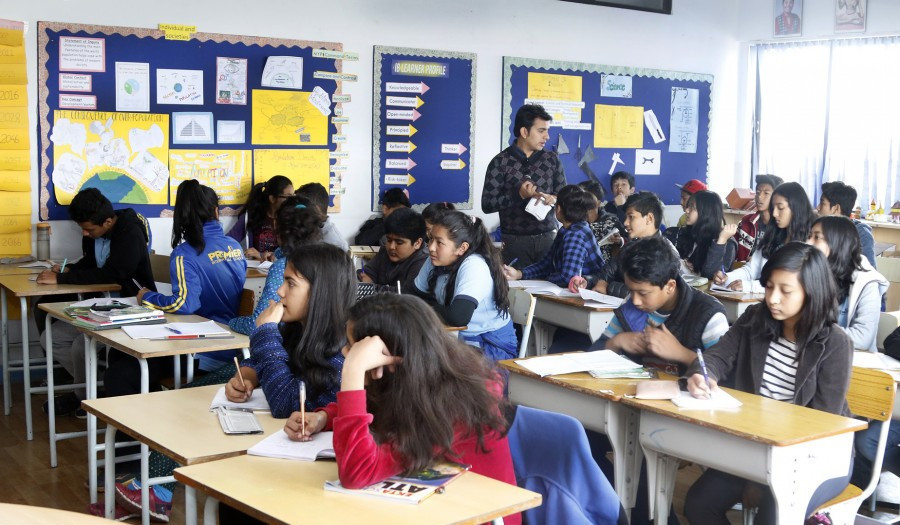
Two days before its presentation in Parliament, the government is giving final touches to the federal budget. The Balendra Shah administration, which has taken departures from several past practices, is expected to continue that approach in budget preparation. Education remains a key sector awaiting a big departure in budget allocation. Nepal in different global platforms has committed to allocating 20 percent of the national budget (or 5 percent of GDP) in education, but successive governments have failed to live up to the commitment. Over the years, the share of the education budget has been hovering around 10-11 percent of the national budget and less than 3 percent of the GDP, even as it’s the highest allocation among the ministries.
The education budget has been steadily declining since fiscal year 2011–12, when it first reached 17.1 percent of the national budget. In the current fiscal year, allocation stands at Rs 211.17 billion, accounting for 10.75 percent of the national budget, compared to 10.95 percent in the previous year. Overall, this reflects a decline of about seven percent since the peak allocation for the sector. UNESCO in a 2024 report highlighted the need for a paradigm shift to prioritise and increase investment in education, teaching and learning, and to ensure that educational resources are distributed more equitably in order to achieve the Sustainable Development Goals by 2030. The report also notes that 34 percent of countries including Nepal had met neither of the established benchmarks for education spending, which is allocating at least 4 to 6 percent of GDP and 15 to 20 percent of the total national budget to education.
Different studies suggest that nearly 90 percent of Nepal’s education budget goes toward salaries of teachers and staff, leaving behind limited resources for improving quality and learning outcomes. Some schools, for instance, receive as little as Rs 50,000 annually for laboratory equipment or library resources. The impact of this is evident in declining education quality. The National Assessment of Student Achievement conducted by the Education Review Office of the federal government indicates that overall student learning achievement is around 50 percent. Recent School Education Examination reports also highlight weak learning outcomes among students. Meanwhile, the Economic Survey for fiscal year 2025-26 reveals a worrying trend of student dropout. While multiple factors contribute to this, a key reason is lack of confidence in employability after completing education, which reflects deeper concerns over the quality of learning.
Improving education outcomes is not possible without investing heavily in education, research and academic institutions. This calls for the recruitment of competent, quality teachers, adequate equipment, digital tools, timely curriculum updates, and continuous training for teachers, along with other interventions the sector demands. The incumbent government is focusing on digitalisation in the education sector, and rightly so. These are vital interventions. However, the foundation can only be built through proper investment. Realistically, it may not be possible to allocate around 20 percent or so immediately; however, it is possible to gradually boost allocation, which will unmistakably signal the new government’s commitment to improving education outcomes. With its historic mandate, the Shah government has a unique opportunity to accomplish what its predecessors could not.




 14.4°C Kathmandu