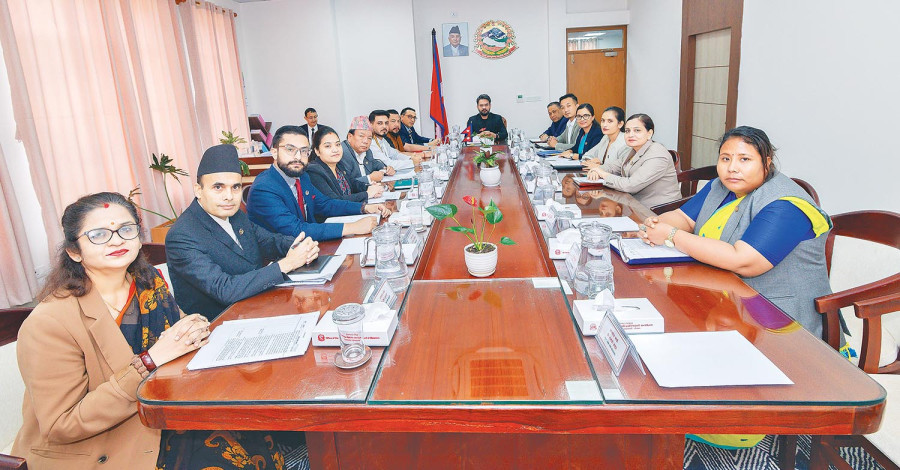
When the Rastriya Swatantra Party came to power in March with a near two-thirds majority, Nepal, for the first time, saw roughly 35 percent women in the House of Representatives. Following this, Prime Minister Balendra Shah appointed six women ministers to his 17-member Cabinet. Even as ministers from the Khas-Arya dominate the ministry leadership, those from the Madheshi, Janajati and Dalit communities are also represented. For a country that has long struggled to place women in top leadership positions, the government’s move was historic and commendable. It also instilled hope that it would prioritise inclusivity in all vital appointments.
But beyond the Cabinet, the government’s appointments to constitutional bodies, commissions, universities and cultural institutions are far from inclusive. Between March 27 and August 11, the Cabinet made more than 50 appointments, of which only four were women. Madheshis, Janajatis and Dalits were thinly represented; Muslims were entirely excluded. Similarly, there isn’t a single woman among the three appointments to the Election Commission; nor are there any people from the Madheshi community. This is a continuation of the disregard of inclusion by previous governments. Even in senior university appointments, the notion of inclusion has been flouted: The government recently appointed seven university vice-chancellors, but not a single woman made the list. Appointments to state-run cultural academies failed to reflect the country’s regional gap and ethnic diversity.
The government justifies the appointments as being based on merit and open competition. It is true that Nepal’s public institutions are in dire need of competent people and should be free from political patronage, but the Balendra Shah government must internalise the idea that excluding people from marginalised communities from vital positions entails exclusion of an array of diverse views, inviting criticisms that the state still views them as ‘incompetent’. These institutions cannot be run by a cluster of historically privileged groups, with a similar worldview.
The Constitution recognises inclusion as the fundamental principle of the state. Hence, it is also vital to ask: What does merit mean in a country where access to education, job opportunities and institutions has often sidelined women, Janajatis, Madheshis and Dalits? Centuries-old social hierarchies, such as the caste system, regional disparities and gender discrimination have resulted in structural inequality in Nepal. Underrepresented groups cannot remain marginalised because they lack sufficient representatives to work for their upliftment and representation. Nepal cannot afford to push them back further.
The current Cabinet is considered the youngest and most academically qualified in the country’s history. They have repeatedly promised not to repeat the political practices of old parties. Being transparent about recent appointments would be a good start, but that is not enough. What’s more vital is for them to understand that they should prioritise inclusion in key appointments not only to correct historical exclusion faced by marginalised communities and people from remote regions but also to ensure that those positions aren’t reserved for the privileged few. If they don’t correct their course, they will lose the confidence of the marginalised communities who also voted them to power. They must break the cycle of exclusion, just as they did in Parliament and the Cabinet.




 14.4°C Kathmandu