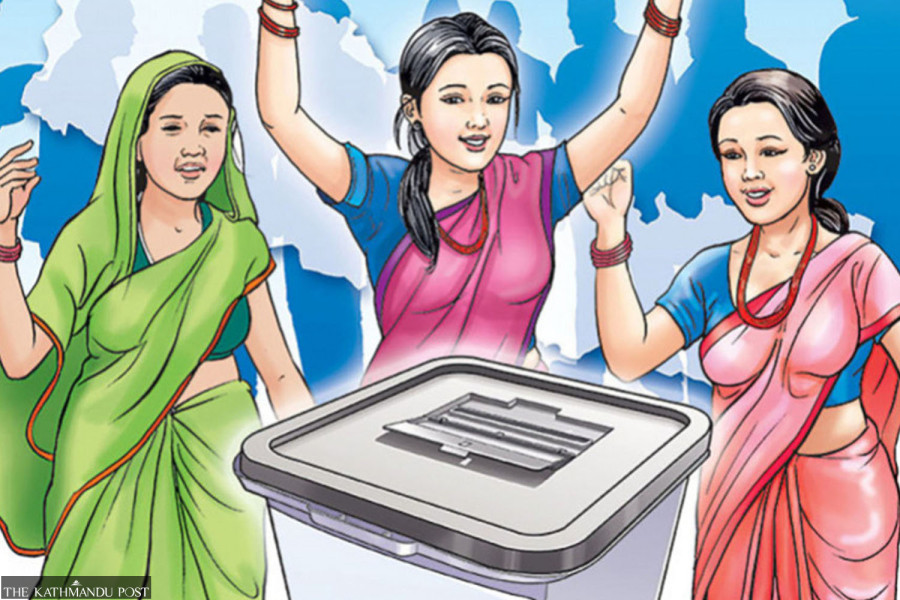
Yesterday, we praised the space even old parties like the Nepali Congress and the CPN-UML had created for younger candidates in the March 5 elections. But side-by-side they have also made a great blunder. Despite the constitutional spirit of inclusion and the Election Commission’s 33 percent directive for women’s representation, the political parties have once again slammed the door in the faces of women. The candidate lists for the First-Past-The-Post (FPTP) elections reveal a disheartening truth: In the eyes of the select few men who run the parties, direct elections largely remain a men-only club.
Out of 3,484 FPTP candidates nationwide, a paltry 395 (or just 11.34 percent) are women. The nomination list of the major parties is even more galling, with a meagre 235 (10.23 percent) women candidates from the total 2,257 nominations filed. The Congress (NC), albeit having recently undergone a generational power transfer, has fielded only 11 women (6.67 percent), up from five women candidates in 2022. The UML has seen its female representation plummet from 11 candidates in 2022 to just eight now (4.85 percent). Meanwhile, the Nepali Communist Party (NCP) follows suit with 10 women candidates (6 percent). Perhaps most shameful is the Rastriya Swatantra Party (RSP), which entered the political fray with a promise of ‘new’ politics and generational change. Its list of 17 women (10.3 percent) proves that it is essentially an old wine in a new bottle when it comes to gender-based inclusion.
There is a toxic narrative that the Proportional Representation (PR) seats in the parliament are an appropriate space for women, while the direct battlefield is reserved for men who can navigate the ‘rough and tumble’ constituency politics. The PR system, initially intended to ensure diversity, is now being weaponised to block women from direct seats, becoming a dumping ground for female leaders, allowing parties to meet their legal quotas on paper while keeping the real levers of power firmly in male hands.
This exclusion is fueled by a cocktail of patriarchal arrogance and financial gatekeeping. Parties argue that women lack ‘winnability’ or cannot manage the astronomical costs of direct campaigns. This narrative discourages women while they are also denied the support mechanisms, networks and political backing that their male counterparts generally enjoy. By refusing to field women in direct elections, parties are essentially saying they do not trust their own female leaders to win. This is a deliberate restriction of representation.
The Election Commission’s role also warrants scrutiny. Although it issued a directive for 33 percent female representation, it remains a toothless tiger in the absence of specific laws to make the directive legally binding. The absence of legal mechanisms emboldens the parties to ignore the directive with impunity. The commission should have the power to reject candidate lists that do not meet inclusive thresholds. Without enforcement, directives are no more than polite suggestions that the top male leaders are all too happy to bin.
Nepal’s claim of being a modern democracy will be in question when more than half of its population is treated as secondary in the electoral process. With the sidelining of women in direct elections, political parties are proving that their commitment to gender equality is nonexistent. The widespread capture of seats by male leaders is a disaster for democracy and a betrayal of the 2015 constitution. It is time for the parties to stop their window-dressing and start treating women as the political leaders they are. Until women are given an equal platform to contest elections, the parliament will remain a skewed reflection of Nepali society.




 14.4°C Kathmandu