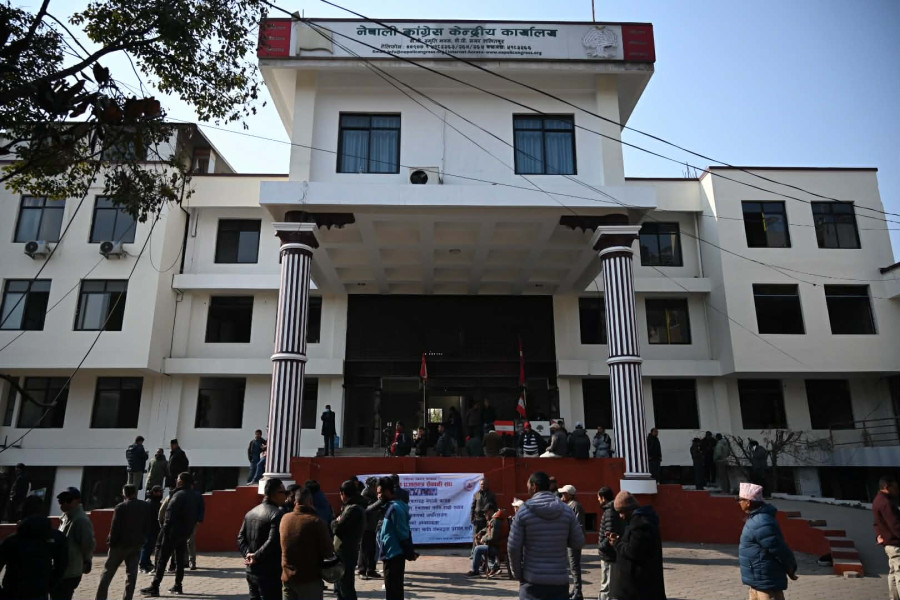
The Nepali Congress formally fractured on Wednesday, an inevitable consequence of the grand old party being treated as no more than a vehicle to fulfil one man’s political ambition. For a decade, Sher Bahadur Deuba steered the organisation with arbitrariness, where his personal greed for power and a stubborn refusal to heed the winds of change superseded democratic principles. By resisting the Gen Z movement’s urgent calls for reform, Deuba has effectively traded the party’s unity for the interests of his inner circle. This third split in the party’s history since 1950 is a damning indictment of a leader who, most recently, chose to sack his general secretaries without even the basic courtesy of a request for clarification.
While the Deuba faction clings to a majority of the (now dissolved) Central Working Committee (CWC) to justify its authority, it ignores a fundamental truth: The central committee is greater than an individual, while the convention is the highest law-making body of the party. The special general convention was summoned by 54 percent of the elected representatives— well above the 40 percent required by the party statute. The hard truth is that if the Congress were to stay a strong democratic force, it could not continue to be held hostage to a handful of ageing leaders.
The Election Commission is now tasked with determining which faction holds the legitimate right to the party’s name and tree symbol. In this, the commission must not hide behind a narrow, pedantic interpretation of the Political Parties Act. Legally, the legitimacy of a political party flows from the majority of the supreme body of the party, i.e., the general convention. Further, it must ensure that its decision is not delayed, as nominations for the first-past-the-post system are scheduled for January 19. Any hesitation will invite legal chaos and potentially derail the March 5 polls, a fiasco the country cannot ill afford.
Meanwhile, as Thapa takes over the mantle of leadership, he completes a journey from the firebrand rebel of the 1990 and 2006 movements to the presidency of Nepal’s oldest party. He has spent years in the roles of moderator and negotiator, but now it is his turn to lead, not just strike deals. To start with, whatever the priorities of the old Deuba faction, Thapa should target institutional reunification by trying to reach out to those in the dissenting faction and bringing them back to the party fold. The new central committee should not be another echo chamber of the party leader.
It is not a salubrious development for Nepali democracy for a party of the NC’s solid political legacy to split on election-eve. Again, the onus for this rests with Deuba who simply refused to accept the reality of post-Gen Z Nepal. Now, it is up to Thapa and his new team to ensure that the party stays true to its old ideal of democratic socialism and other core democratic values the party was founded on. Nepali politics continues to need a strong Nepali Congress, a historically moderate, left-of-centre democratic force. Good luck to Thapa and his reformist team in this endeavour.




 14.81°C Kathmandu