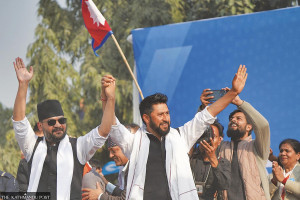
When orthopaedic surgeon Govinda KC began yet another fast on July 23, several words came to mind—an altruist, a stoic, a quixotic campaigner and a tragic idealist. Finally, I settled on ‘an absurd hero’ in the Sisyphean tradition: Someone who knows that goodness may not produce the desired result, yet chooses to be good because goodness, in itself, is worth doing. The similarity with Mahatma Gandhi is tempting at first glance, but neither was Gandhi purely a saint, nor is KC a sage.
Compared with KC’s 24 hunger strikes in about 14 years, Gandhi undertook 18 major political fasts, though his total over 34 years was around 32, many for objectives such as self-purification. The two men also used their fasts somewhat differently: Gandhi saw it as a form of moral and spiritual discipline as well as a political action, whereas KC focused on pressing specific public policy and governance reforms.
Gandhi was an adroit organiser, an outstanding communicator—over his lifetime, he wrote more and perhaps better than either Lenin or Mao—and an effective fundraiser. KC is a lone warrior, writes little, lacks rhetorical polish and uses his own funds for his campaigns. However, what binds them together is perhaps their unreasonableness: The willingness to go to any length to change reality to fit their ideals.
George Bernard Shaw’s oft-quoted aphorism has become a creed for innovators and reformers everywhere: “The reasonable man adapts himself to the world; the unreasonable one persists in trying to adapt the world to himself. Therefore, all progress depends on the unreasonable man.” It is a stirring line, flattering to those who refuse to compromise and comforting to those who imagine history as the work of exceptional individuals.
Yet the old saw mistakes a necessary condition for a sufficient one. Unreasonable people are abundant. Every age has produced its share of zealots, prophets, reformers, cranks, visionaries and dissidents. Most disappear without a trace: The sad fate of philanthropic physician Laxmi Narayan Jha immediately comes to mind. He was made to ‘forcibly disappear’ from his clinic in Janakpur by the Shah regime in June 1985. His whereabouts remain unknown to this day. Few remember him even in his hometown. Similarly, the radical unreason of Rupchandra Bista and his Thaha (comprehension) movement has largely faded from public consciousness.
Only a few unreasonable persons change the course of history or even achieve their specific goals of public service. The difference lies not only in the quality of their conviction but also in the world that receives it. History is less a parade of heroic individuals than an interaction between agency and circumstance.
Ideas succeed when institutions are ready to absorb them, when technologies make them feasible, when publics are willing to embrace them and when crises expose the inadequacies of the old order. An extraordinary individual may light the match, but the fire spreads only if the surrounding conditions are dry.
This is why the question is not whether progress needs unreasonable people—it often does—but why some acts of unreason become history while others become footnotes. The answer lies not in the hero alone, but in the ecology that makes heroism consequential.
Predatory state
Even after the Singha Durbar, the symbolic edifice of absolute control, was burned down in the Chartreuse Revolt, initiating a regime change, the hubristic practice of state dominion in Nepal remains entirely intact. Perhaps a predatory state is inherently an insecure state that lacks the patience and sagacity to respond to grievances as feedback to improve governance. Instead, the government views public voice—howsoever raised—as a challenge to its power.
Forms have changed, but the fundamental character of the ruling elite has remained more or less the same—petty potentates ensconced in their climate-controlled offices still believe they know what is best for everyone else residing in places as far apart as Mustang and Mahottari.
When the state is structurally deaf to dissent because its survival depends on patronage, extraction and the protection of entrenched elites rather than public accountability, even peaceful protests are treated as a nuisance, if not a security threat.
Even though the post-Chartreuse regime is full of supporters and sympathisers of earlier hunger strikes of KC, very few of his consistent demands or agreements with previous governments have been effectively operationalised. However, it will be unjust to blame any particular minister for the lapse. In the political economy of the free market, the quality of education or health is a function of cost; price is set by the supply and demand matrix, circumvention of rules is common, and oversight is often ineffective.
There is a reason for-profit medical or engineering colleges find it difficult to match the standards of the Institute of Medicine or the Institute of Engineering—institutions set up by the government do not have to worry about recovering the cost of land, buildings and other infrastructure, and have benefited immensely from scholarships awarded to their professors in the past. However, the risk that for-profit colleges will pull them down to their level remains high. KC has correctly identified the symptom and is right in raising the demand for their treatment, but the diseases go much deeper.
Apathetic society
The state of Nepal is what it is, but it’s the indifference of the comfortable class in Kathmandu to the shared grievances of the many that makes one wonder if KC is the right man born in the wrong country. KC is an exceptional professional, but a simple person. It requires a team of political scientists, economists and sociologists to frame his demands in terms of more fundamental issues of governance, such as the right to health and education, and the control of corruption in policy and practice. Sadly, he has failed to inspire any other professional body despite his struggles over a decade.
Francis Fukuyama postulated that while China had a strong state and a weak society, India had a weak state and a strong society. Like all generalisations, such a formulation has its weaknesses: Despite its imperial history and communist regime, the reach of Beijing isn’t evenly distributed throughout its large landmass. Even though Brahminism, rather than the Constitution, rules the roost in India, federalism has strengthened the effectiveness of the State in the states of peninsular India. Sandwiched between two global giants with their peculiarities, Nepal has remained a flailing state in terms of capacity and a fragmental society lacking national cohesion largely due to Khas-Arya hegemony over both.
When KC begins a fast in Kailali, there is little or no resonance in Kapilvastu, or when he announces a hunger strike in Kathmandu, few—if any—rise in solidarity in Kaski. The State can’t break his will, but society wouldn’t let it succeed over the apathy of those on whose behalf he is repeatedly risking his life.
It is easy to dismiss him as an unreasonable man obsessed with the need to check the excesses of globally triumphant market forces. But sometimes, the very sight of a lamp challenging the storm, fully aware that it will be extinguished, is morally uplifting.




 20.85°C Kathmandu
.png&w=900&height=601)