



 14.37°C Kathmandu


Fri, Oct 30, 2026
Columns
Preaching sustainability, practising overconsumption
With Teej and Dashain past us and Tihar around the corner, we mindlessly buy either to justify sales and offers or to never rewear an outfit.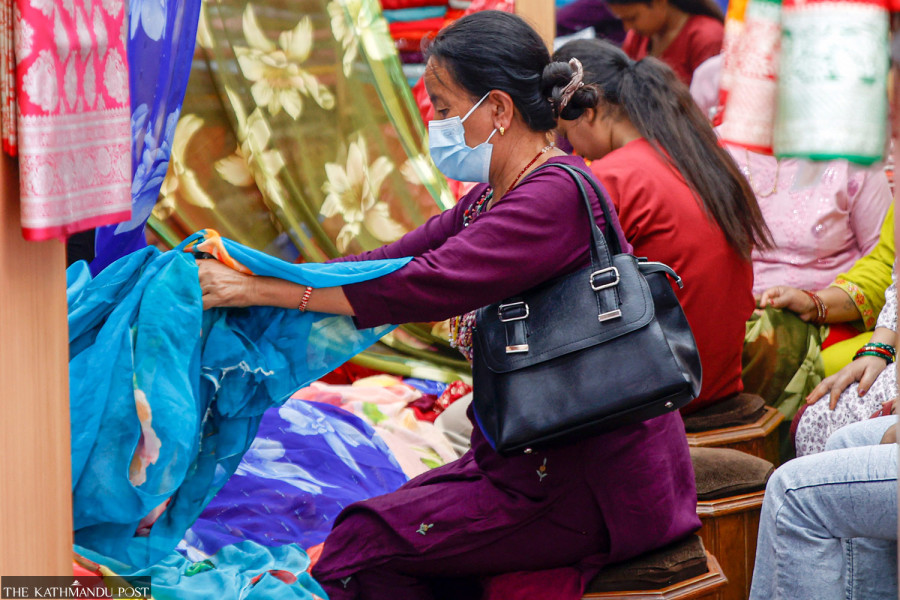
bookmark
Ishanvi Acharya
Published at : October 29, 2026
Updated at : October 30, 2026 07:27
Five blazers drooping off shoulders, 15 handbags crowding elbows, seven stacked sunglasses, 30 layers of lipstick, and five sandals gripping each foot. This is what the world would look like if people wore everything they owned.
Talking about sustainability is not only about making industries and projects sustainable; it is also about doing the same with our choices. To make sustainable choices is to avoid long-term depletion of natural resources. And to amend our choices, we must start analysing and tracking a pattern as to why, how and at what times we make such choices.
Why do we choose fast fashion? Today, our actions and needs are somehow dependent on what we see on the internet, especially on social media. We scroll, we see, we want, we buy. Engaging with products of one category alters our algorithm in a way that it continues to recommend and expose us to more of it. Repeated buying rewards us with something called dopamine release.
In the cycle of consumerism, we first experience ‘immediate gratification’. This arises when the action of ‘buying’ triggers a surge of dopamine. We anticipate it throughout the shopping process, from the shipping window to delivery. But our dopamine crashes once we receive the purchase, leaving us feeling empty. To recreate that same excitement and thrill, we fall into the same compulsive loop of having to buy again. This pattern leads to clutter and overspending, which is overconsumption.
To attract consumers, sellers increasingly gamify shopping by adding game-like elements, such as points and rewards, to boost engagement. Brands use loyalty schemes, offers and badges to keep consumers buying. In Nepal, methods include ‘Spin and Win’, ‘Scratch and Win’ and streak challenges, such as spending over Rs3,000 for free delivery or lucky-draw entry. Consumers keep chasing these purchases for dopamine spikes and the positive anticipation they bring.
But purchases must be backed up by an ability to spend. In Nepal, that ability is boosted by seasonal bonuses. These bonuses arrive during festivals. Higher disposable income emotionally primes individuals to buy goods and services for themselves and their families. Brands then use offers and discounts in the form of ‘Buy One Get One (BOGO)’, ‘Buy Three for the Price of Two’, ‘Threshold Discounts’ and freebies to easily hook consumers. Because festivals start and finish within a span of a handful of weeks, sellers rush to put up sales and buyers rush to justify and exhaust them. ‘Dashain Dhamaka’, ‘Dashain Deals’, ‘Mega Dashain Sale’, ‘Dashain Hungama’ and ‘Bada Dashain ko Bada Offer’ are some examples of generic taglines that brands use during Dashain to create urgency and attract consumers. The same pattern can be seen during Tihar: ‘Tihar Super Saver’, ‘Deepawali Bumper Sale’, ‘Bhai Tika Bazaar’ and ‘Laxmi Puja Special’.
Hence, treating shopping as therapy, also known as ‘retail therapy’, is the first reason why Nepalis overconsume. The Nepal Rastra Bank Report 2020/21 states that each household spends more than 35 percent of its income during festivals to purchase garments and household items. According to the Revenue Department Report, Nepal generally has an average import rate of 5.5 percent from January to August. But it rises to 13.9 percent during the festive months. There is an evident spike in expenditure during the festive season. If people normally continue buying to satisfy the need for dopamine release, why would they miss out on opportunities when prices are lowered?
This pattern among Nepali consumers drives overconsumption. Critics argue that the season mobilises money and boosts the economy, overlooking its consequences. Buying would be harmless if people used items to their full potential before upcycling or disposing of them responsibly. In reality, sellers sell, buyers buy, sellers sell, buyers buy and so on, resulting in hoarding or dumping. Hoarding consumes space; dumping depletes it. Nepal faces a growing fast-fashion and textile-waste crisis, with discarded clothing accumulating in local landfills and clogging rivers.
The second reason why we overconsume in terms of fashion is that we refuse to show up at places wearing the same cloth, same shade of lipstick, same watch, same shoes and so on, that we already wore once.
People face ‘permanence anxiety’, which leads them to not repeat, not rewear. Especially with our photos up online, individuals are anxious that their appearance has become a public record anyone can view at any time. When our visibility is accessible 24/7, repeating the same outfit might feel like keeping ourselves socially exposed and in the ‘spotlight’. While we cannot deny that our existence can be viewed at any time, we must also remember that not everybody is there to notice and remember what we did.
However, overconsumption is not only driven by how ‘others perceive us’ but also by how ‘we compare ourselves’. Individuals tie ‘their’ status and success to the status and success of ‘others’. ‘Sartorial variety’ is the diversification of your wardrobe; moving beyond basic items of fashion. Nepalis who generally wear T-shirts, jeans, hoodies or plain kurtas at other times of the year might feel the urge to upgrade or add to their clothing collection and buy ‘traditional’ and ‘tailored’ outfits during the festive season. This ‘sartorial variety’ becomes a metric to compare wealth and social capital. Therefore, people consume to remain conspicuous, to stand out.
This mere consumption is overconsumption, and it is the same reason Nepal is repeatedly hit by natural catastrophes. Overconsumption drives climate change by creating a massive demand for the production, transportation, packaging and disposal of goods, which together release billions of tons of greenhouse gases into the atmosphere.
Synthetic fibres like polyester, nylon and spandex are petroleum-based plastics whose production requires energy-intensive processes, often powered by coal. Conventional cotton occupies about 2.5 percent of the world’s agricultural land and relies on synthetic fertilisers and machinery that emit nitrous oxide, a greenhouse gas nearly 300 times more potent than carbon dioxide. Wool and leather production also contributes to methane emissions and deforestation through cattle ranching, destroying natural carbon sinks.
Turning raw fibres into fabrics involves energy-intensive wet processing, dyeing and chemical treatments, adding significantly to the industry’s carbon footprint. Transporting materials and finished clothes further increases emissions, while rapidly discarded garments generate waste. Decomposing organic waste in landfills releases methane, a powerful greenhouse gas. Thus, every stage of clothing production, from extraction to disposal, contributes to environmental damage.
We are the first to urge nations to protect the environment, yet our actions say the opposite. To actually achieve a ‘disaster-free’ future, we must stop preaching sustainability and start practising it through our choices. As festivals near, consumption spikes, making awareness of its hidden links to climate change essential. So, before ordering one more kurta, shirt, saree or cushion cover, let us ask: what happened to the old one, and do we really need another?
Ishanvi Acharya
Acharya is a student at Rato Bangala School.


Most Read from Columns



Editor's Picks

Who is Inam Sapkota, the man linked to Cholendra Rana and top police officials?

Ani Choying’s new role brings old controversies to the fore

Xtreme is betting on Nepali sport. It’s helping both — for now
Nepal’s historic loss and damage allocation falls short of its needs

What to know about the US trial over Mamta Kafle’s disappearance
E-PAPER | October 30, 2026

×