



 14.37°C Kathmandu

Fri, Oct 30, 2026
Columns
Why Modi 3.0 is a pale shadow of its first two terms
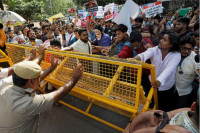
In its third term, the BJP government is merely reacting to its rivals’ agenda, unlike the first two terms when it set the narrative and the Opposition did a shoddy job of trying to catch up.
bookmark
Ruhi Tewari
Published at : October 29, 2026
Updated at : October 30, 2026 07:27
It would hardly be an exaggeration to say that this is perhaps the most challenging and perception-wise uncomfortable phase that India’s Prime Minister Narendra Modi-led government has faced in its 12 years in power at the Centre since its meteoric rise in 2014. Successive youth and Opposition protests in the national capital and the government’s defensive responses have dimmed the aura of this once-infallible machinery, making it appear more unsure than confident and poised amid its third consecutive term.
The national capital has been rocked by protests—first over gaps in the education sector that eventually led to the resignation of the education minister and now over the Election Commission’s questionable conduct and alleged complicity with the ruling regime. The reverberations of these uprisings are being felt across the country among certain sections, and the fatigue and disillusionment that come with an anti-incumbency of over a decade are further adding to the Bharatiya Janata Party’s woes.
The most striking difference between the BJP government in its third term as compared to the first two is that unlike then, when it was setting the narrative and the Opposition was doing a shoddy job of trying to catch up, this time, it is being forced to merely react to the agenda its rivals are crafting. In its first term, it led with a deadly combination of rooted welfarism and esoteric nationalism, while in its second stint, it dominated the discourse with an aggressive push to its ideological agenda.
Thus, from leading the political pack to reacting to its story, Modi’s BJP today is struggling to respond to its rivals’ blueprint, seemingly having lost the imagination to build an overarching narrative that would give it a decisive edge.
Modi 1.0 & 2.0
Narendra Modi is a shrewd, astute politician who, along with a team that had its ear to the ground, knew exactly what story to weave that would give the BJP government a perennial advantage, constant publicity, mass support and a lead in public perception, thereby rendering its opponents helpless, directionless and, therefore, peripheral.
In his first term from 2014 to 2019, Modi realised he had to capitalise on the idea of good governance, an aspirational India and the story of a self-made leader to not just live up to its mandate but also leave the opposition scratching its head. Thus, welfare delivery became its biggest footprint in that era, with schemes like free gas connections, individual household toilets in rural areas and rural housing dominating the policy and political discourse. The government pushed these schemes hard and ensured effective percolation, adding a healthy padding of using Aadhaar (the unique identification number), digitisation and penetration of bank accounts to create efficiency and heft in delivery.
To add to it, Modi led the discourse as a self-made ‘kaamdaar’ leader who was taking on entitled dynasts, the ‘naamdaars’, like Congress leader Rahul Gandhi. He, thus, made himself the symbol of an aspirational India, both as a politician and a policymaker.
The Balakot airstrikes as a response to the Pulwama attack brought in another of the BJP’s favourite angles—national security—adding yet another welcome layer to the conversation it had curated around itself.
The Opposition was forced to play catch-up, yet failed at each step. Nothing the opposition said or did would stick, thanks to the BJP’s intelligent agenda-setting.
The Modi government’s second term was more difficult from a policy perspective, given the burden of incumbency and the tremors of the Covid-19 pandemic proving to be a double whammy. Modi’s BJP, however, knew what it needed to dominate the conversation. It, therefore, dedicated the five years from 2019 to 2024 to its ideological purposes. This led to the Triple Talaq legislation, the abrogation of Article 370 in Jammu and Kashmir, the Citizenship Act and, as the final cherry, the construction of Ayodhya’s long-pending Ram temple. The emphasis, besides battling the pandemic, was on its core Hindutva agenda, and its primary discourse—be it the Ram Janmabhoomi, a hardened Hindutva line, the idea of ‘illegal immigrants’, Kashmir or Muslim personal laws—revolved around that.
Once again, the Opposition didn’t quite have a stellar counter and was forced to keep itself busy drafting a fitting reaction to the BJP’s agenda. In the Lok Sabha elections that followed, the BJP found its numbers reduced but achieved the significant feat of winning a third consecutive term at the national level, not seen since the Jawaharlal Nehru era in the 1950s and 1960s.
Its hard-won third term, however, has so far been an entirely different story.
Modi 3.0
This is not a regime that is used to retreating or reacting or firefighting as its dominant theme. But this term has brought it less good and more bad news. Over a decade in power at the Centre and across several states has bred hubris, a dulled imagination and a dimming of the ability to read the ground mood accurately.
In sharp contrast to its agile, narrative-setting and crafty avatar of its earlier terms, the Modi government now looks more desperate, shaky and defensive. From brutally cracking down on protesting youth, to giving the directionless opposition a solid agenda to run with, not finding convincing answers to the questions being hurled at it, desperately trying to connect with Gen Z, firefighting on the economic front and reducing itself to a caricature on several fronts, this is a dispensation that is struggling to keep pace. It hasn’t been able to put forward a single imaginative idea, conversation, or policy decision. It further seems to have shed the idea of even pretending to display any accountability, and with PM Modi being projected as a prime ruler and now in his third term, it has even lost its advantage of playing the self-made versus entitled card.
Sure, there was Operation Sindoor in May 2025 following the Pahalgam terror attack, which ensured the government made headlines and had a story to tell. But that is long forgotten, and it perhaps did not leave as much of a lasting impression as to allow Modi’s BJP to build on it endlessly.
To be sure, these are early days still. The national election is a good three years away, and even one big-bang idea can reverse the course. It would also be unfair to declare doomsday for this government given the massive popularity, perhaps in many ways unprecedented in Indian politics, Modi has enjoyed. It isn’t as if the BJP’s vote bank has vanished or is threatening to desert it entirely. To believe that yet would be quite a stretch.
However, the stark difference between the Modi government’s two earlier versions and now is unmissable. From projecting the image of being an in-control and steely regime that dominated the game, the BJP today seems more of a toe-curling experience to witness. It’s too early to say this is the beginning of the end of Modi, but it is quite definitely the beginning of the dulling of his sheen.
Ruhi Tewari
Tewari is a Delhi-based senior journalist and author of ‘What Women Want—Understanding the Female Voter in Modern India’.



Most Read from Columns

Editor's Picks

Who is Inam Sapkota, the man linked to Cholendra Rana and top police officials?
Ani Choying’s new role brings old controversies to the fore

Xtreme is betting on Nepali sport. It’s helping both — for now
Nepal’s historic loss and damage allocation falls short of its needs
What to know about the US trial over Mamta Kafle’s disappearance
E-PAPER | October 30, 2026

×