



 14.39°C Kathmandu


Thu, Oct 29, 2026
Columns
What a regional climate agreement for the Himalayas should contain
Prime Minister Shah’s proposed Himalayan Climate Resilience Mechanism is a welcome start. A regional legal agreement among Nepal, India and China would give it a foundation.
bookmark
Ananda Mohan Bhattarai
Published at : October 28, 2026
Updated at : October 28, 2026 16:12
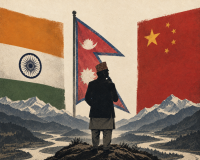
Prime Minister Balendra Shah’s told the UN General Assembly on September 24 that Nepal, India and China should lead a Himalayan Climate Resilience Mechanism. It is a welcome beginning, and those of us engaged in the scientific, ecological and legal side must capture the positive momentum. But a mechanism without a law beneath it rests on goodwill, and goodwill is the first casualty when relations cool. The Himalayas need a legal agreement that protects the system as a whole, delivers just climate governance and promotes a clean, healthy and sustainable environment. I made that case in my September 1 opinion article. Here I set out what the arrangement should contain, and what stands in the way.
The overall objective should be environmentally sustainable development, and the rejuvenation of livelihoods for people and communities across the Himalaya region. The regime should be guided by the best available scientific information in areas of climate change, biodiversity conservation, sustainable forest management and hydropower and infrastructure development. Human rights, harmony with nature, inter-generational equity and climate justice should belong within that objective as inseparable parts of it.
A common reference point is international law, customary and treaty-based, on climate change and biodiversity, along with emerging principles on forests. The International Court of Justice’s advisory opinion of July 23, 2025, which the UN General Assembly endorsed on May 20, 2026, is an authoritative contribution to that law and should shape the agreement’s framework.
As for coverage, the states may start with the central Himalaya and spiral out to the eastern and western Himalaya, and their zones of influence. They may start with climate change and move step by step to other subjects. The boundary of the Himalayan system must be delimited, and meaningful dialogue among the participating states is the way to do it.
In principle, sustained regional cooperation comes first. The UN Charter gives resonance to collaborative action among states on economic, social, environmental and humanitarian challenges. In the Himalaya, that cooperation must reflect the range’s geomorphological, ecological and environmental characteristics, its intrinsic and aesthetic values, the integrity of its ecosystem, livelihood connectivity and ecosystem services. It enables information sharing for prevention and early warning of mountain hazards, and for designing and implementing mitigation, adaptation, technology transfer, strengthening cross-border connectivity and communication. It promotes topography-sensitive landscape land use and the sharing of eco-bio resources. It also helps states streamline their domestic laws so that none, overtly or covertly, cause serious harm to the environment beyond its border. Due diligence is the core of it.
Protecting the Himalaya is a common concern, though the states differ in physical size, demography, economy, industry and technology. Common but differentiated responsibility and respective capabilities (CBDRCC) must therefore govern their cooperation, a principle Shah also invoked before the General Assembly. The International Court of Justice has said that the distinction between developed and developing states is not a static one: a country which was recognised as a developing state in the 1990s may have prospered into a developed one. The court calls on states with greater emissions and greater economic and technological prowess to take the lead. Best available scientific information should inform every state of its duty of due diligence, which means taking appropriate and necessary precautionary measures to the best of its capacity.
The precautionary and polluter pays principles belong in the agreement as well, and the states of the region already accept both as legal or judicial principles. Nepal’s Constitution recognises them as the policy of the state in Part IV, and courts in South Asia and China have recognised them as important environmental principles. Climate treaties shy away from polluter pays for fear that it implies compensation, but its acceptance in domestic law eases its path into regional law. Science adds its weight. The possibility of establishing a causal link between emissions and the black carbon that settles on Himalayan snow, reducing its albedo and enhancing its melt, requires polluter pays in a regional regime.
The Himalaya sustains the people who live in it and offers food, forest, water and renewable energy to those downstream and in adjoining regions. It modulates the monsoon with its altitudes. Its tangible, intangible and aesthetic treasures have preserved civilisation for millennia. We have taken all of this for granted. The time has come to count the contribution and pay it back to the community. Nepal’s courts have taken a modest step. In the Upper Karnali hydropower case of 2023, the Supreme Court directed that the government’s share of the project’s returns be spent on the people and ecology of the Karnali watershed. Comparative law has a well-developed contractual regime for accounting and paying for ecosystem services, and nothing stops the same scheme from growing into a mechanism within a regional treaty.
The states differ in size and level of development, in their approach to greenhouse gas and black carbon emissions, and in their use of natural and bio resources. Bilateral relations are uneasy in places, political stalemates nag, and strategic considerations pull apart. The same divergence appeared in the ICJ proceedings and again in the General Assembly vote, which carried 141 to 8 with 28 abstentions, India among them.
Given such relations, a regional treaty looks ambitious. It is within reach all the same, if state and non-state actors work in concert, mindful of the enormity of the climate crisis and the benefits of collaboration. They must first define the problem neatly and identify areas of cooperation, and they must remove the trust deficit. A minimum agenda can carry them there, and the Himalayan Climate Resilience Mechanism the Prime Minister announced is the natural first item. From it, the states can spiral out to cognate issues. India, Nepal and China can begin with non-controversial matters, seek consensus, and bring other states aboard later. A multidisciplinary task force constituted by the three should start the work now.
Ananda Mohan Bhattarai
Bhattarai is a former Justice at the Supreme Court of Nepal.



Most Read from Columns





Editor's Picks

What to know about the US trial over Mamta Kafle’s disappearance

NPL returns with bigger ambitions and global recognition

What’s new in the Nepal Premier League’s third season?
After Nepal’s recent disaster, it wants to test whether COP31 can deliver climate justice

Why does an hour long flight to Dhangadhi cost more than a flight to New Delhi?
E-PAPER | October 29, 2026

×