



 25.92°C Kathmandu

Tue, Oct 27, 2026
Columns
The economic costs of Nepal’s air quality crisis
Pollution carries serious economic implications, especially for the cities that drive national growth.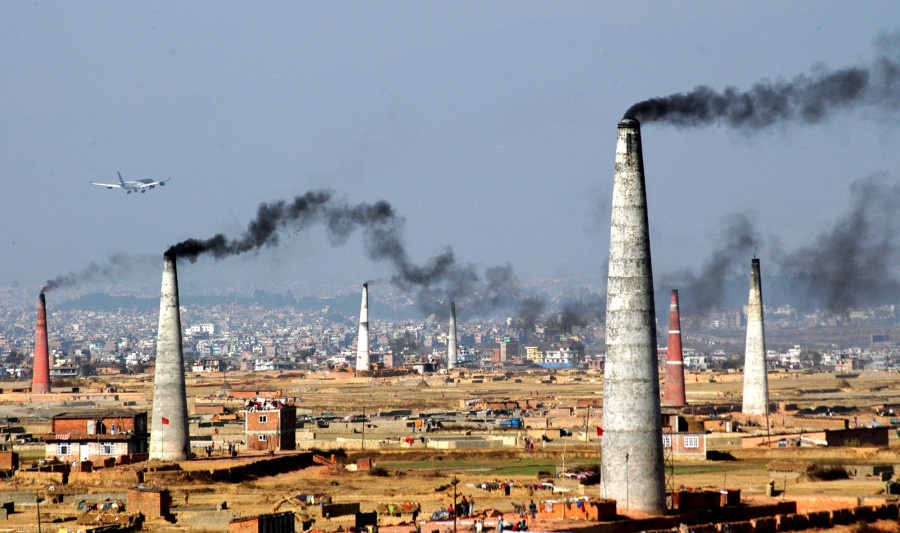
bookmark
Astha Guragain
Published at : April 30, 2026
Updated at : April 30, 2026 18:56
Nepal’s unbearable pollution has become a routine spring reality. According to a Swiss-based Air Quality Index (AQI), a score above 100 signals unhealthy conditions for sensitive groups. Kathmandu consistently ranks among the world’s top 10 most polluted cities, with an air quality index reaching up to 247, certifiably hazardous, on April 24, 2026. Outside, two-wheeler commutes persist, street labourers uphold the mandate of outdoor commerce, and traffic crawls through in a way that accepts the invasion of pollutants as an instance of bad weather, rather than the national crisis it is.
Pollution rarely arrives as a single catastrophic event. However, its slow accumulation—in lungs, hospital bills, missed days of work and fatigue setting over the population—has dramatic and negative effects on society’s capacity to prosper.
Air pollution is now the leading risk factor for death and disability in Nepal, shortening the average Nepali’s life span by 3.4 to 4.1 years and contributing to between 26,000 and 42,000 premature deaths annually, according to a 2025 report by the World Bank. The same study highlights that lost productivity through disruptions in sectors of aviation and tourism, paired with healthcare costs and labour loss, drains about 6 percent of the country’s GDP. In Pokhara, Nepal’s tourism capital, airlines report rising cancellations due to haze, directly threatening one of Nepal’s most valuable industries. While these costs are quantifiable, the immeasurable damage is what pollution does to a region’s culture of possibility.
Data from the World Inequality Index, solidified in a 2023 Brookings report, outlines the increasing inequality within countries, despite the decline of inequality between countries. Cities have become the primary engines of growth, innovation and upward mobility. In this framework, urban centres function as concentrated hubs of human capital, infrastructure and economic possibility. A 2025 Spatial Economic Analysis by leading economic researchers Robert Huggins and Piers Thompson further proposes that regional development is largely derived from a ‘culture of possibility’—the decision-making capabilities of citizens, ultimately affecting their propensity for creativity and innovation.
When a city like Kathmandu becomes environmentally unlivable, or Pokhara’s high-earning sectors are affected, the consequences extend beyond public health. By failing to prioritise mitigating pollution in cities, Nepal risks undermining its position within a global system where prosperity is increasingly urban, concentrated and unevenly distributed.
In Nepal’s capital, part of the problem is geography. Kathmandu Valley, quite literally, is a bowl, necessitating a level of management that would require consistent attention to the shape of the problem. During winter, temperature inversions trap polluted air close to the ground, as the surrounding hills function as barriers that prevent wind flow or dispersal of pollutants. Economically speaking, Bagmati Province accounted for 36.4 percent of the national GDP in 2024, so the imagination for prosperity here is crucial for sustained national development, despite the geographic challenges.
While transboundary pollution accounts for around 25 percent of the Valley’s pollution, Kathmandu intensifies its own crisis. The very activities that sustain economic life also risk choking it. Brick kilns fire to meet the demand for housing. Construction dust rises from roads that promise development, but contribute over half of Kathmandu’s particulate matter (PM10) load.
Industrial production remains one of the largest and fastest-growing contributors to pollution, yet transitioning to cleaner systems, while costly at up to $5 million per unit reduction in particulate matter, remains far cheaper than the long-term economic losses pollution imposes. Nearly 2 million vehicles move through the Valley each day, carrying workers, goods and ambition. What emerges is a system where local economic activity and regional atmospheric forces converge. Workers who must operate outdoors may suffer, but medical industries and air enhancement producers, selling air purifiers and related goods, experience a spike in income. Growth often arrives wrapped in smog. In a rapidly urbanising economy where regulation struggles to keep pace with expansion, the incentives to produce and tolerate pollution often outweigh the incentives to prevent it. Geography may set the conditions, but policy determines how severe the consequences become.
Despite the adoption of USAID’s clean air financing program (2021-2025)—a program designed to mobilise private investment in pollution-reducing sectors, such as electric mobility, improved waste management, and cleaner brick production—and the collection of millions in petrol and diesel taxes, responsible and full implementation is lacking. The USAID program aimed to shift market incentives, and in some sense, Nepal’s rapid adoption of electric vehicles, accounting for 73 percent of new car sales, demonstrates how environmental shifts can take place with the proper economic incentives.
Nepal ranks second in the world for EV adoption, as the cheaper cost of electricity versus petrol over time may have enabled consumer behaviour to shift. An electric vehicle (EV) in Nepal benefits from a substantial implicit subsidy due to dramatically lower import duties, excise taxes and value-added tax compared with conventional internal combustion engines. This price advantage makes EVs approximately 21 percent cheaper than comparable internal combustion engine (ICE) vehicles. This demonstrates that when economic incentives are carefully aligned with environmental objectives, even a developing economy can achieve swift and large-scale behavioural change, ultimately shaping both regional economic and environmental trajectories.
Beyond this, weak enforcement and limited institutional coordination have led to a lack of tangible outcomes. Nepal is once again confronted with another international initiative as the World Bank steps in, promising Rs7.7 billion ($52 million) for Nepal’s Clean Air and Prosperity Project, through a focus on industrial management and cleaner, more efficient technologies. The pattern repeats in the form of large-scale financial commitments. In the meantime, those who breathe the air are left exhausted and disillusioned.
Pollution carries deep economic implications, especially for the cities that drive national growth. Policy solutions proposed by the World Bank report emphasise transformations towards clean energy through the adoption of new technologies, targeting the main causes of pollution. They further proposed working frameworks that prioritise regional coordination and accountability as key indicators for success. While this transformation may be slow, what is urgent is the need to cultivate Nepali society’s, particularly young people’s, propensity for creativity and innovation towards economic growth by assuring that Kathmandu’s geography and current pollution contributors are properly addressed, cultivating a society that enables hope.
When the air itself becomes adversarial, it subtly reshapes the way people imagine their future; one in which air itself is hostile to the act of living, quite literally reconfiguring ways of seeing. The costs extend beyond environmental destruction to social, economic and deeply psychological aspects of daily life. The occasional rain, then, is nothing but a temporary solace, while institutional reform staggers, and the necessary financial incentives, transformations and accountability remain stagnant.
When you must defend your body against your city, what prosperity are you left to envision?
Astha Guragain
Astha Guragain is a socioeconomic educator, researcher and writer specialising in local economic development.

Most Read from Columns



Editor's Picks

What to know about the US trial over Mamta Kafle’s disappearance
NPL returns with bigger ambitions and global recognition
What’s new in the Nepal Premier League’s third season?
After Nepal’s recent disaster, it wants to test whether COP31 can deliver climate justice

Why does an hour long flight to Dhangadhi cost more than a flight to New Delhi?
E-PAPER | October 27, 2026

×