



 24.63°C Kathmandu

Sat, Oct 24, 2026
Columns
Architectural melancholia in Nepal
To incur human misery with actions performed in a rush is a transcendental violation.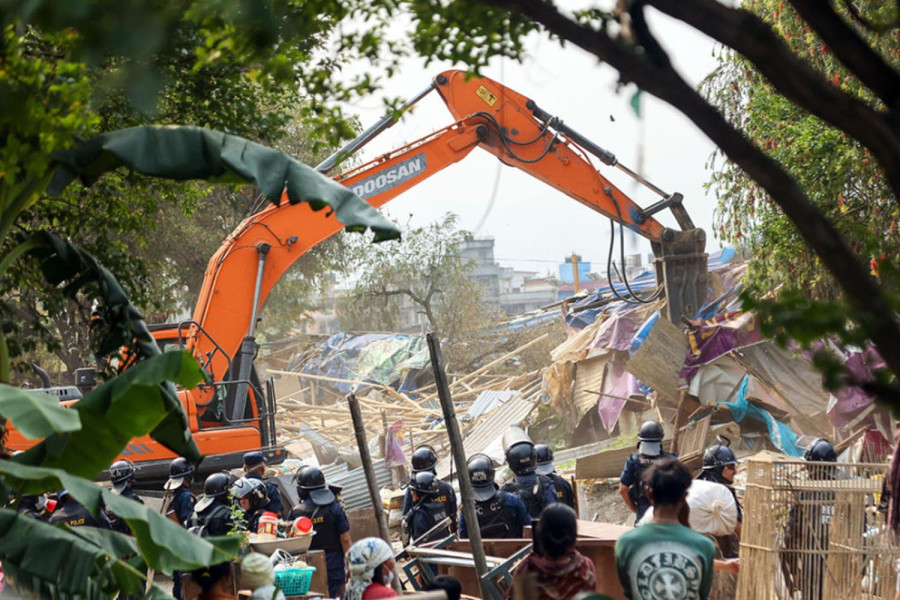
bookmark
Abhi Subedi
Published at : May 8, 2026
Updated at : May 10, 2026 06:46
We are facing a big question of architectural melancholia—an emotional state where built environments evoke feelings of longing, nostalgia, or existential reflection—with demolitions of huts and buildings taking place on the banks of rivers and around the fringes of towns and cities. Nepal is not the only country that harbours thousands of squatters in its cities and towns. We should look at this phenomenon with a simple but stunning estimate of the United Nations Human Settlements Programme 2003, which says ‘one billion people live in squatter settlements and slums’. The problem of squatting should be tackled and solved by the government with prudence, plans and kindness. But the crucial question now is—are you demolishing houses too hastily and recklessly?
I look at this development from the point of view of architectural melancholia, which is dismay generated by constructions and deconstructions of buildings and art. But I want to put my narrative first. When the Gen Z uprising happened in Nepal, nobody had any idea how that was going to change the metropolis and alter the political power structure of the land. I wrote a poem during the upheavels. I feel a little liberated when I read the poem titled ‘A Gen Z crescendo’ to myself and to others today. The first stanza goes like this:
They whom I didn’t see
Two decades ago
Are here carrying times
Speaking in idioms
That I understand, you understand
But perhaps do not use
When we talk about the
Sky that descends and
Speaks with a mouth
Opening like that of an opera singer
With voice rising to a crescendo
On these paths.
The pictures of the Nepal Mandala cities that we saw first were shattering. The primary targets of the people who used the uprising for their purpose were the big buildings that included the Singha Durbar, private houses, shopping centres and hotels. The architectonic sites were the targets. The mode of destruction was fire, vandalism or demolition. Very remarkably, good people raised money afterwards and reconstructed a number of buildings used for public services. Ironically, the Supreme Court itself is exposed like a bizarre installation, a projection of anarchic sculptural absurdity.
Buildings razed to the ground in this manner opened what we can see in retrospect as architectonic melancholia. Buildings were burned or destroyed without discrimination of style or period. A certain architectonic malice came from people to whom the architectural forms were the abodes of sin, and the visible things of what people saw as monuments of corruption, the seat of power and money. I published an article in this newspaper about two weeks after the September uprising, in which I questioned, “Why did the buildings, including humble houses, become targets of the ire of the unprecedented actions in the uprising? A full answer to this question may never come.” The tangible sights were the burned and razed buildings.
Burning of buildings occurs as a result of the mistakes of management or malice. Singha Durbar was first burned on July 9, 1973. The cause of the fire was not known. Perhaps it was an accident. That is widely accepted. But one American hippie poet, a friend of mine, who lived in Dhoka Tole of Kathmandu, had a different view. He wrote a poem titled ‘Singh Durbar in flames’, a little oddly dedicated to the Beat poet Allen Ginsberg, in which he writes “Shiva’s justice rendered one week/ before the revoking of all hashish/ licenses in Nepal.” The façade of Singha Durbar that was saved came under attack during the Gen Z uprising. It was a piece of history that housed, among other things, a Parsi theatre used for staging stories of ghosts and fantasy. That represented a unique melange of power and dreams.
The history of Nepal valley, to take an example, is the history of buildings, the architectural sites and open spaces. But interestingly, buildings were the focus of power. We do not have to go very far. We can take the Neo-Baroque Rana buildings built on the lush green fields, away from the towns of the native Newars. But the other side of the history is that the Newar buildings represented harmony and perfection. No question came about managing the gap between the rich and the poor in terms of abodes. The melancholia of the city planning did not touch them. Those who moved out of the Nepal valley made towns in the hills and a few on the plains.
What strikes me today is how the government that came out of the historical change and successful elections made demolishing buildings its urgent priority? It, too, targeted the architectural sites, this time huts and small buildings occupied by squatters. The targets are abodes of the poorer section of society—people who moved from villages to the metropolitan areas for economic pursuits and proximity to work sites.
Now, especially after the government's action of razing the squatters’ shelters by making them huddle together, the architectural discourse shifted from buildings of style to the squatters’ hovels. What is happening is reported widely. Now the homeless squatters represent a city that manifests in the old women, mothers, children and youths who, sitting on the stumps, are shown by reporters narrating their shattered friendship, sharing dreams and pain of separation and uncertainty.
I have some questions in the end. The first is why squatting, the oldest mode of tenure in the world, is treated as though it has happened only in Nepal. Why should that be addressed by the new government before other very urgent programmes of delivery? I would not say the squatting mode of tenure should not be addressed. Just don’t rush, take time and embark on the demolition only after proper assessment and creating proper alternatives. To incur human misery with actions performed in a rush is a violation; it transcends the boundaries of humanist actions. You, who are young people of the new times, should not harbour any thoughts that are contrary to democratic human principles.
Looking for a theme to write a play, I have found that our actions in the past year and a half have been guided by what I would call an architectural melancholia. I don’t know how the director would set the stage for the play. But the open theatre of the dissolutions will be presented as a reckless problem play on the stage.
Abhi Subedi
Abhi Subedi is a poet, playwright and a columnist.





Most Read from Columns





Editor's Picks





E-PAPER | October 24, 2026

×