



 23.1°C Kathmandu
.png&w=200&height=120)
Thu, Oct 15, 2026
Columns
Why BJP’s sweep in West Bengal is causing deep discomfort in Bangladesh
The BJP’s sweep has dismantled old buffers, but has also shattered outdated assumptions.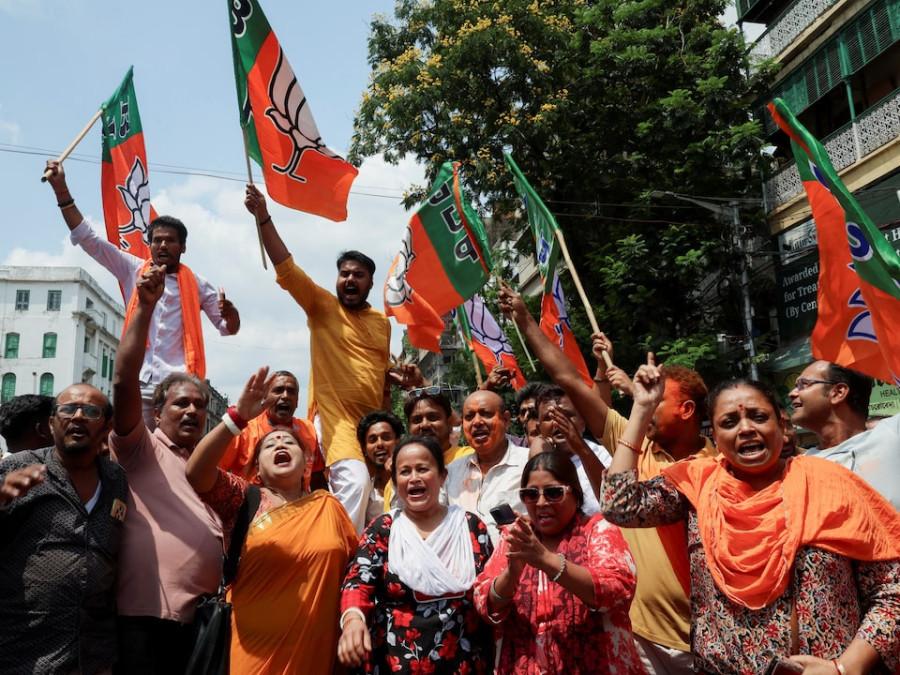
bookmark
Jannatul Naym Pieal
Published at : May 7, 2026
Updated at : May 7, 2026 18:32
Bharatiya Janata Party’s (BJP) decisive landslide victory in the West Bengal Assembly elections has triggered widespread unease in Bangladesh, as the results mark not just a state-level change but a fundamental shift in the regional power dynamics.
With the BJP now commanding both the central government in New Delhi and the state administration in Kolkata, the much-discussed ‘double engine’ model promises a more unified, ideologically charged and administratively streamlined approach towards Bangladesh.
Many in Dhaka see this as the removal of the last meaningful political buffer that once allowed some negotiation room on critical bilateral issues.
For over a decade, TMC-ruled West Bengal frequently acted as a reluctant intermediary. It delayed, diluted or forced renegotiations on matters ranging from water sharing and border management to connectivity projects and security cooperation.
That era of federal friction appears over. A centralised command structure is expected to accelerate India’s eastern agenda with greater efficiency and less accommodation for Bangladeshi concerns.
Post-poll violence and communal anxieties
BJP’s victory has already produced visible discomfort through reports of post-poll violence. TMC offices were vandalised in several districts, with workers allegedly harassed and attacked.
While the BJP leadership has urged restraint and warned against involvement by its cadres, images and accounts circulating in Bangladeshi media and social platforms have amplified fears of rising majoritarianism.
Incidents and rhetoric perceived as targeting Muslim communities resonate strongly in Bangladesh, where public sentiment is sensitive to perceived threats against India’s Muslim minorities.
Celebrations accompanied by communally charged sloganeering have been widely shared, reinforcing narratives of an ideological shift that prioritises religious identity over shared Bengali heritage. Such perceptions are deepening discontent and contributing to a sense of vulnerability.
Rising human concerns
One of the most immediate worries centres on the 2,200+ km shared border. Unified control is likely to fast-track the completion of border fencing, including in difficult riverine stretches, while expanding the use of drones, sensors, AI-powered surveillance and floodlights.
Coordination between the Border Security Force (BSF), state police and intelligence agencies will improve significantly. This may effectively curb the smuggling of cattle, narcotics, arms and fake currency, along with unauthorised crossings. 
However, the human and socio-economic costs could be steep. Informal trade networks and deep kinship ties that have supported millions of border residents on both sides for generations face disruption.
More gravely, Bangladeshi civilian deaths at the hands of the BSF remain a flashpoint.
In 2025, 34 Bangladeshis were reportedly killed—the highest figure in five years. A stricter enforcement environment under BJP rule risks pushing these numbers higher, particularly in remote or disputed areas.
Without credible accountability mechanisms, joint investigations, transparent reporting and clearly defined rules of engagement, the border could evolve from a zone of difficult coexistence into a persistent humanitarian concern, fostering deep resentment and complicating diplomacy for years.
Ideological mirroring and push-in fears
In Bangladesh’s February 2026 general elections, Jamaat-e-Islami achieved a historic breakthrough, winning 68 seats with notable strength in border-adjacent areas. On the Indian side, the BJP’s dominance also extends deeply into districts bordering Bangladesh.
This symmetry suggests that long-standing linguistic and cultural commonalities are increasingly yielding to religiously mobilised politics on both sides of the frontier.
Practices pioneered in Assam under Chief Minister Himanta Biswa Sarma —including ‘push-back’ operations against those labelled ‘illegal Bangladeshis’—could now spread across West Bengal.
Bangladesh authorities documented over 2,400 such push-ins in 2025. A wider, less transparent approach to migration control raises fears of arbitrary actions that could affect genuine kinship ties and cross-border movement.
Strain in people-to-people ties
The everyday connections between the two peoples face fresh strains. Visa issuance for Bangladeshis to India remains uncertain and restricted, a lingering effect of earlier political tensions and security concerns following Bangladesh’s 2024 political changes.
Although talks of phased normalisation are underway, processing remains limited, severely impacting medical patients, students, family visitors and small traders.
Historically, over two million Bangladeshis visited India annually, with medical tourism forming a major component. These bottlenecks are not just administrative hurdles—they symbolise a broader cooling of relations and fuel public frustration in Bangladesh.
Realignments and insecurities
Economically, a BJP-led West Bengal is poised to accelerate large infrastructure projects, industrial corridors, Special Economic Zones and enhanced connectivity to India’s Northeast. While Bangladesh could benefit from improved formal trade routes and energy imports, challenges abound.
A more competitive West Bengal may intensify rivalry in key sectors like ready-made garments (RMG), jute, textiles and light engineering. Informal cross-border commerce, vital for many local economies, will likely shrink, forcing Dhaka to implement protective measures and renegotiate terms for equitable gains.
The long-stalled Teesta water-sharing agreement exemplifies shifting dynamics. Previously blocked by Mamata Banerjee due to concerns for North Bengal farmers, the path now appears clearer. Yet, the BJP’s strong performance in the Teesta basin districts such as Jalpaiguri, Alipurduar and Cooch Behar means any deal will remain tightly linked to local electoral interests.
With the 1996 Ganges Water Sharing Treaty expiring in 2026, India’s river interlinking projects advancing and growing industrial demands, Bangladesh—as the lower riparian—faces severe dry-season challenges affecting agriculture, fisheries, navigation and drinking water.
Dhaka must advocate robustly for a comprehensive Ganges-Brahmaputra-Meghna framework, real-time data sharing, independent assessments and guaranteed minimum flows. Emerging Chinese interest in Teesta projects adds another layer of geopolitical complexity.
Time for strategic recalibration
In this new reality, traditional diplomacy relying on high-level visits and general assurances may prove inadequate. Bangladesh requires a comprehensive reset: enhancing technical and legal expertise in hydrology, border management and trade negotiations; developing independent research capacities; forging alliances with other lower-riparian and climate-vulnerable nations; and diversifying partnerships with prudence.
Appointing politically experienced diplomats in key postings could mirror India’s reported choice of Dinesh Trivedi, a BJP-linked figure, as High Commissioner to Dhaka, signalling a more politically attuned phase of engagement.
The BJP’s sweep has dismantled old buffers, but has also shattered outdated assumptions. Amid climate stress, resource scarcity, demographic pressures and great-power competition, functional cooperation remains indispensable.
Yet it must be anchored in clear-eyed realism, strategic discipline and an unyielding defence of Bangladesh’s national interests. Dhaka’s response will demand foresight and strength to navigate this markedly less accommodating environment.
Jannatul Naym Pieal
Pieal is a Dhaka-based writer, researcher and journalist with over a decade of experience in professional journalism.
.png&w=200&height=120)


.PNG&w=200&height=120)

Most Read from Columns

Before you take credit for Khula Manch, read its history
Shah went to the UN to speak for Nepal, then left before he could make the most of it

Bhotekoshi flood wasn’t a freak event. It’s the Himalaya doing what it does
Lesson learned after the death of Ronaldo
What Lubra can teach Nepal about climate-induced migration and resettlement
Editor's Picks

Constitutional Bench caught in seniority, ‘pick and choose’ dispute

A Dom boy’s long road to becoming a doctor

From blankets to handmade dolls, two foreign women bring comfort to flood survivors

News Analysis: When institutional defence exposes institutional fault lines

It’s a bird … it’s a plane … it’s the Indian ambassador’s farewell tweets
E-PAPER | October 15, 2026

×