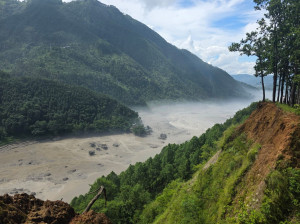
Two years ago, while conducting fieldwork for a PhD in the riparian settlements of the Kathmandu Valley, I met families who had been living along the riverbanks for decades. Some had spent more than 50 years there; others, more than two decades. What struck me most was not just the duration of their stay, but the endurance that defined their lives. These were not transient populations drifting in and out of informal spaces, but multi-generational, deeply rooted communities who were waiting for the state to recognise their plight.
The story of these settlements stretches back further than many of the political events we often cite to explain them. While the Maoist insurgency is frequently invoked as the primary driver of internal displacement, the reality is more complex. The insurgency did accelerate the growth of informal settlements by pushing displaced populations toward urban centres. But it was not the only force at play. The decline of the once-thriving carpet industry, which had drawn waves of workers from surrounding villages into the Valley, also contributed significantly. When that industry collapsed, many were left without stable employment or the means to secure formal housing. These overlapping crises—economic, political and social—created a pathway towards informality. For people priced out of the cities, riverbanks became sites of last resort.
Yet, over time, these so-called ‘illegal’ spaces evolved into something far more substantial than temporary shelters. They became neighbourhoods. What began as clusters of makeshift huts or taharas gradually transformed into more permanent structures. Brick walls and concrete slabs replaced bamboo frames. However, such morphological changes were more than just physical; they reflected aspiration, resilience and a belief in the possibility of permanent dwellings.
It is important to recognise that life within these settlements is not devoid of order or structure. Land politics exists here as much as it does in a formal city. Informal transactions—buying, selling and transferring plots—are common knowledge. Residents may lack legal titles, but they operate within a system of mutual recognition and social contracts. This informal land economy, while precarious, provided opportunities for people who either wanted to be in or out of these neighbourhoods. To simplify it as just ‘illegal’ is to misunderstand them entirely.
At the same time, we must confront the uncomfortable truth that these settlements exist only because the formal systems have failed. When affordable housing is inaccessible, when livelihoods collapse and when displacement goes unaddressed, people will find other ways to survive. Informal settlements, therefore, are a symptom of a more chronic problem in Nepali society. The people living along the riverbanks are citizens awaiting a response from their government. And these people have waited through changing governments, shifting policies and promises of rehabilitation. During this wait, in the absence of any meaningful intervention, like all of us, they have built lives with whatever resources they have.
This is what makes the recent demolitions so deeply troubling.
In just three days, homes that took decades to build were reduced to rubble. Not all were disposable structures. They were people’s lifelong investments of labour, money and hope. The Balendra Shah-led government, in its efforts to reclaim the land, has acted with remarkable speed. The notices went out, bulldozers arrived and evictions were carried out. Such efficiency from the government would have been admirable in any other circumstances. The same urgency and efficiency are now needed for rehabilitation.
The government is now investigating who qualifies for assistance. However, a critical question remains: Why was there no comprehensive plan in place before the demolition began? If the government can mobilise resources to clear settlements on such short notice, it is equally capable of ensuring that those displaced are not left without dignity. The rehabilitation plan should not have been an afterthought—it is always an integral part of any intervention that affects vulnerable populations. To remove people from their homes, without viable options for rehabilitation, will only perpetuate the very cycle that created these settlements in the first place.
Additionally, addressing the Sukumbasi problem requires more than short-term relief measures. It demands rethinking of urban policies so that it prioritises inclusion, affordability and, most of all, a consensus on who can belong to the city. The present rhetoric paints the informal settlers as outsiders. Yet, they are residents of the city who enable urban functioning and are part of its fabric. It is important to acknowledge that informal settlements are not aberrations, but enduring features of cities.
Hence, a short-term urgency is required for dignified rehabilitation. A lesson that can be learned from the recent events is that the government is capable of acting decisively, quickly and at scale, when it is set on its agenda. Now the challenge is to direct that same energy towards solutions. Rehabilitation should have moved ahead, or in tandem with demolition. While little can be gained from lamentation, it is not too late to respond differently. The government must treat rehabilitation with the same level of urgency and commitment that it demonstrated in clearing the settlements.




 15.26°C Kathmandu