



 14.2°C Kathmandu

Fri, Oct 16, 2026
Columns
The case for pricing climate risks now
Rising climate shocks are silently erasing up to 2 percent of Nepal’s GDP every year.
bookmark
Abiral Khatri
Published at : May 18, 2026
Updated at : May 18, 2026 21:20
Nepal is preparing a budget estimated at $14 billion for the upcoming fiscal year, amid ongoing debates over how much to allocate for infrastructure, private sector growth and human capital. What seems not yet to have been debated seriously is the annual cost of climate inaction.
As per the 54-year analysis of climate-induced economic losses in Nepal, published by the Loss and Damage Collaboration in 2025, the country’s average annual economic loss from climate-induced disasters stands at $18 million, with extreme years touching 2.08 percent of GDP. Without action, that figure could reach nearly 10 percent of GDP by 2100. A budget that does not price in these risks will keep Nepal in a cycle of rebuilding, rather than growing.
The price of not planning
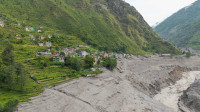
In June 2021, a cascading flash flood tore through the Melamchi River Valley in Sindhupalchok, burying the headworks of one of Nepal’s 21 designated national pride projects under metres of debris. The flood destroyed 63 houses, swept away nearly 17 hectares of land and killed livestock. Combined losses across Melamchi and Helambu amounted to approximately $641 million—more than Nepal had spent building the project over three decades. What made it harder to accept was not the scale but the preventability.
The ADB’s post-disaster technical assessment was quietly damning, too: Earlier designs had focused only on rainfall at a time when climate change was considered a non-issue, and the actual flood exceeded the project’s design limit by a factor of 4.5. Nepal lost this to infrastructure planning that had never priced in climate risk.
The question is simple enough: How much extra does it cost to build a road, bridge or water project to withstand the climate shocks? According to the World Bank, climate-proofing a project adds less than 1 percent to its cost and returns $4 for every $1 spent in avoided losses. When 80 percent of Nepal’s population is already exposed to climate-induced hazards and $124 billion of its infrastructure lies in the path of climate-driven disasters, investing a relatively small amount now in resilience would prevent losses of this scale.
Tagged but not spent
Nepal was the first country in the world to introduce a climate expenditure tagging system, in FY 2012-13, when 6.7 percent of the total budget was formally labelled as climate-relevant. Over the following decade, that share grew steadily, reaching nearly half of the entire federal budget. On paper, that is a remarkable achievement. But in practice, it is where the problem begins.
Tagging is not spending, and spending, it turns out, is not always impactful. The share of Nepal’s climate budget considered directly relevant to actual outcomes has marginally declined over five years, meaning more money is being labelled climate-related without addressing climate risks. In FY 2024-25’s mid-term review, climate change recorded the lowest budget utilisation even as floods were destroying highways, hydropower plants and harvests across the country.
The same holds for green tax revenues. In FY 2024-25, Nepal collected around $14.3 million in green tax levied at Rs1 per litre on petrol and diesel, deposited directly into the government’s general account, but not into a climate fund. There is no transparency or accountability in how these funds are used, and no evidence that they reach forests, flood barriers or clean energy projects. The upcoming budget must change this.
It is not that Nepal lacks a national plan for disaster risk reduction. The problem is that it is mostly response-oriented and lacks the right budget orientation to match it.
Costs that never make budget
Petroleum imports alone accounted for $2.4 billion in FY 2024-25, a commodity Nepal is fully dependent on and has no control over the price. Meanwhile, the hydropower sector was generating surplus electricity in the wet season. Despite a surplus of 1,400 MW, only 1,141 MW was approved for export to India, while the rest spilt into rivers. A strategic approach with the budget would be to electrify transport using the current power the country already generates. In fact, in 2025, two out of every three cars sold were electric, the fastest adoption rate in the world by percentage. Then a single glacial lake outburst flood (GLOF) destroyed the Kerung bridge, took 250 MW of hydropower offline, and EV imports fell by 14.47 percent in six months. Nepal’s own energy transition, slowed by the very climate risk its budget has yet to price in.
The fuel dependency is also leading to rising health costs as air pollution is now the country’s leading risk factor for death and disability, causing 26,000 premature deaths a year and an economic drag of more than 6 percent of GDP. Nepal has collected $160 million in pollution control taxes since 2008, none of which, auditors confirmed, was ever spent on pollution control.
The agriculture sector has been bearing similar costs. In July 2025, the Government of Nepal declared Madhesh Province—the country’s grain basket, producing more than two-thirds of its foodgrains—a drought disaster zone. The satellite analysis from ICIMOD found over 40 percent of rice-growing areas under severe stress, with a potential shortfall of 400,000 to 450,000 metric tons, which is roughly 10 percent of the national supply.
What this budget must decide
The climate finance architecture requires political will over political convenience. The government has already established a Climate Resilience Fund. Now, green tax revenues must actually go into it, publicly audited and ring-fenced from general expenditure. Every major infrastructure project should carry a mandatory climate risk assessment as a condition of approval, and not something simply ticked off years into construction. EV policy must graduate from annual budget tinkering to a five-year statutory framework, weighted towards public transport rather than only private ownership. And climate budget tagging must mean something to ministries that consistently under-execute their climate allocations.
Nepal’s contribution to global greenhouse gas emissions is just 0.1 percent, a fact long repeated in conference rooms and climate dialogues without ever translating into economic advantage. It is now time to turn these into balance sheet assets.
Abiral Khatri
Khatri works at the intersection of climate finance, energy transition and sustainable economic development.


.PNG&w=200&height=120)

Most Read from Columns

Before you take credit for Khula Manch, read its history

Shah went to the UN to speak for Nepal, then left before he could make the most of it

Bhotekoshi flood wasn’t a freak event. It’s the Himalaya doing what it does

Lesson learned after the death of Ronaldo

Why passive neutrality won’t take Nepal anywhere
Editor's Picks

Constitutional Bench caught in seniority, ‘pick and choose’ dispute

A Dom boy’s long road to becoming a doctor

From blankets to handmade dolls, two foreign women bring comfort to flood survivors

News Analysis: When institutional defence exposes institutional fault lines

It’s a bird … it’s a plane … it’s the Indian ambassador’s farewell tweets
E-PAPER | October 16, 2026

×