Cycling was once central to daily life. Now it’s done mostly for fun
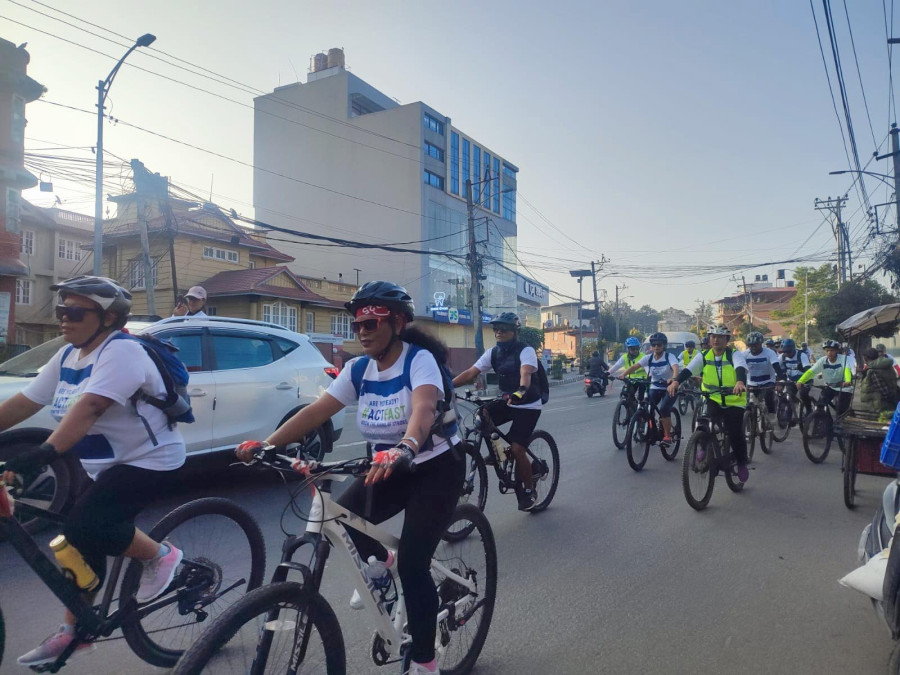
Interest in bicycles is growing again. But poor infrastructure, unsafe roads and status-driven attitudes continue to keep cycling from becoming a mode of commuting. Women cyclists ride through Kathmandu in the early morning hours, when lighter traffic makes roads safer for riding. Photo: Courtesy of Chakshu Malla
At 4am in Patan, the streets are quiet enough to ride. A small group of women cycles through dimly lit roads, riding in a loose line, slowing at turns and calling out to one another as they move. By 6 in the morning, they are already heading home to take their children to school or complete household chores.
Just 30 years ago, cycling was widely popular, a regular activity and mode of everyday transport. Now, with the rise of motorbikes and the expansion of roads, cycling has largely disappeared from daily life.
Organisations like the Cycle City Network Nepal (CCNN) and groups such as Women Cycling Nepal are trying to revive this practice. Through weekend rides, school programmes and cycling challenges, they are working to bring bicycles back into daily life.
For the last decade, growth around cycling has happened on the recreational side only. “People head up to the hills for a ride and then return home to the city and go to work. That trend has been increasing,” said Devendra Basnet of the Nepal Cycling Association (NCA).
Social media has amplified the movement, with riders posting videos and photos that draw in newcomers, especially young people. “When children see others riding, they become curious,” Basnet said.
In Nepal, much of this rise is tied to mountain biking, which has steadily developed since the 1980s. Today, it is one of the most organised forms of cycling in the country. The NCA hosts annual national championships that now draw more than 100 participants, with numbers increasing each year, especially among young riders. Female cycling populations are also rising, though their presence in competition remains limited. “We still have only one women’s category because there are not many riders,” Basnet said.
Outside formal competition, however, more women are taking up cycling.
Asmita Rajbanshi, co-founder of Women Cycling Nepal, said the number of female cyclists has increased significantly in recent years, especially after the pandemic, largely because of bicycle events and challenges. “When I started cycling, in a group of 100 riders, there were only five to 10 women. We could count them on our fingers,” she said.
Women Cycling Nepal began as an informal network to connect female riders. Today, the group includes riders of all levels, ages and castes, as well as those with disabilities, with one member taking part in paracycling. Across the Valley, Rajbanshi estimates that there are now more than 5,000 women riders, up from fewer than 500 two decades ago.
Chakshu Malla, president of the CCNN, recalled another group where women ride together, training early in the morning. Communities like these have helped drive the rise in female cyclists across Kathmandu. An avid mountain biker, Malla rides on weekends with a group of six others. “Two or three years ago, we didn’t see any women riders,” he said. “But now, there are many.”
Events across the country reflect that shift. The 2025 Kora Cycling Challenge saw more than 1,000 women participants—a record number—and over 6,000 participants in total. In the inaugural Kora Cycling Challenge in 2011, there were only 35 participants. While those statistics are encouraging to Anu Shrestha, Learning and Community Impact Lead at CCNN, she finds there is still room for growth.
In Chitwan, through CCNN’s Pedal Paathshala initiative, the organisation is working across 10 schools to teach students how to ride, repair bicycles and navigate roads safely.
Malla said the organisation chose Chitwan, Nepal’s plains region, for a reason.
“Bicycles used to be the main mode of transport there in the 1980s,” he said. “Everyone—men and women—used them. To go to school or the market, people travelled by bicycle.”’
As motor vehicle use increased, streets became more dangerous for cyclists, and cycling rates fell sharply. By 2011, only 1.5 percent of people travelled by bicycle in Kathmandu Valley, according to a factsheet by Clean Energy Nepal.
To bring back everyday cycling, CCNN has partnered with the municipality and Chitwan’s local schools to teach children how to ride. The programme trains 30 local instructors, who then form bicycle clubs and organise regular rides for students.
“You need to work with school kids because they are the future,” Malla said. “If they learn how to ride bicycles, they will continue as they grow older.” The goal is long-term, to make cycling a regular part of daily life.
A generation ago, that culture existed.
Basnet’s father rode a bicycle to his office every day. Malla remembers students in Kathmandu regularly cycling to school, back when the streets were far less crowded. Shrestha’s aunt once cycled long distances to work from Bhaisepati to Hattiban.
As a child, Shrestha herself rode freely around her neighbourhood, running errands for her family and going to the shop. She would even teach her friends how to ride. “Back then, it was common to see children cycling,” she said. “Even if not everyone owned a bicycle, they would share.”
“As I grew up, I don’t know what happened,” she recalled. Her school was close enough to walk, so it was uncommon to take the bicycle. After that, her father sold the bicycle, and later, Shrestha started riding an electric scooter.
Others share similar memories. Lawmaker and transportation engineer Ashish Gajurel said he rode a bicycle to school growing up, but after moving to Kathmandu, he stopped because of heavy traffic.
Malla said the shift to cars and motorbikes is partly driven by perception. “Cycling was seen as a poor man’s thing,” he said. “If you can’t afford a motorcycle, that’s why you ride a bicycle.”
Gajurel echoed this view. “Many people see it as a status issue. If you don’t have money, you walk, cycle or use public transport,” he said. Rajbanshi noticed the same dynamic growing up in the Tarai region of Nepal—those with fewer resources cycle, while those who can afford it opt for motorbikes. “It was just a part of livelihood,” she said.
But when Rajbanshi moved to the Valley, cycling was almost nonexistent outside of tourism and mountain biking. “Luckily, I got to cycle in one event and that pushed me to do more,” she said.
A cyclist since childhood, Malla switched to a motorbike in college before returning to the bicycle, inspired by his love for mountain biking and by watching others take to the hills for weekend rides.
Now, Malla serves as a commissaire, or race official, at the NCA’s annual National Mountain Bike Championship. He said Nepal’s geography is a major draw for the sport.
But that growing interest has not translated into widespread daily cycling. While people choose the bicycle for fitness or sport, they do not choose it for commuting.
“Cycling in Nepal basically means mountain biking,” Malla said. “The city is not cyclable.”
“It’s very scary to ride on the road,” Basnet said. “The infrastructure is poor, and the behaviour of drivers makes it worse.”
Efforts to improve infrastructure have been slow. For years, CCNN has been lobbying the Department of Roads and local governments to build several cycle-friendly roads within Kathmandu. Gajurel has tried to raise awareness, even cycling from his home to the first session of Parliament to send a message and highlight the need for stronger infrastructure.
Existing cycle lanes are often disconnected, poorly designed or unenforced, with vehicles frequently parked in them and little accountability for drivers.
“Sometimes you’re riding on a cycle lane, and suddenly there’s a parked car blocking it,” Basnet said. “When I spoke to the city office, they said there is no regulation to punish drivers for parking in cycle lanes,” Gajurel said. He believes change must begin at the policy level, with laws that both invest in and enforce dedicated cycling infrastructure.
Basnet said many parents, including himself, do not feel comfortable allowing their children to cycle on public roads.
Gajurel has two sons, one in seventh grade and the other in fifth. When they asked if they could cycle to school, he said no. “Cycling is good, but it is unsafe,” Gajurel said. “If we work on safety, cycling will increase in Kathmandu. That, I believe.”
The NCA has been unable to organise road races because of congestion on city roads. “We have to use the same roads as regular traffic,” Basnet said. As a result, it is difficult for the association to introduce road races and other city-based events.
Before the Kora Challenge in 2023, CCNN trained a group from Patan on cycling’s technical skills. However, the organisation did not initially train people to ride on city streets, a lesson they realised was critical in a place as unsafe for cyclists as Kathmandu. Now, for the past three years, ahead of the Kora Challenge, CCNN has trained cyclists on both technical skills and on riding safety.
Ultimately, cycling’s revival comes down to whether people feel secure on the roads. “We need to make cycling safe,” Gajurel said. “If people feel safe, they will choose it.”




 23.73°C Kathmandu