Kathmandu cleared riverside settlements. Now experts warn the rubble could spark another crisis
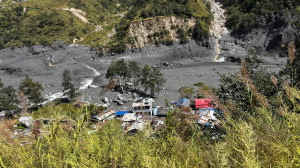
As the government plans to turn demolition sites into gardens, environmental experts say tens of thousands of tonnes of mixed debris could contaminate rivers, worsen flooding, and repeat mistakes made after the 2015 earthquake. People seen on the demolition debris near the Dhobikhola corridor in Kapan, Kathmandu in this recent photo. Angad Dhakal/TKP
As broken concrete and household waste from recent demolitions of squatter settlements pile up along the Bagmati, Manohara, and Dhobikhola river corridors, public attention has largely focused on displaced families and on where informal settlers will go next. But environmental experts warn another crisis may already be taking shape beneath the rubble itself.
Without proper segregation, recovery and disposal systems, waste management expert Ashish Khanal said the debris generated from the demolitions could trigger “a second crisis,” this time an environmental one.
The government has tasked the High-Powered Committee for Integrated Development of the Bagmati Civilisation with managing the waste and coordinating the next steps.
Udhav Nepal, the deputy project director at the high-powered committee, said the government plans to turn the demolition sites into “very beautiful gardens,” covering the debris with soil and planting greenery on top. The committee also plans to build an embankment parallel to the river, along with a drainage structure.
Nava Raj Pyakurel, spokesperson at the Ministry of Urban Development, said the Bagmati committee’s first priority is identifying lowland areas along the riverbank where debris can be used as filling material.
The Ministry of Urban Development lacks data on the total volume of debris produced—an information gap that makes many doubt how the committee can appropriately address the issue. “You cannot properly design transport systems, storage sites, recycling capacity, disposal plans, or environmental safeguards without understanding the volume and composition of the debris,” said urban planner Shrinkhala Khatiwada.
According to Khanal, an average structure demolished generates eight to ten tonnes of debris. With 2,687 structures destroyed across the entire eviction drive, there are likely tens of thousands of tonnes of demolition waste produced.
Given the scale and complexity of the debris, environmental experts argue the government’s plan is flawed and unscientific. While environmental engineer Saksham Shrestha agreed that using debris to fill lowland areas is an effective method to repurpose concrete waste, he said the material in its current condition is likely unsafe to reuse.
Concrete debris must be tested before reuse because of how it may interact with surrounding soil, groundwater and river systems, Shrestha argued.
When river runoff or rainfall percolates through debris, it can produce leachate, a highly alkaline liquid waste. The leachate can alter the water's pH and trigger algal blooms, harming aquatic life.
Shrestha said there are ways to neutralise concrete waste. One method is microbial-induced calcite precipitation, which chemically stabilises the concrete and reduces leachate production. But he questioned whether the government is thinking along those lines.
Khatiwada echoed the concern. While the concept itself is not inherently wrong, she said there is a major difference between “engineered reuse and uncontrolled dumping.” If debris is sorted, tested, processed, and compacted properly, then some reuse may be appropriate. But she argued that if mixed debris is simply dumped into floodplain areas because they appear empty, it could increase long-term flood risk.
Khanal agreed that the government’s proposed embankment could reduce overflow if scientifically designed, but if poorly managed, could create problems later on.
Nepal said the Bagmati committee is asking informal settlers to retrieve their belongings from the debris. Whatever remains, he said, “will be managed,” a vague promise that worries Tanuja Pandey, co-founder and president of climate justice movement Harin Nepal.
Pandey argues Kathmandu has long offloaded its environmental burden onto poorer communities outside the city. “The costs of rich cities are always being paid by economically vulnerable settlements nearby,” she said.
Of the remaining debris, the committee will decide what can be reused and what will be discarded. “Whatever is usable, we will sort out,” Nepal said, though committee officials have not yet detailed how the segregation process will work.
Some decisions have already been made. The committee, for example, has decided not to recycle concrete. But Shrestha argued that concrete can still be repurposed into road aggregates, pipe bedding and retaining walls.
Iron is fully recyclable without losing its strength, while wood can be repurposed into furniture, mulch or biomass fuel.
A 2024 study showed that more than 70 percent of demolition waste can be recovered and recycled, a standard upheld by the European Union. Khanal said many countries consistently recycle construction and demolition waste, offering examples Nepal could learn from. Countries such as Japan, Ukraine and South Korea have integrated recycling into reconstruction efforts and turn rubble into materials for roads and other construction projects.
“Internationally, there is a growing shift toward circular reconstruction, where demolition material is treated as a recoverable resource,” said Khatiwada.
Nepal has seen the consequences of poor debris management before. In the aftermath of the 2015 earthquake, debris from collapsed buildings was dumped along riverbanks, scattered across open spaces and left blocking streets for months. Thousands of tonnes of debris ended up in landfills.
Now, as large-scale demolitions once again leave vast piles of rubble across Kathmandu Valley, the country risks repeating many of the same mistakes. However, there is a major distinction this time, one that places far greater responsibility on the government: unlike the 2015 earthquake, this destruction was planned.
“That response was understandable during a national emergency,” Khanal said. This time, he argued, the ecological consequences should not have come as a surprise.
From an environmental perspective, experts believe the government’s approach was flawed from the start. According to Khanal, an environmental impact evaluation (EIE) should be conducted before a single structure is demolished. Through EIE, authorities would identify the materials present in the structure and determine what can be reused, recycled and safely disposed of.
Second, the demolition itself would be controlled and phased. Khanal said many countries now use selective demolition methods that separate materials during dismantling rather than after structures have already been torn down. “We should not mix all the materials together during demolition and then try to extract them later,” he said.
However, in the latest eviction drive, that is exactly what happened. With hazardous materials now mixed into recyclable debris, there is a limit to what can be recovered. While Khanal said restoring the river corridor with greenery is positive in theory, he argued that simply covering mixed demolition waste with soil and vegetation is not a sustainable solution.
At this point, the next step is sorting the mixed debris. Khanal said the government must immediately establish a debris management site to enforce segregation and identify the recyclable fraction of material that can be extracted. He thinks the Bagmati committee’s plan to build a garden may potentially work if non-hazardous waste is separated from the rest of the debris and properly compacted to maintain ground stability.
“But the committee is failing on this as well,” Pandey said. She argued that officials are overlooking the full scope of what has been destroyed. During demolitions, it is not only concrete and brick that break apart, but household contents as well: batteries, electrical units and metal cookware. Batteries, for example, can contain heavy metals and high levels of mercury, which can pose serious environmental risks if not properly separated and disposed of.
“Demolishing an entire settlement and not having a proper plan will create problems,” said Pandey.
While Pyakurel insists the situation will be managed better than it was after the 2015 earthquake, environment experts are sceptical in the absence of proper data and a research-backed plan.
At demolition sites, families climb through the rubble in sandals or flip-flops, pulling planks of wood, dented cookware, and torn, dust-covered clothing. This is what Khanal calls “informal recovery”, where individuals sift through the waste to retrieve valuable materials. But the process is unplanned and unregulated, raising public health concerns.
Neither Nepal nor Pyakurel outlined a clear health and safety strategy, something Khanal said is critical. Informal handling of debris exposes local residents to dust and harmful substances. The lack of personal protective equipment, dust suppression systems and regulated transport presents serious public health risks.
With the monsoon season round the corner, environmentalists warn that time is running out. The demolition sites’ close proximity to river corridors already makes the area particularly sensitive. Khanal worries that, once heavy rainfall begins, the debris will be swept quickly into the rivers.
Once regular rainfall begins, debris becomes mobile, with runoff carrying pollutants much faster into rivers. Floodplains are critical to the river systems because they absorb excess water during heavy rainfall.
If the Bagmati committee fills the plains with mixed debris under its proposed plan, Khatiwada worries the river's natural flood absorption capacity will be reduced.
“The monsoon changes the entire risk profile,” she said.
Officials say they are aware of the risks posed by the approaching monsoon. Pyakurel said authorities are working on “some design and backup plan” to prevent flooding, but he declined to give details, saying the plans are still being developed
Nepal defended the overall approach arguing that it would protect the areas around rivers. “It will be good from an environmental point of view,” he said. “We’ll manage it.”
Construction and demolition waste is a concern not only during large-scale demolition drives. It is already an ongoing issue across Nepal, particularly in rapidly urbanising areas like Kathmandu Valley. According to a study published in the Journal of UTEC Engineering Management, Kathmandu Valley generates approximately 28.5 tonnes of construction and demolition waste every day. Nationally, the total volume is estimated to be 55-65 million tonnes. Even without disasters or large-scale demolition drives, Nepal faces significant waste management challenges.
The emerging problems expose broader structural gaps in the country’s waste management system. Shrestha said Nepal still lacks the technology needed to sort, process and recycle large volumes of demolition debris.
Currently, much of the demolition waste is handled through informal systems including NGOs and local recyclers. With the recycling industry growing rapidly in Kathmandu, both Pandey and Shrestha are hopeful the government can collaborate with the private sector to access increased resources.
But the onus does not fall on the government alone. It also begins at an individual level. Shrestha said many people remain unaware of the consequences of waste, throwing trash directly into rivers instead of segregating it. “Environmental justice has never been a priority in Nepal,” said Pandey.
Whatever approach the government chooses, Shrestha says it must be properly documented: how the waste was repurposed, how it was managed, and what is the current condition?
He remains optimistic that, with proper documentation and skill development, Nepal can manage demolition debris effectively.




 14.69°C Kathmandu