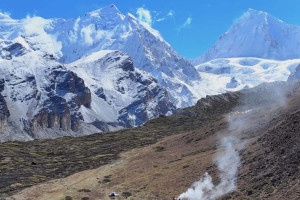
Sunday holidays make many jobholders’ Saipal dreams come true
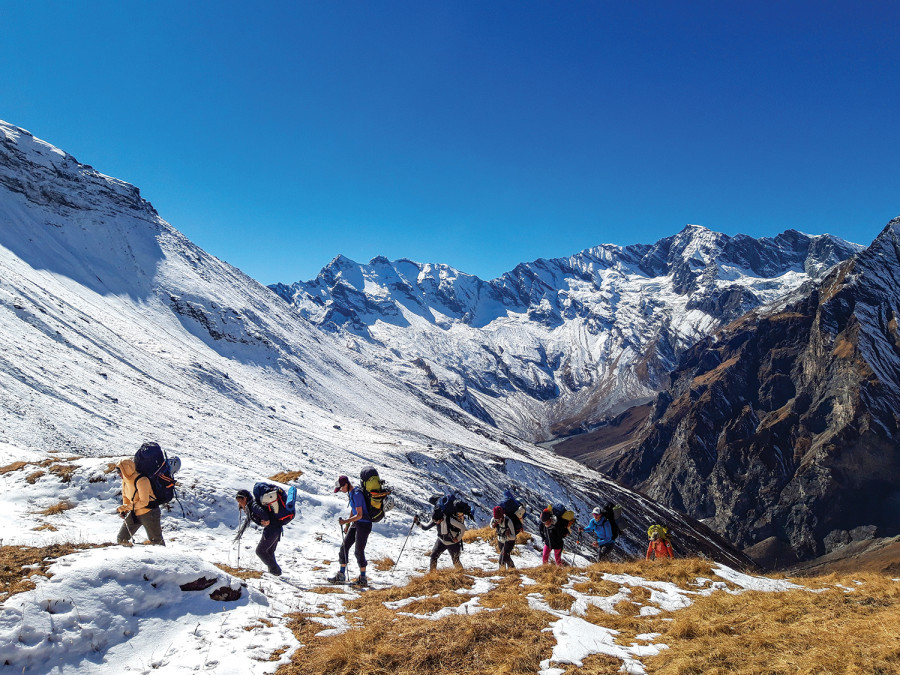
Growing numbers of travellers from across Sudurpashchim are flocking to the remote Himalayan destination, boosting homestays, local businesses and trekking activity. Travellers en route to Saipal. Basant Pratap Singh/TKP
Harish Awasthi of Sunarya Rural Municipality in Baitadi works at the Saipal branch of Everest Bank.
A travel enthusiast, he had long dreamed of reaching the Saipal Base Camp. But despite being posted at Dhalaun, the gateway to Saipal, for nearly two years, he had never managed to fulfil that wish.
“The very day I was posted here, the first thing I thought I would do was visit Saipal Base Camp,” Awasthi said. “But work pressure and having only one weekly day off meant I never got the chance.”
This time, however, he finally made the trip after getting two consecutive days off. Taking advantage of the three-day break created by Labour Day on May 1, followed by the weekend, he reached the base camp and returned mesmerised by the beauty of Saipal.
“If I had been transferred without seeing such a beautiful place, I would have regretted it deeply,” he said. “The moments spent in the lap of Saipal are unforgettable.”
Since the government introduced a two-day weekend—Saturday and Sunday—on April 5, employees like Awasthi have increasingly begun using their weekends to travel to various destinations.
As the number of travellers grows, tourist destinations across Sudurpashchim Province, including Saipal, have started seeing increased activity. The usually quiet Saipal Himal Base Camp in Bajhang has witnessed a noticeable rise in domestic visitors since the Nepali New Year.
Visitors are arriving not only from Bajhang but also Kailali, Kanchanpur, Doti and Dadeldhura to witness the beauty of Saipal.
“I had already visited Annapurna and Api Base Camp, but my wish to visit Saipal remained unfulfilled,” said Ramesh Kunwar, chief of the Health Office in Kailali, who returned from Saipal Base Camp last week. “The two-day holiday finally made that dream come true.”
Kunwar said the Saipal region, where snow-covered mountains can be seen in every direction, felt more beautiful and attractive than other Himalayan base camps he had visited.
Taking advantage of three public holidays, he added two extra leave days and completed the Saipal journey in five days before returning to Dhangadhi. At a time when Tarai districts are experiencing rising temperatures, he believes Saipal could become an ideal destination for people seeking cool.
Paras Khadka, a public health officer at the Health Office Bajhang and a member of the team, said the trip had given him renewed energy after exhausting routines at work.
“We were tired from continuous walking. But once we reached the lap of Saipal, all our fatigue disappeared,” he said. “After returning, I feel refreshed with new energy.”
He added that the peace and magical scenery he experienced in Saipal could not be adequately described in words.
According to him, Saipal could become an ideal destination for employees looking to make the most of short holidays, as the journey can be completed within a limited time.
He said upgrading trekking trails, improving homestay facilities, and training local guides and porters in tourist-friendly hospitality could help turn the Saipal region into a major trekking destination.
From mid-April to mid-May, more than 500 people visited Saipal Base Camp. Of them, 130 were employees from various offices, according to Milan Dhami, an employee of Saipal Rural Municipality stationed at Dhaloun, the entry point to the base camp, to maintain visitor records.
“This is the first time we have seen so many employees coming to Saipal,” said Dhami, who has been keeping visitor records for the past four years. “Previously, only a few employees would visit during Dashain and Tihar holidays. This year, however, four or five arrive almost every day.”
He said employees working in offices across all districts of Sudurpashchim Province have been visiting Saipal, though most are currently based in Bajhang.
The rise in domestic tourists has also increased activity in homestays within the rural municipality.
“Since the beginning of the Nepali New Year, not a single day has been empty. Around 10 to 15 guests arrive daily,” said Rudma Bohara, who operates a homestay in Dhaloun. “Some days, we even have to send guests elsewhere because there is no room left in the house.”
Operators say all 10 homestays along the route to Saipal Base Camp are regularly packed with visitors.
Manabir Bohara, chairperson of the Saipal Rural Municipality, said the government’s decision to introduce a two-day public holiday has helped promote destinations like Saipal and boost domestic tourism.
“People visiting Saipal post photos and videos on social media. Some even write travel experiences,” he said. “Seeing those posts encourages others to visit too.”
He added that trekkers visiting Saipal often buy local products as souvenirs, increasing sales of ghee, honey, wool products, bamboo handicrafts and agricultural goods. This, he said, has helped locals earn some money while staying in their villages.
Hotel operators in Chainpur say tourist movement has also increased in other destinations in Bajhang, including Khaptad National Park and Surma Sarovar.
“Every day, around 15 to 20 people who are either heading out on trips or returning from them visit our hotel,” said Ramesh Kunwar, a hotel operator in Chainpur, the district headquarters of Bajhang.
“The number of travellers has grown after the introduction of the two-day weekly holiday.”




 25.89°C Kathmandu