Court halts government’s ‘reform push’, and some see institutional friction
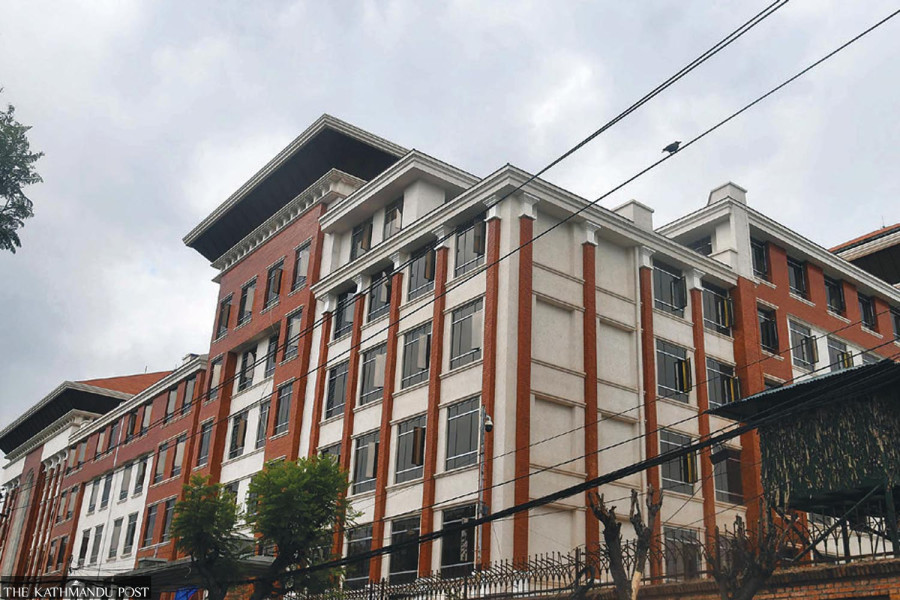
The orders blocking ban on trade union and student union come against a backdrop of tensions, including disputes over recent habeas corpus orders and chief justice nomination. A new building of the Supreme Court within the Singha Durbar premises. Post Photo
Within a week, the Supreme Court issued orders suspending three major decisions of the Balendra Shah-led government, obstructing the implementation of key priorities it had set.
On Monday, the court stopped the implementation of a pair of decisions that had been presented as key reform measures in the government’s ‘100-point action plan’. One order suspended the government’s move to abolish trade unions of civil servants, while another blocked its decision to ban student unions in universities and colleges. Although the rulings are temporary, they prevent the government from enforcing the decisions until further hearings are completed.
Earlier, on May 8, the Supreme Court had also ordered the government not to forcibly evict squatters and informal settlers from riversides without following due legal procedures and ensuring proper rehabilitation.
The back-to-back interim orders issued by different benches of the top court within 47 days of the government’s formation have raised questions over whether they signal a troubled relationship between the executive and the judiciary.
Former Supreme Court justice Krishna Jung Rayamajhi said the recent developments did signal a rift between the executive and the judiciary, as court rulings have halted the execution of priorities set by the Balendra Shah administration.
While rulings have been issued halting three crucial decisions, hearings on petitions challenging the formation of a commission to investigate the wealth of public officials and the appointment of the attorney general are expected soon.
The first major order was halting the demolition of squatter settlements.
On April 24, the District Administration Office in Kathmandu issued what it called an ‘urgent notice’ dated April 23, asking residents living along riverbanks to vacate the land by 7 pm on April 25.
The notice gave residents less than 24 hours to leave. Even before the notice became public, police had begun making announcements through loudspeakers in several squatter settlements.
Gen Z leaders of the informal settlers’ movement, including Gopal Ranapaheli from the Thapathali settlement, filed a petition at the Supreme Court the same day, arguing that the government was attempting to evict people without identification, compensation or alternative arrangements.
The first hearing was held on April 27, two days after the demolition drive began. Ten days later, on May 8, a division of Justices Kumar Regmi and Nityananda Pandey finally issued an order barring the forcible removal of additional squatters and informal settlers.
Coincidentally, the previous day (May 7), the Constitutional Council led by the prime minister recommended Manoj Sharma, fourth in the seniority ranking, for appointment as chief justice of the Supreme Court. He was picked over Acting Chief Justice Sapana Pradhan Malla and Justices Kumar Regmi and Hari Prasad Phuyal. “The chief justice nomination made without considering seniority has complicated the relations between the two state agencies,” said Rayamajhi.
Signs of tension were also visible during the Law Day celebrations on Saturday.
Acting Chief Justice Malla had invited President Ram Chandra Paudel, Prime Minister Shah, Speaker DP Aryal and Law Minister Sobita Gautam to the annual function. While the President, Vice President and Speaker attended, the prime minister and law minister were absent. Their absence prompted speculation that relations between the executive and judiciary had deteriorated further.
Speaking at the event, the acting chief justice said judges should not fear pressure even if the government enjoys a [near] two-thirds majority in parliament. She also suggested she was prepared to face impeachment if necessary while protecting judicial independence.
Her remarks drew strong reactions from leaders of the ruling Rastriya Swatantra Party, including party chair Rabi Lamichhane, who publicly defended the government’s decisions. Ganesh Parajuli, the party’s deputy parliamentary party leader, has even accused the acting chief justice of breaching judicial norms, saying Malla challenged the ‘two-thirds government from the streets’.
If the claims of Supreme Court justices are anything to go by, the government has expressed dissatisfaction over recent habeas corpus orders issued by the court in cases involving former prime minister KP Sharma Oli, former home minister Ramesh Lekhak and former minister Deepak Khadka.
The issue was reportedly raised during a meeting of judges after Manoj Sharma was nominated for chief justice.
One senior justice claimed the government found itself in a difficult situation after the Supreme Court ordered the release of detainees and it took it as a challenge to its decisions. “We believe the seniority in the chief justice recommendation was bypassed because it anticipated further obstruction from the Supreme Court against its decisions,” said the justice.
The top court’s intervention in the Shah government’s decision continues. On Monday, it asked the government not to implement its decisions to ban student unions in universities and dissolve employees’ trade unions. Both moves were high on the government’s priorities. It has even issued ordinances to execute the decisions. Three judges on the five-member constitutional bench found the ban to be against the constitutional rights to organise.
With the court order in place, student unions are now free to continue organisational activities inside universities and colleges until the case is settled.
Senior advocate Bipin Adhikari, who also is a professor at the School of Law, Kathmandu University, argued that such a major restriction on student unions should have been discussed in Parliament instead of being introduced through executive decisions and ordinances.
“The right to organise students in universities was achieved through a long political struggle. It cannot be suddenly removed through administrative decisions,” he said.
Rayamajhi said the government had bypassed the proper legislative process in imposing the ban. “In a democratic republic, people must have the right to organise and develop leadership. If political parties believed student unions were unnecessary, they could have introduced a law through Parliament after broad debate,” said Rayamajhi.
Supreme Court spokesperson Arjun Prasad Koirala declined to comment on specific interim orders, saying justices are independent in expressing their views through rulings.
Besides the interim orders already issued, the Supreme Court is also hearing petitions against other controversial decisions of the Shah government. One petition challenges the appointment of Attorney General Narayan Datta Kandel, arguing that he does not meet constitutional qualifications for the post. The court had initially rejected the petition but later ordered its registration. A hearing has been scheduled for May 18.
Another set of petitions challenges the government’s decision to form a commission under former Supreme Court justice Rajendra Kumar Bhandari to investigate the assets of high-ranking officials and employees who have held public office over the past two decades.
Petitioners argue that the commission is unconstitutional. On April 29, a single bench of Justice Balkrishna Dhakal ordered the government to submit a written response. Another petition filed this week objects to the inclusion of judges and former judges within the commission’s investigative scope.
Senior advocate Raju Prasad Chapagain says the court’s decisions should not be linked to broader political disputes. “These decisions should be viewed through constitutional principles, not political calculations,” he said.




 14.4°C Kathmandu