She climbed the sky: Half a century of women conquering Mount Everest
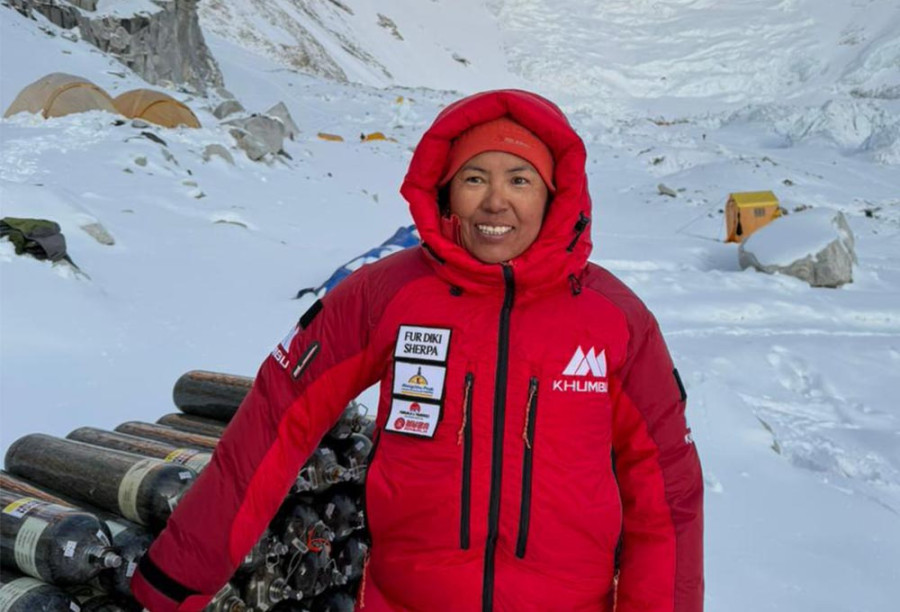
From Junko Tabei’s historic ascent in 1975 to a new generation of Nepali climbers, women have steadily reshaped Everest’s record books. Everesteer Phur Diki Sherpa at the base camp. Photo: Courtesy of Phur Diki Sherpa
May 12, 2026. Phur Diki Sherpa returned to the Everest Base Camp after a three-day acclimatisation rotation to Camp III. This season, however, the 51-year-old’s sights are not on Everest but on neighbouring Lhotse, the world’s fourth-highest mountain.
Phur Diki has an ambitious plan: to reach Lhotse’s summit from Base Camp within roughly 24 hours, and return—a record-setting climb.
Yet when she speaks of her overall climbing career, she starts not with her own aspirations, but the dreams her husband never fulfilled.
“My husband was an icefall doctor,” she recalls. Icefall doctors are the experienced Sherpas who fix and maintain climbing routes for other climbers. It was in the pursuit of this work that Phur Diki’s husband lost his life.
“It was his lifelong ambition to stand on the summit of Everest,” she says. “But he was lost in an accident in the Khumbu Icefall. That dream remained unfinished.”
Phur Diki was 37 when her husband, Mingma Sherpa, died in 2013. She was raising three daughters in a small village in Solukhumbu, running a modest hotel and looking after a few yaks. Back then, the mountains were simply part of the horizon, not part of her life’s path.
“Slowly, I started making a plan,” she says. “Two of us decided to climb Everest to give hope to widowed women, to show that even without husbands, we are still capable of building a life and achieving something on our own.”
On May 23, 2019, at 5:25am, she reached the summit of Everest alongside Nima Doma Sherpa. Nima had also lost her husband on the mountain. At the top, they held up a banner that read: Hami pani garna sakchhaun [We can do it too].
The banner captured the essence of women’s struggle to reach the Everest summit.
Her story mirrors the long, uneven ascent of women in Himalayan mountaineering.
Phur Diki’s journey is not hers alone — it is the collective story of women's success on Everest over the last 50 years.
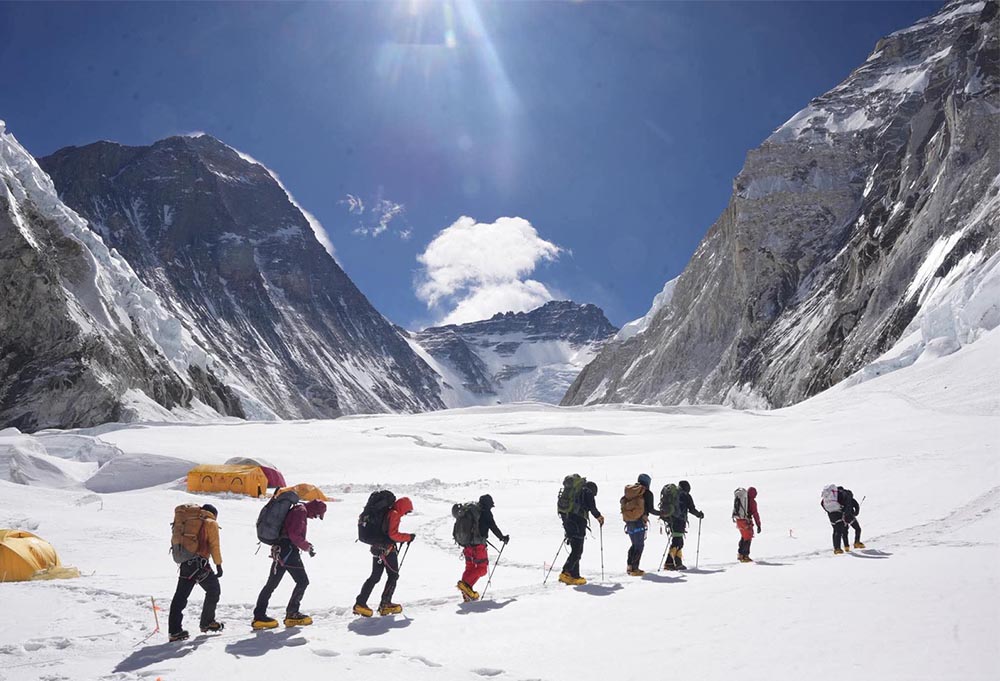
A group of climbers seen ascending to the higher camps. Photo: Courtesy of Purnima Shrestha
The non-governmental organisation Himalayan Database has documented thousands of summit attempts during this period. Within those statistics, the numbers of women climbers, successful ascents, and survival rates show a steadily rising trend.
But the data on Everest tells only half the story. What the numbers cannot measure is the weight of hardship these women carried — long before they ever faced the mountain.
The long wait for women on Everest
On May 29, 1953, Tenzing Norgay Sherpa and Edmund Hillary became the first to reach the summit of Everest. A woman would not stand there for another 22 years.
On May 16, 1975, Junko Tabei, a 35-year-old Japanese climber, reached the top. Just two weeks earlier, she had been buried in an avalanche and briefly lost consciousness after her tent collapsed under snow. She recovered and continued.
Eleven days after Tabei’s footsteps marked the summit, Chinese climber Phanthog arrived at the same point from the north face — a different route, the same sky.
Two women. Eleven days apart. In a sport that had spent decades telling women that the summit was no place for women in this line of work.
That year, 31 women attempted Everest. Only two stood on top. A success rate of under 10 percent — less than half the rate achieved by male climbers that same season. The mountain was not harder for them. The world around the mountain was.
Today, the gap has narrowed significantly. Yet women still represent only about one in every ten Everest climbers.
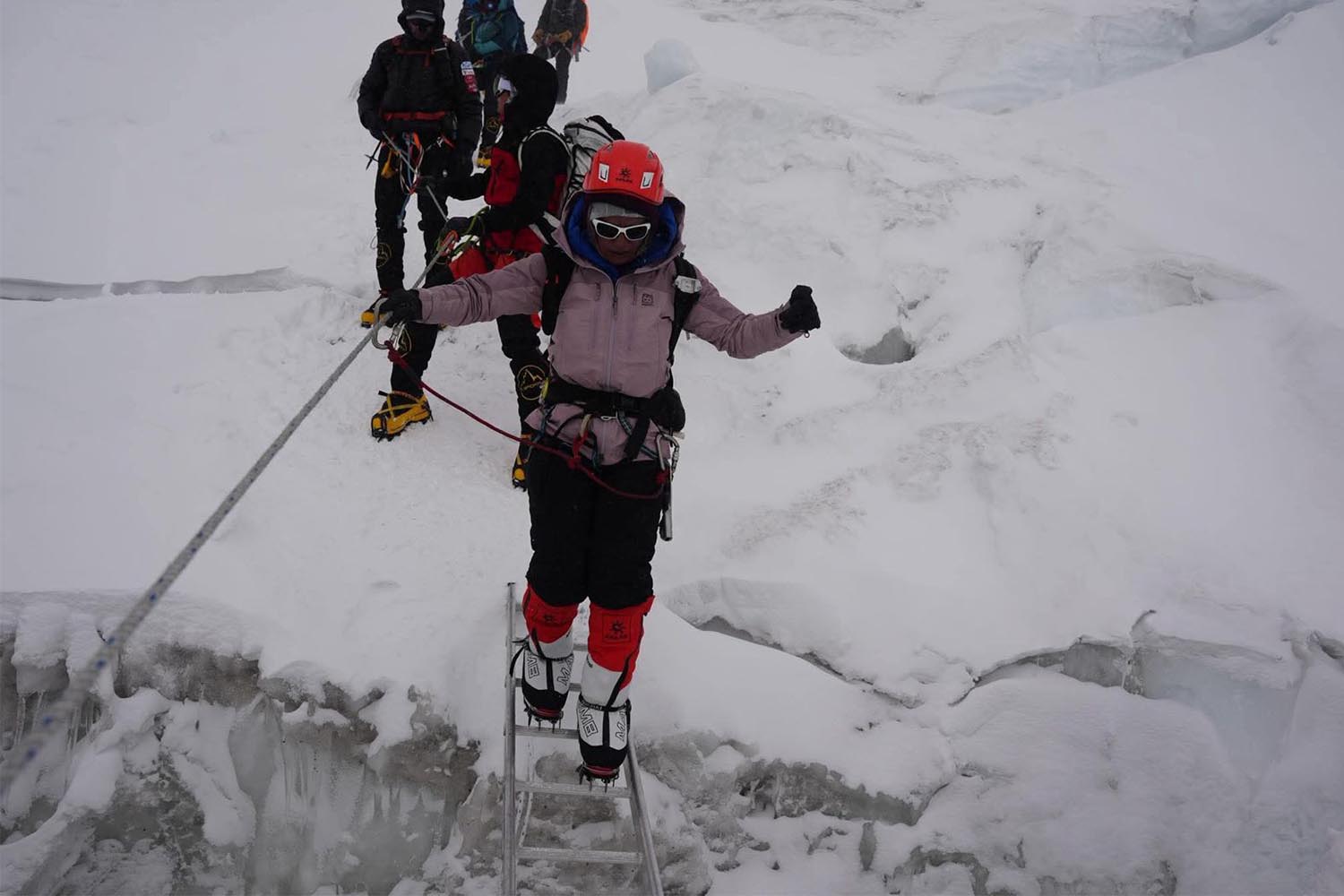
Purnima Shrestha, a photojournalist from Gorkha, climbed Everest for the first time in 2018 and, in 2024, set a record by summiting it three times in a single season, all within 13 days. Photo: Courtesy of Purnima Shrestha
For Nepali women, the summit remained out of reach for nearly two more decades after Tabei’s historic climb.
Pasang Lhamu Sherpa, 30, changed that.
After three attempts, she finally obtained a permit and reached the summit on April 22, 1993, becoming the first Nepali woman to do so. She died during her descent the same day at around 8,750 metres.
Her death cast a long shadow. Another Nepali woman would not summit Everest for seven years.
It was not until May 18, 2000, that Lhakpa Sherpa reached the summit and returned safely, becoming the first Nepali woman to survive an Everest ascent. In the 25 years since Tabei set foot on the summit, more than four dozen foreign women had successfully climbed and returned — yet not a single Nepali woman had claimed that achievement. Lhakpa broke that silence.
The same expedition also saw Pemba Doma Sherpa reach the summit the following day. The climb was part of the Millennium Nepali Women Everest Expedition, organised by a team that included Ang Tshering Sherpa, a seasoned climber then active in Nepal’s mountaineering association.
By then, dozens of foreign women had already summited Everest. Nepali women were still catching up.
Ang Tshering remembers the effort clearly.
“More than 50 foreign women had already stood on that summit,” Ang Tshering said. “But not a single Nepali woman. That’s why we organised the expedition.”
Ang Tshering has been in mountaineering since he was 11, carrying loads alongside his father and uncle on Himalayan expeditions. Now 74, he still vividly remembers the preparations for that landmark women’s Everest expedition 26 years ago.
“There were five women in the team,” he says.
When Lhakpa Sherpa successfully summited Everest, she went on the following year to set a record for the most ascents by a woman. The record was later broken by a foreign climber. Sponsors were then brought in to send Lhakpa back up the mountain again.
“She reclaimed the record,” Ang Tshering says. “Then it was broken again, and she climbed once more. But after her fifth ascent, nobody has been able to break her record for a long time.”
That climb marked the beginning of a career that would make Lhakpa one of the most accomplished women in Everest history.
Now based in the United States, she holds the women’s record for most Everest summits, reaching the top ten times by 2022. She is now at the base camp for another attempt.
Breaking barriers beyond Everest
Maya Sherpa was beginning her career as a trekking guide when Pemba Doma and Lhakpa set foot on the summit.
“I started as a trekking guide in 2001,” Maya said. “Most of my clients were women. And they would always ask me — ‘When are you going to climb a peak yourself?’”
The question followed her. Eventually, she stopped deflecting it.
In 2003, she decided to try, first on Ama Dablam, then Cho Oyu, both among the most technically demanding peaks in the Himalaya. In 2006, she climbed Everest, followed by another ascent from the Tibetan side in 2007.
At the time, only five Nepali women had reached the summit.
“Back then, people would say women did not belong in this job,” she says. Maya says access to opportunities and the high cost of climbing remain major challenges even today for women who want to pursue mountaineering as a profession.
In 2008, a major milestone arrived with the Inclusive Women Everest Expedition, led by Sushmita Maskey. Ten Nepali women reached the summit between May 22 and 24, including Usha Bista, Shailee Basnet, Chunu Shrestha, Maya Gurung, Asha Kumari Singh, Nima Doma Sherpa, Pemba Doma Sherpa, Pujan Acharya and Nawang Phuti Sherpa.
Since then, Nepali women have steadily increased their presence in high-altitude climbing.
Mingma Sherpa, the first Nepali climber to complete all 14 peaks above 8,000 metres, says the change has been structural as well as cultural.
“Now the idea that women can do this has taken root,” he says. “Earlier, they were confined to household roles. That has changed.”
From porters to record holders
Dawa Yangzum Sherpa began as a trekking guide but struggled to find work.
“People said this is a man’s job,” she recalls. “They said there was no future for me. But I had no other option.”
In 2012, she joined an expedition as support staff, carrying loads and fixing ropes. Today, she is the first Asian woman certified as a mountain guide and has climbed all 14 eight-thousanders.
Her trajectory reflects a broader shift in Himalayan mountaineering.
Data from the Himalayan Database, maintained since 1921, shows more than 26,000 Everest climbing attempts over a century. Women still represent a small fraction, but their presence has grown steadily.
In this field, long dominated almost entirely by male Sherpa workers, Himalayan Database records show that among the 8,637 people who have attempted Everest as support staff and load carriers, only seven women, including Dawa, have ever worked on the mountain in those roles.
Records, ambition and unfinished dreams
Among the newer generation of climbers is Purnima Shrestha, a photojournalist from Gorkha. She climbed Everest for the first time in 2018 and, in 2024, set a record by summiting it three times in a single season, all within 13 days.
“Reaching the summit is only half the success,” said Shrestha, who is at the base camp for another ascent. “Coming back alive is when I feel complete.”
Another record belongs to Phunjo Jhangmu Lama, who completed the Base Camp to summit and back in 24 hours and 26 minutes.
Beyond these individual records, the past five decades have brought significant progress for women across many areas of mountaineering. An analysis of Himalayan Database records shows one of the clearest signs of change is that climbing in the high Himalaya has become markedly safer for women.
Safety, survival and changing patterns
In the five years after a woman first reached the summit of Everest, only one out of every 10 women who attempted the climb succeeded. Among men, the figure was roughly two in 10.
Today, those success rates have risen dramatically. In the five years since 2020, around seven women and eight men out of every 10 climbers attempting Everest have successfully reached the summit.
Ang Tshering Sherpa, former president of the Nepal Mountaineering Association, attributes the improvement to advances in technology, better access to information, and modern climbing equipment. He says the rise of commercial expeditions has also drawn more trained climbers who can afford the cost of high-altitude mountaineering.
During the spring climbing season last year, not a single woman died on Everest. Of the 112 women who attempted the summit, 85 succeeded.
A broader look at the past 50 years shows that Everest has gradually become safer for both women and men. But the improvement has been particularly striking for women, whose mortality rates have fallen significantly over time.
An analysis of Himalayan Database records shows that as summit success rates on Everest have improved, death rates have fallen sharply as well. Between 1975 and 1980, around 40 out of every 1,000 men attempting Everest died on the mountain. Among women, the figure was about 25 in every 1,000 climbers.
Over the past decade, mortality rates for both men and women on Everest have fallen to below one percent. But men are still dying at a significantly higher rate, nearly five times more than women. In practical terms, that means roughly 10 men die for every 1,000 climbing attempts, compared with about two women.
One major reason is that the most dangerous work on Everest is still carried out almost entirely by male Sherpa workers, who fix ropes, carry loads and prepare climbing routes through hazardous terrain.
By the end of the 2025 climbing season, 348 people had died on Everest. More than a quarter of them, 96 climbers, were Sherpa workers on expeditions. Three more Sherpas have already died this year.
Another reason is that the number of female climbers still stands at only about 10 percent. Over the last 50 years, while 23,320 men went to the Everest region as climbers, only 2,252 women reached there. In other words, the sample size is small compared to that of men. Physician Buddha Basnyat, an expert in high-altitude medicine, explains that such factors contribute to the lower mortality rate among women (when comparing the ratio of men and women who attempt the climb based on gender).
According to the International Mountaineering and Climbing Federation, most deaths on the mountains are caused by altitude-related health complications, conditions that appear more frequently among men.
However, its medical commission notes that no clear biological explanation has been established for the difference in mortality rates. It suggests that a range of practical, social and cultural factors may play a role in these outcomes. These may include the tendency for women to climb in groups rather than alone, a lower likelihood of undertaking solo expeditions, and a greater willingness to turn back when weather conditions deteriorate. The report, however, stresses that these are not confirmed findings and should not be treated as proven facts.
Data from the Himalayan Database also offers a glimpse into how decision-making differs between male and female climbers when abandoning an ascent.
On Everest, women are more likely to turn back after noticing early signs of health problems. In contrast, many male climbers tend to retreat only after getting lost or losing their route, suggesting different thresholds and circumstances for retreat on the mountain.
So far, 14 women have died on Everest, and only one of them was Nepali, Pasang Lhamu Sherpa. In most of these cases, eight of the 14 deaths occurred during the descent from the summit, including Pasang Lhamu. She had reached the summit and was just 99 metres into her descent when she died.
A review of five decades of data reveals a paradox. The use of supplemental oxygen has risen steadily among both male and female climbers. Yet women have consistently used it less than men.
Between 1975 and 1980, 12 percent of women and 28 percent of men attempting Everest used supplemental oxygen. By 2020 to 2025, those figures had risen sharply to 74 percent for women and 84 percent for men.
Across each decade, oxygen use has increased, but the gap between men and women has persisted rather than closing.
A 2020 study by Raymond Huey of the University of Washington, along with researchers from three other US universities, examined how age, gender, experience and the growing number of climbers influence both summit success and mortality on Everest.
The study focused only on commercial climbers, excluding Sherpa support staff.
It found that improved weather forecasting, increased use of supplemental oxygen and the rise of organised commercial expeditions were key factors behind higher success rates on the mountain.
The weight of dreams
For women who want to enter mountaineering, the barriers often go beyond what statistics can capture. Phur Diki says the most persistent obstacle is perception.
“Even when women do good work, there is still this belief that they cannot do it,” she says. “But if given the opportunity, they can achieve anything.”
Phur Diki herself stands as proof of that. After summiting Everest, she found limited work opportunities and decided she had to build her skills further. She trained as a guide and instructor. In October last year, she led an all-women expedition to Himlung Himal (7,126 metres), another record-setting ascent.
She is now preparing to summit Lhotse, carrying with her her father’s unfinished dream.
One dream belonged to her husband, who had once reached the South Col before turning back. She fulfilled that dream seven years ago when she climbed Everest.
The other belonged to her father, Ang Nima Sherpa, also an icefall doctor, who had long wanted to climb Lhotse but died before he could attempt it.
“My father’s dream was to climb Lhotse,” she says. “This time, I will complete that too.”
Her husband’s dream was fulfilled
Now it’s time for her father’s dream.
“And after that?”
“Dreams of three daughters,” she says without hesitation.




 22.94°C Kathmandu