New customs rules halt informal border trade at Tatopani
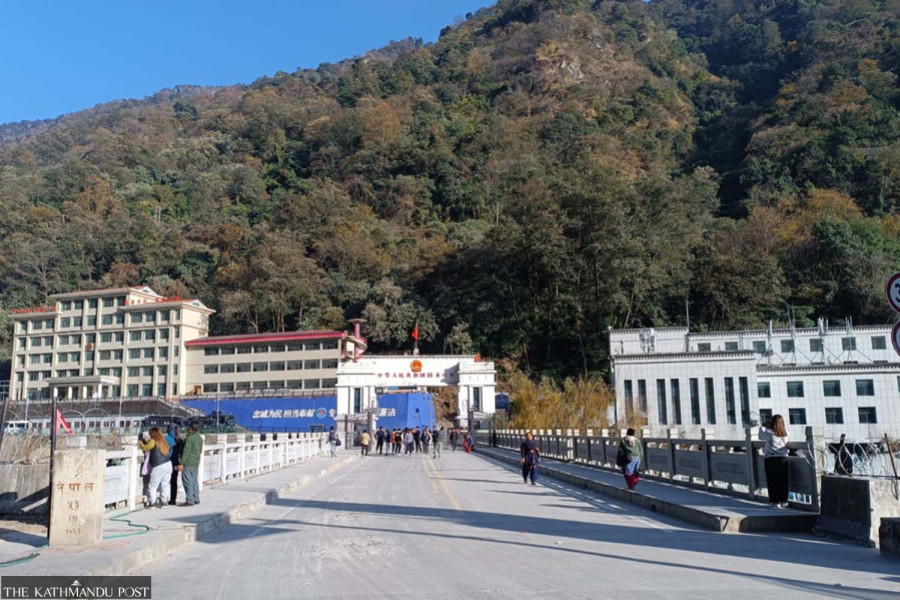
Restrictions on food imports without quarantine clearance have disrupted livelihoods in Nepal’s northern border communities and emptied the once-busy Zhangmu market across the frontier. Anish Tiwari/TKP
Nepal’s Tatopani border point with China has fallen unusually quiet in recent weeks after a new customs restriction abruptly halted the small-scale cross-border trade that sustained hundreds of families in the area.
The daily movement of local residents carrying bags of goods from the Chinese border town of Zhangmu has almost disappeared following a ban on bringing in food and plant-based products without quarantine clearance.
The Tatopani Customs Office said the restrictions were imposed at the Miteri Bridge passenger checkpoint after the government tightened enforcement of food and plant quarantine rules.
The move has effectively shut down the informal trade, a long-standing practice in which locals crossed the border each day to buy small quantities of goods from China and resell them in nearby Nepali towns.
Residents and local representatives said the new rules have pushed many border-area families into financial hardship.
Kumar Shrestha, ward chair of ward 2 of Bhotekoshi Rural Municipality, said many households in the area depended entirely on the small-scale trade for survival.
“Many families in the border region depended on this trade for their livelihood. Now they have been left with almost no work,” he said.
Until recently, residents from Tatopani, Listikot, Phulpingkatti and nearby settlements regularly travelled to Zhangmu to purchase food, household items and electronic goods before returning the same day to sell them in local markets.
Locals said the income from the trade covered daily expenses, children’s education and loan repayments.
Shanta Shrestha, who has been involved in the trade for years, accused the government of cutting off the livelihood of poor communities.
“We are not industrialists. We survive by selling the goods we carry back ourselves,” she said.
According to residents, food items have effectively been barred from entering through the passenger checkpoint for the past month.
The impact has also spread across the border into Zhangmu, where many small shops that relied heavily on Nepali customers have become deserted. Nepali workers employed there have also started returning home.
Sete Shrestha, a resident, said alternative employment opportunities are scarce in the Bhotekoshi area due to its rugged terrain.
“There is little cultivable land here and no industries. Cross-border petty trade was our main source of income,” he said.
Phunu Sherpa, president of the Bhotekoshi Chamber of Commerce, said discussions were ongoing at various levels to resolve the problem, but no breakthrough had been reached.
“People had been waiting for the full reopening of the Khasa route, but now they cannot even bring basic household goods,” he said.
The Tatopani border point has repeatedly faced disruptions over the years due to disasters and geopolitical events, including the 2015 earthquake, floods and landslides, the Covid-19 pandemic and fires on the Chinese side of the border.
A recent wildfire in China had also temporarily affected border operations.
Tul Bahadur Pandey, information officer at the Tatopani Dry Port and Customs Office, said the restrictions were being enforced under the government’s new regulations.
According to him, only VAT-registered businesses that complete all required procedures are now allowed to import goods.
“Quarantine clearance has been made mandatory for food products. At present, no goods are being released without customs procedures,” he said.
Before the new rules came into force, travellers commonly brought in goods worth up to Rs5,000 after paying customs duties.
Small traders, however, said the situation changed after the formation of the new government, and that almost no goods are now being allowed through the border point.




 15.28°C Kathmandu