



 28.24°C Kathmandu
1.jpg)
Wed, Sep 30, 2026
Bagmati Province
Regular school evolves into special for children unable to hear, speak
Eight students, all deaf and unable to speak, sat for the SEE after years of effort by teachers, parents and helping hands.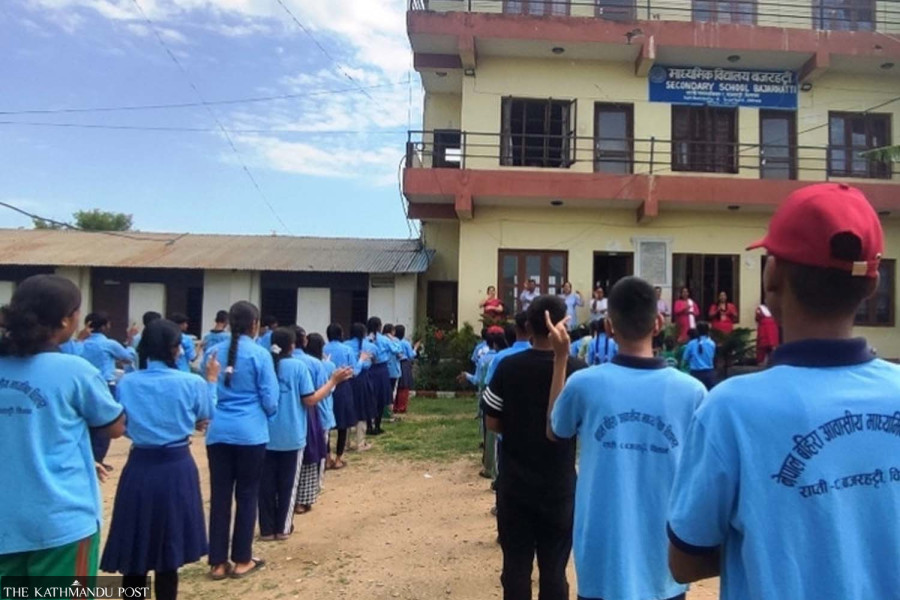
bookmark
Ramesh Kumar Paudel
Published at : May 8, 2026
Updated at : May 8, 2026 10:21
Chitwan
A small community school founded 57 years ago in Bajarahatti of Rapti Municipality-8, Chitwan, reached a milestone when its students sat the Secondary Education Examination (SEE) this year.
Eight students, all deaf and unable to speak, appeared in the SEE after years of effort by teachers, parents and other stakeholders determined to keep the children in school.
For Principal Mithu Kumari Pathak Dallakoti, the moment was emotional. “We started teaching children with hearing and speech disabilities in 1997. This year, we finally managed to take them to the SEE,” said Dallakoti.
The school, established in 1969, initially managed only grades 1 and 2. It started teaching up to grade 5 in 1983. In 1997, it opened a class for 10 deaf children with its internal resources and began teaching them through sign language before integrating them into regular classrooms.
Over the years, the number of normal students declined, and the school gradually transformed into a specialised institution where most classes are now taught through sign language. It currently runs as a residential school, providing both education and accommodation for children who often come from distant districts.
“Officially, we are still an ordinary community school that is supposed to run from 10 am to 4 pm like others. But the children we teach cannot simply return home every evening, so we had to arrange hostels as well,” said Dallakoti.
The school had 112 students last year and expects enrolment to reach around 135 this academic session. Most students are deaf and dumb. Children come not only from Chitwan but also from Makawanpur, Bara, Parsa and Nawalparasi East districts.
Ranjana Baral from ward 1 of Jitpur Simara Sub-Metropolitan City, Bara, travelled to Bajarahatti after hearing about the school from acquaintances. Her daughter, Roshani, joined the school last year after completing grade 6 at a school in Simara.
“There was no place nearby to continue her education in sign language. When I heard about this school, I came here with hope. Now my daughter can study and stay safely here,” said Baral.
Many guardians of students with hearing and speech impairments frequent the Bajarhatti-based school for education and safety of their wards.
Laxman Gurung from Ichchhakamana Rural Municipality-2 in Chitwan has enrolled both his daughters, Krishnamati and Nima Kumari, at the school. Neither can hear nor speak.
“My elder daughter joined here in grade 2 and is now in grade 9. She is very good at her studies,” said Gurung. “Without this school, my daughters would never have received this kind of education.”
Despite these successes, the school’s financial foundations remain fragile. Buddhi Raj Pathak, chairman of the school management committee, said the institution survives largely on community support apart from limited government funding. According to him, the government provides Rs5,000 per hostel student each month for 10 months a year, but the amount is insufficient to cover food, accommodation and staff expenses.
Local people regularly donate food, money and construction materials in memory of deceased relatives, during birthdays or on other family occasions. On April 16, local resident Dilliram Sapkota donated food supplies worth more than Rs15,000 on his son-in-law’s birthday. Earlier this month, Babita Dallakoti Kandel provided sugar and flour for hostel meals in memory of Khimraj Kandel and also contributed Rs5,000 to the school’s education fund.
“Food is often managed through such donations. We ask parents to buy clothes if possible, but we arrange stationery and other essentials ourselves,” said Dallakoti.
The school currently has seven buildings, only one of them fully concrete. An eight-room building was constructed with support from a donor living in the United Kingdom, while the Bagmati provincial government later added two more rooms.
The school is now preparing to build a new hostel block after a Japanese donor pledged Rs5 million through the initiative of Nepalis working in Japan. “We plan to construct a two-storey building with six rooms for hostel students,” said Dallakoti.
According to teachers, the institution faced criticism in its early years, with some people questioning why deaf children should be educated beyond primary level. The school began by teaching only up to grade 5 before gradually upgrading to secondary level in 2023.
“There were people who said teaching deaf children up to secondary level was unnecessary. But one mother came to us crying after her daughter passed grade 5 and asked where she could continue her studies. That pushed us to start higher classes,” said Pathak.
The school now has 15 staff members, including six permanent teachers. Four teachers are fully trained in sign language, while others have completed shorter courses. Students also participate in sports and arts activities. Last year, grade 10 student Bipin Thing represented Bagmati Province in football in Kathmandu.
Parents now hope the school will eventually introduce grades 11 and 12. Nepal has only a handful of institutions that provide sustained education for deaf children, although local governments have recently discussed expanding inclusive education support.
Baral said parents of deaf children often spend years searching for schools willing to teach children. “Many families lose hope because they think their children cannot study further. But when we see these students taking the SEE examinations, doing sports and dreaming about jobs, we feel their future can change.”
Ramesh Kumar Paudel
Ramesh Kumar Paudel is the Chitwan correspondent for Kantipur Publications.
Most Read from Bagmati Province
Editor's Picks

What triggered the Rasuwa flood? Scientists piece together a complex chain of events

The floods keep coming. Nepal keeps starting over

In a settlement destroyed by the Bhotekoshi flood, a disabled couple offer strangers the little they have

Nepal working on detailed assessment as Bhotekoshi flood reconstruction could cost up to $5 billion

Rabindra Dhant gave Nepal a reason to smile. Now his camp wants real action behind the praise
E-PAPER | September 30, 2026

×