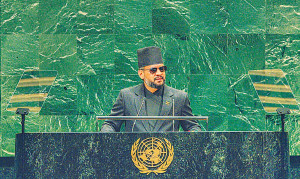
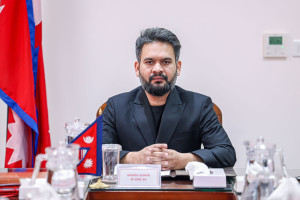
Nepal’s Foreign Minister Shisir Khanal has said the international community must make a decisive shift from commitments to implementation to address the crises created by climate change.
Addressing a high-level meeting on climate action and just transition held at the United Nations headquarters, Khanal said it would be difficult for climate-vulnerable countries to cope with the current crisis through fragmented, uncertain and delayed assistance.
Referring to the devastating floods that recently hit Nepal, Khanal said the country had suffered huge human and physical losses, with hundreds of people killed and widespread damage to homes, infrastructure, agriculture and livelihoods. He said hydropower infrastructure had also suffered serious damage, setting back development gains achieved through decades of effort.
According to preliminary assessments, Nepal has suffered more than $5 billion in losses from recent climate-related disasters, equivalent to around 15 percent of the country’s gross domestic product, he said.
“Nepal did not create this crisis. Nepal’s contribution to global greenhouse gas emissions is less than 0.1 percent. Yet Nepal is experiencing its impacts disproportionately and repeatedly,” Khanal said.
He said climate-related disasters were no longer merely humanitarian emergencies for Nepal but had become a development emergency, a crisis of justice and a serious challenge linked to the survival of communities and future generations.
Recalling the United Nations Secretary-General’s call three years ago from the foothills of Mount Everest to “stop the madness”, Khanal said the warning that the mountains were “crying out” for help was grounded in science. He said it was now important to ask whether the international community had listened to that warning with seriousness, wisdom and determination.
Khanal said the disaster in Nepal should not be viewed as a local incident alone, but as a serious warning for other climate-vulnerable countries around the world.
“What happens in the Himalayas does not remain confined to the Himalayas,” he said. “The Himalayas are an integral part of the Earth’s life-support system.”
Calling for a fundamental transformation from commitments to implementation, Khanal said climate finance should be adequate, upfront and easily accessible to communities before disasters occur, rather than relying on a system that assists only after disasters strike.
He stressed the need to prioritise climate adaptation, saying that for countries like Nepal, adaptation was not an option but the foundation for saving lives.
Khanal also called for increased investment in universal access to early warning systems, reliable technologies suited to mountain ecosystems, climate information services and climate-resilient infrastructure.
He said the Loss and Damage Fund should be adequately capitalised and made faster, simpler and more accessible, while multilateral development banks should mobilise rapid and affordable financing during disasters.
Stressing the need to address climate change impacts in an integrated manner from the mountains to the oceans, Khanal said the world must make stronger efforts to maintain the 1.5-degree Celsius temperature goal.
“This is an issue linked to the survival of mountain and coastal communities,” he said.
Describing the recent devastating floods in Nepal as a “Himalayan tsunami”, Khanal said they represented one of the most tragic disasters Nepal had experienced. But he warned that failure to respond to the climate crisis with urgency could expose the world to even greater risks in the future.
He called on heads of state and government, ministers, philanthropic organisations, the media, civil society, the private sector and the academic community to act with courage and clarity against the climate crisis.
“Climate action must be treated not as charity, but as justice,” Khanal said.
Anil Giri is a Chief Sub Editor covering diplomacy, international relations and national politics for The Kathmandu Post. Giri has been working as a journalist for more than two decades, contributing to numerous national and international media outlets.




 24.07°C Kathmandu