How pressure from the prime minister’s office is accelerating the passport investigation
Officials describe a Monday at Singha Durbar that left a constitutional body cornered, a foreign ambassador fuming, and a long-stalled investigation suddenly moving fast.AI generated
On a Monday morning in mid-June, officials from the Commission for the Investigation of Abuse of Authority received an unusual summons: come to Singha Durbar. The request came from the Prime Minister’s secretariat, where Chief Secretary Suman Aryal helped coordinate the meeting.
Before complying, Chief Commissioner Prem Kumar Rai and senior CIAA officials held an internal discussion about whether it was appropriate for a constitutional body conducting an active investigation to explain its work to the executive branch. They concluded it was not, but went anyway.
What followed over the next several hours would raise serious questions about executive overreach, the independence of Nepal’s constitutional bodies, and the conduct of advisers operating in the name of a reform-minded prime minister.
Rai and senior officials spent the better part of a workday — from office hours until 7pm — facing questions from advisers and aides to Prime Minister Balendra Shah, including Kumar Byanjankar and Asim Shah, who pressed the anti-graft body to accelerate its investigation into irregularities in Nepal’s passport procurement contract and to arrest Department of Passports Director General Tirtha Raj Aryal, who had also been summoned to the PMO that day. The prime minister himself was not present.
“We spent from office hours until evening at the PMO, facing questions from the PM’s advisors,” one official told the Post. “We did not meet the Prime Minister — the entire discussion was conducted only by the advisers.”
Rai explained to the advisers that the complaint had been filed roughly a year earlier, that a related case was pending in court, that the Public Procurement Monitoring Office had already weighed in, and that procedural and technical factors had delayed the investigation. The advisers were unmoved and grew increasingly displeased as they pressed for faster action. At one point, Rai called in three additional commissioners — Jay Bahadur Chand, Hari Prasad Paudel, and Sumitra Shrestha Amatya — in an apparent attempt to reinforce the CIAA’s position. It did not work. “After the commissioners arrived and tried to explain the investigation and the constitutional boundaries involved, the PM’s advisers did not want to listen,” an official said.
By evening, the advisers told CIAA officials to begin the investigation “today, right here.” Aryal, the chief department official who had been present throughout, was served an emergency arrest warrant on the spot and taken into custody. Shortly after, Sunil Kumar KC, director of the department, was also arrested. Initial reports, including by Kantipur and the Post, incorrectly identified the date of these arrests as Tuesday; they in fact took place on Monday.
Two more arrests followed in the days after: Tula Prasad Acharya, a former Department of Passports accounts officer, and Manindra Malla, the Nepali representative of Muehlbauer, one of the two German contractors. The Special Court extended the detention of all four by five days, for a second time, on Friday. CIAA Spokesperson Suresh Neupane confirmed that the four remain in custody and that the process of recording statements is ongoing.
That Monday at the PMO was eventful in another way. German Ambassador Udo Volz arrived at Singha Durbar without a prior appointment and was made to wait for nearly three hours. His presence was not incidental. One of the two German security printing companies awarded Nepal’s e-passport contract last June — Veridos GmbH — has the German government as a stakeholder, and Volz had been alerted that an investigation was beginning into the company. He was not the only one summoned that day: PMO advisers, in the course of their discussions, had also called Veridos’s local representative, Siddhartha Thapa, to the PMO.
The advisers were unmoved by Volz’s explanation that both German companies are state-owned and overseen by the German Finance Ministry, and that it was therefore within his duties to inquire. “After making him wait nearly three hours, an official asked him why he had come,” one official present said. “The advisers reprimanded him loudly and rudely, telling him to come only with permission from the Foreign Ministry.” The ambassador, the official added, appeared visibly dissatisfied and left, saying the conduct of the PM’s advisers had not been acceptable.
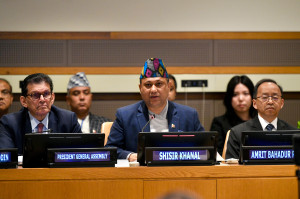
Sources say Volz has since informed members of the diplomatic community that he intends to brief Foreign Minister Shisir Khanal on what transpired that Monday. As of Friday evening, he had requested a meeting with Khanal but had not yet been given a time. On Friday afternoon, Volz wrote on X: “Media outlets in Nepal have been reporting about my recent visit to the PMO in various forms and manners. I would like to underline that neither I personally nor the German Embassy have had any exchanges with journalists on this and have not authorised any publication in this respect.” When reached for a comment, the German Embassy declined a response, saying it would make its position public only if and when it deemed appropriate.
According to a Veridos source who is familiar with the situation, Siddhartha Thapa had been called to the PMO under a different pretext entirely — to discuss the project implementation plan with German engineers. It was only that evening, the source said, that a PMO adviser informed Thapa that an investigation was underway and that CIAA officials were present taking statements. Thapa has not been in contact with the CIAA since. The CIAA has directed the Central Investigation Bureau of the Nepal Police to locate him, and Thapa’s whereabouts are currently unknown.
To understand why any of this was happening at the PMO that Monday, it is necessary to go back to June 2025, when KP Sharma Oli of the CPN-UML was the prime minister, and the government was backed by the Nepali Congress. On June 6 of that year, the Department of Passports awarded two German companies — Veridos GmbH and Muehlbauer — contracts for Nepal’s eMRTD system, covering pre-enrolment, enrolment, data management, personalisation, and delivery: Rs 6.15 billion to Veridos for passport printing, and Rs 1.60 billion to Muehlbauer for biometrics, a combined Rs 7.75 billion. The previous contractor, IDEMIA — now known as IN Groupe Identity France SAS, which had supplied Nepal’s biometric passports since November 2021 — saw its contract expire in December 2025. Under the new agreement, the German companies were required to deliver their first passport consignment within 240 days of signing, with personalisation centres installed across all 77 districts and Nepali missions abroad by December.
The German companies were not ready. The PMO, which began taking a closer interest in passport procurement about two months ago, dispatched a technical team to the DoP and conducted an internal review. “We found several anomalies in the procurement process and uncertainty regarding passport delivery,” a PMO official told the Post. “The stock was depleting rapidly, enough to last only about three weeks.” The official added that the PMO promptly raised the matter with the CIAA and with Foreign Minister Khanal.
The Veridos source who spoke to Kantipur offered a different account of why delivery had been delayed. According to the source, former interim Prime Minister Sushila Karki had ordered 700,000 passports on a variation order from the previous contractor, a decision that effectively pushed back the go-live date for the new German firms. The source said the allegation that the new contractors failed to deliver on time is, therefore, not just misleading but, in their characterisation, fabricated.
The contract’s origins have been contested from the start. IDEMIA, having lost the tender, lodged a complaint at the PMO and subsequently filed a petition with the Supreme Court on July 23, 2025, alleging serious irregularities in the Department of Passports’ procurement process — including violations of technical requirements during bid evaluation, miscalculation of foreign exchange rates, and the overlooking of a qualified bidder. The Supreme Court declined to grant an interim stay order. The case is now sub judice, with the most recent hearing on June 6, 2026, directing that a full hearing be scheduled between mid-June and mid-July.
The Veridos source pushed back on the timing and nature of IDEMIA’s complaints, saying the procurement process was conducted by the Department of Passports in full accordance with Nepal’s established procurement laws. During pre-bid meetings — where vendors are permitted to raise questions — IDEMIA lodged no complaints, the source said, nor did the company protest after technical bids were opened. It was only after the financial bids were opened, and IDEMIA lost on price, that the allegations began to surface.
The source also noted that Veridos had proactively declined to provide technical specifications or cost estimates to the Department of Passports in preparation for the tender, precisely to avoid any conflict of interest should the company decide to participate. A copy of an email obtained by the Post shows a Veridos official writing to Aryal, stating that the company would not share technical specifications or tentative prices for the same reason. In the same email, the official also asks Aryal to consider breaking the tender into two separate components so that the incumbent vendor — IDEMIA — would not receive a comparative advantage. The email could be read in two ways: as evidence of Veridos acting scrupulously to protect the integrity of the tender process, or as a company that, while declining to share pricing, was proposing to the department how to structure a procurement it intended to bid on — a distinction that investigators and critics of Veridos’s contract are likely to press.
On the question of political influence — a central allegation in the CIAA probe — the source said that Thapa had no communication with then-Foreign Minister Arzu Rana Deuba or any Department of Passport staff during the tender process, and that there are no communications of any kind advising how the tender should be structured. His contact with Aryal, the source said, began only after Veridos received a Letter of Intent, for coordination purposes related to project implementation. Similarly, Thapa met Malla — the local representative of Muehlbauer — only after receiving the letter.
The speed of developments after that Monday is notable. A notice was affixed at Arzu Rana Deuba’s Budhanilkantha residence — the same house burned down during the protests last September — on Tuesday, directing her to appear within three days. She responded by email to the CIAA on Thursday, saying she is abroad for medical treatment and cannot appear for a statement. She and her husband, former Prime Minister Sher Bahadur Deuba, are believed to be in Hong Kong. The CIAA is preparing to name her as a defendant in the case. “Although the procurement committee is based at the Department of Passports, it appears pressure and influence came from the ministry’s political leadership,” a commission official said.
The investigation has since widened. By Friday, the CIAA had recorded statements from more than 30 people, including former Foreign Minister Narayan Kaji Shrestha, Foreign Ministry Secretary Amrit Rai, and former secretary Sewa Lamsal, along with staff at the Home Ministry, the PMO, and Nepali diplomatic missions abroad. “Work is underway to file the case as early as possible,” an official involved in the investigation told Kantipur.
Whatever the merits of the passport investigation, the manner in which it was accelerated has alarmed legal experts and governance observers. Senior advocate Shrihari Aryal said the PMO advisers’ conduct — summoning CIAA officials to Singha Durbar to discuss an ongoing corruption investigation — was inappropriate, improper, and an attempt to undermine the dignity of a constitutional body. He added that CIAA officials should have refused to attend. “They should not have forgotten their constitutional boundaries and should have clearly said they were not ready to engage in such discussions,” Aryal said. “They failed in that regard. I am also not satisfied with the CIAA’s own conduct — but if Parliament is dissatisfied with its work, it has the power of impeachment, and the numbers to use it. Threatening, scolding, intimidating, and pressuring them to investigate as one wishes is not a good sign.”
Nepal’s constitutional bodies have a long history of being filled with politically affiliated appointees, and the CIAA has in the past faced criticism for failing to resist executive pressure. But this episode — in which a sitting government’s advisers appear to have directly influenced the pace and targets of an active anti-corruption investigation — marks a new and more overt breach of that boundary.
Former Public Service Commission chair Umesh Mainali echoed that concern. “Constitutional commissions, including the CIAA, were conceived precisely because governments can become biased — they exist as independent, self-regulating checks on government, with autonomy guaranteed by the Constitution itself,” he said. “The executive may show concern, the Prime Minister may even request greater activism for good governance, but interference in autonomous institutions and restricting their independent character is not acceptable.”
The Prime Minister’s Chief Adviser, Byanjankar, said that the executive cannot summon the chiefs of constitutional commissions and denied having done anything of the sort. When asked whether they had held discussions with the CIAA chief, he replied, "If there are some developments, seeking and sharing information is a regular process."
Anil Giri is a Chief Sub Editor covering diplomacy, international relations and national politics for The Kathmandu Post. Giri has been working as a journalist for more than two decades, contributing to numerous national and international media outlets.




 19.27°C Kathmandu