In candid discussion, chief ministers urge PM to empower provinces
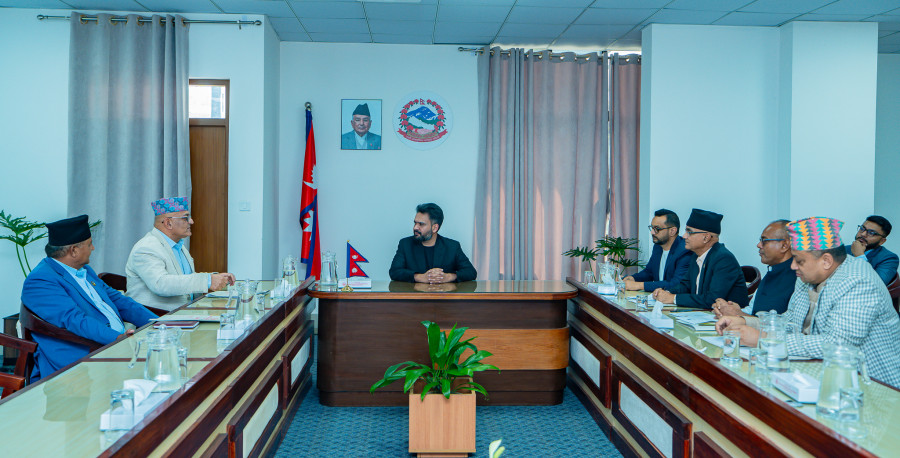
Provincial leaders cite gaps in laws, fiscal transfers and policing authority, as prime minister pledges to strengthen federalism.Prime Minister Balendra Shah (centre) meets five chief ministers in Singha Durbar, Kathmandu, on Thursday. Photo: Courtesy of Prime Minister’s Secretariat
Three weeks after assuming office, Prime Minister Balendra Shah began consultations with provincial governments on Thursday, listening to their grievances and assuring them of efforts to strengthen the provinces.
During the three-hour meeting, the chief ministers voiced dissatisfaction over what they described as the federal government’s continued reluctance to devolve authority in order for the provinces to exercise their constitutional rights.
The chief ministers, who travelled to Kathmandu at the prime minister’s invitation, raised concerns that the provinces had not been fully functional as envisaged in the 2015 constitution.
The interaction marked one of the most direct engagements between the federal and provincial leaderships in recent months. This was the first meeting Prime Minister Shah held with chief ministers in his third week in office.
Shah sought to reassure the provincial leaders, reiterating a commitment he had expressed during his campaign. Addressing his first major election rally in Janakpur on January 19, he had said that provinces must be made stronger.
That speech had helped ease doubts about his stance on federalism, particularly after questions were raised during the 2022 elections when he cast his vote for the House of Representatives but abstained from the provincial ballot.
These uncertainties appeared to have been largely dispelled after Thursday’s meeting. Chief ministers who attended the discussion said they found Shah clear and positive on federalism and provincial autonomy.
“We did not find any confusion in the prime minister regarding provinces,” said Surendra Raj Pandey, chief minister of Gandaki Province. “He is clear that provinces must be strengthened. The discussion was productive and candid. He not only listened to our concerns but also assured us that solutions would follow soon. We are hopeful.”
Two chief ministers, Hikmat Bahadur Karki of Koshi and Kamal Bahadur Shah of Sudurpaschim, were absent from the meeting due to personal reasons. Chief ministers from Madhesh, Bagmati, Gandaki, Lumbini and Karnali provinces outlined a range of structural and operational challenges they are facing.
A central concern raised by all participants was the gap between constitutional provisions and their implementation. Although the constitution gives provinces specific powers, the absence of enabling legislation has prevented them from exercising even their exclusive powers effectively.
Nearly nine years have passed since the federal structure came into implementation, and provinces are approaching the completion of two full five-year terms following elections in 2017 and 2022. Yet, chief ministers argued, the legal and institutional framework required to make federalism functional remains incomplete.
“We drew the prime minister’s attention to the fact that provinces have not been able to exercise their powers,” Pandey said. “This has undermined their effectiveness.”
Fiscal issues also featured prominently in the discussions. Chief ministers complained that budget allocations from the federal government do not reflect the distribution envisaged in the constitution. They expressed concern over the gradual reduction of equalisation and special grants to provinces.
With the federal government preparing its budget for the new fiscal year, the provincial leaders urged the prime minister to increase fiscal transfers and ensure a more equitable distribution of resources, said Pandey.
Control over law enforcement emerged as another major issue. While the constitution envisages provincial authority over policing and internal security, chief ministers said they have been unable to exercise that role due to delays in police adjustment.
Krishna Prasad Yadav, chief minister of Madhesh, said the absence of a provincial police force has left provincial governments unable to fulfil their constitutional responsibilities.
“Maintaining law and order within the province is our mandate, but we have no police under our control,” Yadav said. “The Police Personnel Adjustment Act was passed years ago, yet it has not been implemented. The federal government has shown little urgency in this regard.”
He said the chief ministers had collectively urged the prime minister to expedite the process. According to Yadav, Shah acknowledged the issue and indicated that the government would move to introduce the necessary laws and push their implementation forward.
The chief ministers also raised a range of administrative concerns, including a shortage of staff and frequent transfers of federal employees assigned to the provinces. They said federal employees often remain unaccountable to provincial governments and are reluctant to serve in provincial postings. In response, Prime Minister Shah suggested introducing clearer performance agreements with staff and enforcing stricter accountability mechanisms.
Participants described the meeting as informal in tone, with chief ministers speaking in turn while the prime minister frequently intervened to seek clarification and share his views. They said the exchange allowed for a more substantive discussion than previous engagements.
Chet Narayan Acharya, chief minister of Lumbini Province, said the discussion covered both shared concerns and province-specific issues.
“We raised the broader challenges facing federalism as well as the specific problems within our provinces,” Acharya said. “The prime minister appears committed to strengthening federalism through coordination and cooperation. The discussion was constructive, and we are encouraged.”
Acharya said the provinces had urged the federal government to prioritise legislation critical to the functioning of federalism, including laws related to civil service, education, policing, land acquisition, forestry, national parks and public procurement.
“Some laws need to be enacted, while others require amendments,” he said. “Delays in legislation have directly affected the implementation of the constitution.”
The absence of a federal civil service law remains a particularly acute issue. Without it, provinces have struggled to manage staffing effectively, leaving them dependent on federal structures for personnel decisions.
Both Houses of Representatives elected in 2017 and 2022 failed to pass the necessary legislation, prolonging the uncertainty.
The constitution provides for anInter-Province Council, chaired by the prime minister, to facilitate coordination between federal and provincial governments. Prime Minister Shah said the council could be convened to formally resolve some of the outstanding issues discussed on Thursday.
The government’s 100-point roadmap, unveiled after he took office on March 27, includes a commitment to drafting a civil service bill within 45 days. Provincial leaders said timely delivery on such commitments would be crucial to restoring confidence in the federal system.
Beyond legal and administrative matters, chief ministers also objected to what they described as federal overreach. They cited recent correspondence from the Office of the Prime Minister instructing that government advertisements be placed only in state-owned media, arguing that such directives undermine provincial authority.
“Provinces are not administrative units under the prime minister,” Acharya said. “They are autonomous governments defined by the constitution. They must be allowed to operate within their jurisdiction without undue interference.”
He said the chief ministers had urged the federal government to refrain from issuing circulars that encroach on provincial powers.
Despite the long list of grievances, the overall tone following the meeting was cautiously optimistic. Chief ministers said Shah’s willingness to engage directly and his apparent clarity on federalism principles marked a positive shift.
Quoting the prime minister, Yadav said Shah had emphasised the need to implement federalism as envisioned in the constitution.
“Only then can provinces become functional,” Yadav quoted him as saying. “We must work together to build the provinces.”
Deepa Dahal, Prime Minister Shah's press and research expert, said the discussions were open and candid.
Departing from the traditional protocol where participants speak in turn and the prime minister concludes, Shah adopted an interactive approach with the chief ministers.
Quoting the prime minister, Dahal said, “The federal and provincial governments must work together in nation-building. There will be no discrimination in the budget. Political considerations will not guide it; resources will be distributed fairly and justly.”




 20.85°C Kathmandu