Government unveils ambitious 100-point roadmap for effective governance
The Shah administration has announced it will abolish party-affiliated student organisations in the academic sector and strictly enforce the provision requiring private hospitals to allocate 10 percent of their beds free of charge to needy patients. RSS
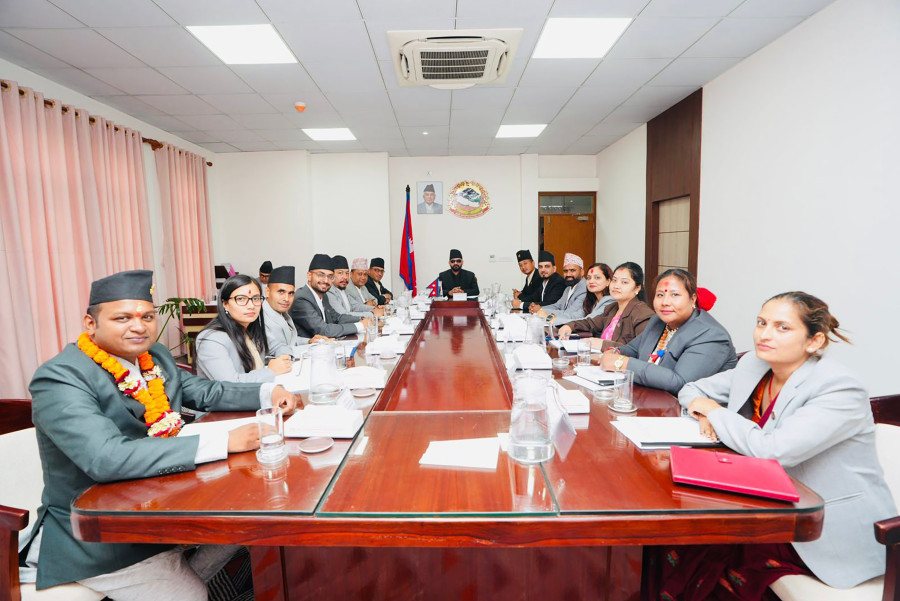
The government on Saturday unveiled an ambitious 100-point work plan for effective governance. The first Cabinet meeting of the Balendra Shah administration on Friday approved the roadmap for good governance in line with the Rastriya Swatantra Party’s manifesto.
Formation of a committee to investigate the properties and assets of senior political officeholders and high-ranking government officials who held public positions after the second people’s movement to date in the first phase, within 15 days, is one of the crucial decisions. The committee, which includes experts in law, finance, revenue, and research, will operate under the Prime Minister’s Office and the Council of Ministers.
The panel, in the second phase, will probe the assets and properties of those holding crucial public positions between 1991 and 2006.
Likewise, the government will implement delivery-based governance to make overall government performance efficient, effective, measurable, and accountable, with a focus on bringing direct improvements to people’s lives.
Under this framework, each ministry will prepare and implement a work plan for its seven core areas, specifying key tasks, timelines, responsible officials, and performance indicators, stated the document released on Saturday. Progress on these tasks will be submitted to the Prime Minister’s Office for review, evaluation, and periodic reporting in accordance with established standards and procedures.
Furthermore, based on the principles of Nepal’s constitution, the strengthening of the democratic system, and the people’s mandate, a “National Commitment” will be prepared by synthesising implementable actions across all political parties, parliamentary groups, and stakeholders.
“This commitment will establish shared ownership under the government of Nepal. The commitments will be linked to concrete policies, programmes, budgets, and reform agendas. Necessary structures will be established to ensure accountability for their implementation,” reads one of the points.
The commitments will be linked to concrete policies, programs, budgets, and reform agendas and implemented immediately. The Prime Minister’s Office and the Council of Ministers’ office will establish the necessary structures to ensure accountability for their implementation. Preparation of a discussion paper for the constitution amendment within seven days is another important announcement of the Shah government.
Even as then coalition government of the CPN-UML and Nepali Congress led by KP Sharma Oli had announced a revision in the statute, mainly electoral reforms, it took no step to this effect. The discussion paper will guide the work plan and ensure that the debate process is participatory, transparent, and evidence-based.
“ Within 15 days, the state will officially acknowledge historical injustices, discrimination, and deprivation faced by marginalised and excluded communities from the state, society, and institutional structures. Based on the acknowledgement, the government will prepare a framework for social justice, inclusivity, and reconciliatory integration, including formal apologies and related reform measures led by the state,” states another point in the priority list.
Following the September 8 and 9 Gen Z movement, an integrated initiative will be undertaken to restore the trust of affected families and citizens, ensure rehabilitation, and provide recognition, according to the work plan. This initiative will include respectful rehabilitation and recognition of martyrs’ families and victims, as well as the protection of livelihoods and social security.
Within 100 days, implementation of a comprehensive rehabilitation package according to eligibility, including government, private, and civil sector employment opportunities, skill development, psychosocial counselling, and rehabilitation assistance, the plan says.
Based on the findings of the report prepared by the commission led by former Special Court chairperson Gauri Bahadur Karki, the government has announced the immediate initiation of investigations, legal action and procedural measures against those found responsible.
The report has already begun to be implemented. Former Prime Minister KP Sharma Oli and former Home Minister Ramesh Lekhak were arrested on Saturday morning.
The government has also announced that a high-level investigation committee will be formed within a week to verify the facts surrounding the incidents that occurred on September 9.
“The committee will collect and analyse all relevant evidence related to the incidents, identify those responsible and submit its report within the stipulated timeline,” the government’s work plan states. “Based on the committee’s recommendations, further legal and procedural actions will be initiated immediately.”
The work plan also aims to address the long-standing problem of inquiry reports remaining largely unimplemented. Within 30 days, recommendations from past reports will be implemented through necessary legal, administrative, and procedural measures, including administrative reforms, restructuring, and effective enforcement.
To tackle administrative inefficiency caused by an excessively large number of ministries, the government has decided to reduce the number of federal ministries to 17 within 30 days.
While restructuring the ministries, the government says it will ensure that the management of existing departments does not disrupt service delivery or hamper routine administrative operations.
To facilitate the transition, the government will prepare a “Transition Roadmap” to address issues related to personnel management, budget allocation, and operational continuity.
A “Restructuring and Management Secretariat” will be established under the Office of the Prime Minister and Council of Ministers to oversee and coordinate the restructuring process.
The work plan also calls for reforms across civil service agencies to address duplication, delays, and unnecessary procedures that slow and inefficient public service delivery. Unnecessary processes will be scrapped, and multi-level approval systems will be limited to three layers.
Through Business Process Re-engineering (BPR), the government says the overall service delivery mechanism will be simplified, made faster and more results-oriented. Necessary standards, monitoring mechanisms and operational procedures will be prepared or revised within 30 days. Where legal amendments are required, draft bills will be prepared within the same timeframe.
In a significant administrative reform measure, the government has announced the abolition of all party-affiliated trade unions within government bodies, aiming to make public administration free from political influence.
The directive states that civil servants, teachers, professors, and other personnel in national service positions will no longer be allowed to directly or indirectly affiliate with political parties, groups, or interest centres. Any violation will invite strict departmental action in accordance with existing laws.
The government has also decided to abolish party-affiliated student organisations in schools and universities. Within 90 days, a new structure— called the Student Council or Voice of Students—will be introduced to replace the existing student political bodies.
Among other initiatives, the government plans to introduce free “Blue Bus” services for women in all seven provinces to ensure safe transportation. According to the 20-page policy document, at least 25 buses will be brought into operation within the first 100 days.
The government roadmap also states that the Federal Civil Service Bill will be drafted within 45 days.
In the education sector, the government has pledged to ensure that universities publish undergraduate and postgraduate examination results in accordance with a fixed academic calendar set by the Ministry of Education, Science and Technology.
Universities will also be instructed to immediately establish procedures allowing students to pursue studies up to the bachelor’s level without requiring citizenship certificates.
From the upcoming academic session, internal examinations for students up to Grade 5 will be discontinued. The government says alternative assessment systems will be introduced to ensure that students are not subjected to unnecessary psychological stress.
The work plan also includes several other proposals aimed at reforming government agencies and improving administrative efficiency.
In the health sector, the government will strictly enforce the requirement that 10 percent of beds in public and private hospitals be provided free of charge. This will ensure access for poor, helpless and abandoned patients.
Anil Giri is a Chief Sub Editor covering diplomacy, international relations and national politics for The Kathmandu Post. Giri has been working as a journalist for more than two decades, contributing to numerous national and international media outlets.




 25.02°C Kathmandu