Delegates selection widens factional differences in UML
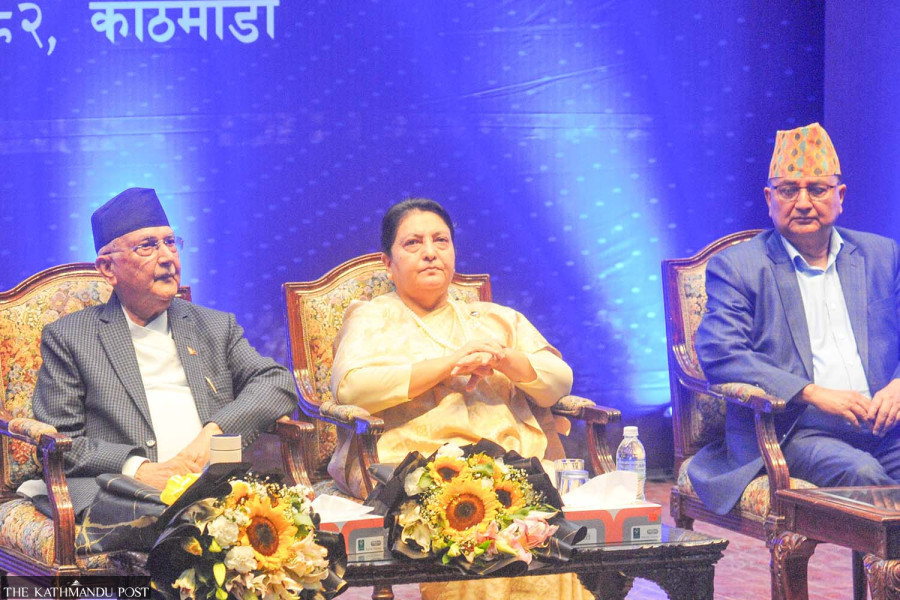
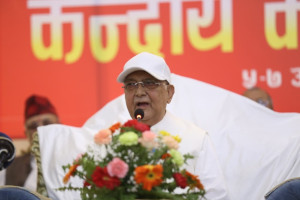
Many districts held elections to select general convention delegates. Rival camp claims it will cash in on infighting within the Oli faction. CPN-UML chair KP Sharma Oli, former President Bidya Devi Bhandari and UML Senior Vice-chair Ishwar Pokhrel at an event in June this year. Post file photo
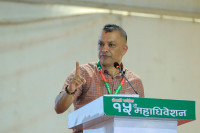
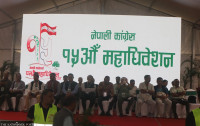
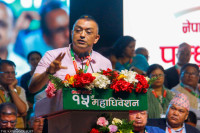
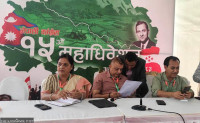
Factional rivalry has intensified in the CPN-UML, the second largest party in the dissolved House of Representatives, as it expedites selection of around 2,300 representatives for its 11th General Convention scheduled to be held in Kathmandu from 13 to 15 December.
The delegates selection process took more time than directed by the party as party members tried both approaches—selection through consensus or through voting. According to UML leaders, the results so far have signalled a highly competitive scenario.
Senior Vice-chair Ishwar Pokhrel has already announced he’d challenge incumbent party chair KP Sharma Oli. Former President Bidya Devi Bhandari’s backing to Pokhrel is likely to make the race a competitive one.
Oli, who was considered an all-powerful leader in the UML, is seen to have lost his influence significantly after the Gen Z movement ousted him as prime minister on September 9. In the aftermath of the Gen Z protests, Oli also faced pressure to hand over the party leadership as well.
Amid the pressure, the party decided to hold the General Convention a year ahead of the regular schedule.
Pokhrel is contesting the chairmanship after the party establishment denied former President Bhandari party membership in July. She had earlier sought renewal of party membership with a plan to contest for the party chief.
The selection of general convention delegates is seen as a key indicator of the strength of the rival factions because they are the ones who elect the next leadership.
Even though the party had instructed that delegate selection be concluded by Saturday, the process was still ongoing in many areas as of Monday.
The selection process has prolonged beyond the schedule due to intense competition among aspirants vying to become delegates.
In Koshi Province, the selection of general convention delegates had not been completed as of Monday evening, when this report was prepared.
UML lawmaker Indra Mani Parajuli from Koshi Province said that the delegates selected so far represent a mixed composition. Although Binod Dhakal’s panel won in Morang, Parajuli claims that it is still uncertain whether Dhakal will support Oli or Pokhrel. Despite Parajuli’s claim, Dhakal has generally been regarded as a leader close to Bhandari within the UML.
Similarly, apart from Morang, the Bhim Acharya faction has also secured victory in Sunsari. According to Parajuli, this group, too, is inclined to support Oli in difficult political circumstances, provided that Oli ensures them an appropriate position within the party.
In addition, Parajuli said given that it is his home district, Pokhrel may have influence in Okhaldhunga.
Parajuli said that out of the eight individuals selected as convention delegates from Bhandari’s home district Bhojpur, six are aligned with the establishment. In the district, rather than an Oli-versus-Bhandari division, the competition is said to be between the Sherdhan Rai faction and the faction against him. Parajuli claims that, so far, the majority there appears to be with Rai, who supports Oli.
Ekaraj Karki, another UML leader from Koshi Province, also claims that, overall, around 90 percent of the delegates selected from the province will be Oli supporters.
Meanwhile, Rajendra Gautam, head of the UML’s publicity department, said that though it is too early to make a trend analysis of the delegate selection based on the results so far, at least 80 percent of the delegates are likely to be from the Oli camp.
“The leadership of our party is not determined by social media, the media, or anyone else,” Gautam said. “It is our general convention delegates who make that choice. However, based on the results we have received from across the country so far, at least 80 percent of the delegates appear to be supportive of Oli.”
Some scenarios, however, don’t support his claim.
In Gandaki Province, two camps led by two senior leaders Prithvi Subba Gurung and Khagaraj Adhikari have seen serious disputes over delegates selection despite the fact that both Gurung and Adhikari are close to Oli. Despite assigning central committee members to forge agreement between the two sides, the selection of delegates in Kaski was unresolved until Sunday morning.
Leaders from the Bhandari-Pokhrel camp express confidence that they can capitalise on such divisions within the Oli camp.
Gandaki Province is not the only province where Oli camp suffers internal disputes. Leaders who are ready to shift to another camp if they do not get an appropriate position within the Oli faction may turn the tide in the convention, said a UML leader.
Party members in some districts have chosen to keep their cards close to their chest, at least in the process.
According to UML leader Manoj Kumar Singh in Siraha, in three of the total four constituencies in the district, delegates were selected based on consensus.
Even in one constituency where competition took place, there was no panel-based contest. The competition was based on individual initiatives, according to Singh.
Nevertheless, Singh claims that more than 80 percent of the delegates from Siraha and from Madhesh Province overall are likely to stand in favour of Oli.
However, another UML leader from Madhesh Province, Hari Narayan Mahato, does not agree with Singh’s claim. Mahato said that only one electoral constituency in Mahottari district has yet to complete the selection of delegates, and that this was to be concluded on Monday.
Mahato thinks that it is not possible, at this stage, to definitively say what the outcome will be.
In Bagmati Province, the delegates selection was completed within the stipulated timeframe. Party members in the province adopted voting to pick the delegates. However, UML Bagmati Province leader Prakash Shrestha said that it is still too early to determine which faction holds the upper hand based solely on the delegates selected from the province.
This time, the UML has arranged that each of the 165 electoral constituencies must send at least one young delegate to the general convention.
Kashi Nath Adhikari, head of the party’s organisational department, said that more than 165 delegates under the age of 40 will, in fact, be participating. He explains that while the party ensured a mandatory provision of selecting one young delegate per constituency, a significant number of additional young members have also been selected through competition in open category as well.
Adhikari said he has not yet had the opportunity to analyse the overall trend of the delegates selection. “I don’t think party members will seek an alternative to Oli’s leadership through this convention,” Adhikari said.
However, several leaders argued that had there been slightly more effort, it would have been possible to bid farewell to Oli through this convention.
They claimed that the Oli camp selected delegates unilaterally in areas where it was strong, while in places where the Bhandari-Pokhrel faction is influential, elections were prevented and delegates were chosen on the basis of “consensus” so that their supporters could be accommodated as delegates.
Overall, the contest for the leadership is expected to be competitive.
Many leaders said they are not in a position to determine the number of delegates won by any side.
According to the party, around 2300 delegates will take part in the convention scheduled to be held in Kathmandu from December 13 to 15.
Bhisma Adhikari, the central office secretary of the party, said that the criteria for delegate selection was determined based on the number of party members in a district. The number was divided into various ‘clusters’.




 20.85°C Kathmandu