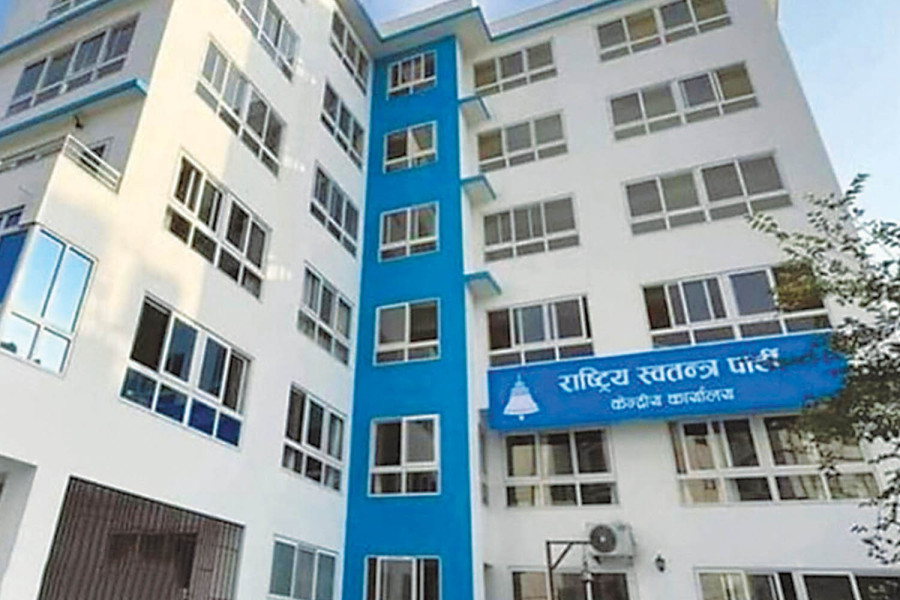
As the March 5 election draws near, the Rastriya Swatantra Party (RSP) has been hit by a wave of resignations from several provincial-level leaders who had until recently been at the forefront of the party’s campaign. Most of those stepping down have cited a range of concerns, including allegations of financial irregularities and dissatisfaction over candidate selection.
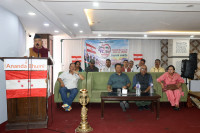
Mamta Sharma, who served as the founding chair of RSP’s Madhesh province committee and recently resigned from the party, said transparency within the party had been steadily eroding. Speaking at a press conference on Saturday, she remarked that while the party publicly promotes accountability and clean politics, its internal practices tell a different story. According to her, this widening gap between rhetoric and reality has led to a growing number of members leaving the party on a daily basis.
Earlier, on February 18, Sharma had announced her resignation through a statement on social media. In her message, she said the party’s principles were not being translated into action and that key decisions appeared to be driven largely by financial irregularities.
“I can no longer remain a silent witness to these activities,” she stated, adding that her resignation would take effect immediately and that she would no longer remain even an ordinary member of the party.
However, the party’s treasurer, Lima Adhikari, has firmly rejected the allegations of financial misconduct and called them baseless.
She maintained that the party has not sought or accepted any financial benefit outside its established rules and procedures, and all financial matters have been handled in line with the party’s formal framework.
Beyond allegations of financial misconduct, leaders leaving the party also criticised what they described as undemocratic practices within the party structure.
Dinesh Humagain, who recently resigned as vice-chair of RSP’s Bagmati province committee, accused the party of straying from its founding ideals. At the same press conference on Saturday, he said the party had failed to hold its general convention on time and had not followed a fair and transparent process in selecting election candidates. He further claimed that there was a lack of accountability within the leadership, which ultimately prompted his decision to step down.
Pranaya Shumsher Rana, another leader who has parted ways with the RSP, accused the leadership of weakening organisational transparency and undermining internal democracy. He argued that the party, which was established under the slogan of initiating order and ending disorder, now appeared to be heading in the opposite direction.
Rana had hoped to contest the March 5 election from Kathmandu-5 on an RSP ticket. In line with the party’s stated commitment to holding primaries, he claimed to have paid the required Rs25,000 fee to participate in the internal selection process.
However, the party ultimately nominated another candidate for the constituency without conducting the promised primary. It was this decision, taken without what he believed to be a fair and transparent process, that gradually deepened his dissatisfaction with the party, Rana said at the function.
Party treasurer Adhikari argues collecting primary election fees cannot be considered financial misconduct. She said that organising primaries involves administrative costs, and the party had therefore required aspiring candidates to contribute a fixed amount.
According to her, the framework governing the primaries clearly stated that the fee paid for participation would be non-refundable and that all candidates had agreed to these terms in advance.
Other leaders leaving the RSP include Ashok Kumar Thapa from Nuwakot who announced his resignation on Facebook on Saturday morning, and Ishwari Bista, the founding municipal chair of the party in Dhangadhi Sub-Metropolitan City.
Bista also hinted at financial influence in candidate selection. “There has been no proper recognition or evaluation of contributions within the party,” he said in his resignation. “When there is a lack of transparency in decision-making and established procedures are not followed, it no longer feels appropriate to remain in the party.”
With polling day fast approaching, these resignations and allegations pose fresh challenges for the RSP, which rose to prominence on a platform of reform, transparency, and a break from traditional political culture.
Treasurer Adhikari insists that the departure of a few individuals will not affect the party’s electoral performance, citing strong public support across constituencies. “A few people leaving will not affect the overall outcome,” she told the Post.
Political analysts, however, are not entirely convinced. Some suggest that resignations by senior or founding figures, particularly so close to an election, can create perceptions of internal instability and potentially influence undecided voters.
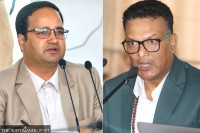
Pitambar Bhandari, head of the Central Department of Peace and Conflict at the Tribhuvan University, suggests that the recent entry of Balendra (Balen) Shah, former mayor of Kathmandu Metropolitan City, into the party, could be a factor. According to Bhandari, individuals close to the former mayor were reportedly granted election tickets despite having made no organisational contribution. This, Bhandari argues, left longtime aspirants feeling sidelined and resentful, ultimately prompting some of them to walk away from the party.
Bhandari cautioned that when individuals holding key leadership roles within provincial committees resign just before an election, it would be unrealistic to assume there will be no impact at all. Such departures can raise questions about internal cohesion and morale.
“RSP is not a party built primarily on a traditional grassroots organisational base,” Bhandari said. “It rose to prominence largely on the strength of a social media wave and public sentiment for change. For that reason, while the resignations may create ripples, the overall electoral impact may not be as significant as it would be for a more conventionally structured party.”
Others quitting the party in recent days include Kamala Rawal Pandey from Nuwakot, Jeet Bahadur Harijan and Gupta Sen Thaguna from Nawalparasi, and Pawan Chaudhary from Bara.




 24.5°C Kathmandu